
Two corpora in the same format are not necessarily comparable. What makes an annotation usable lies not in the container carrying it but in the information that container does not provide for, and that nobody thinks to attach.
This article sets out those questions. It extends the article on quality in image segmentation.
The three families of representation
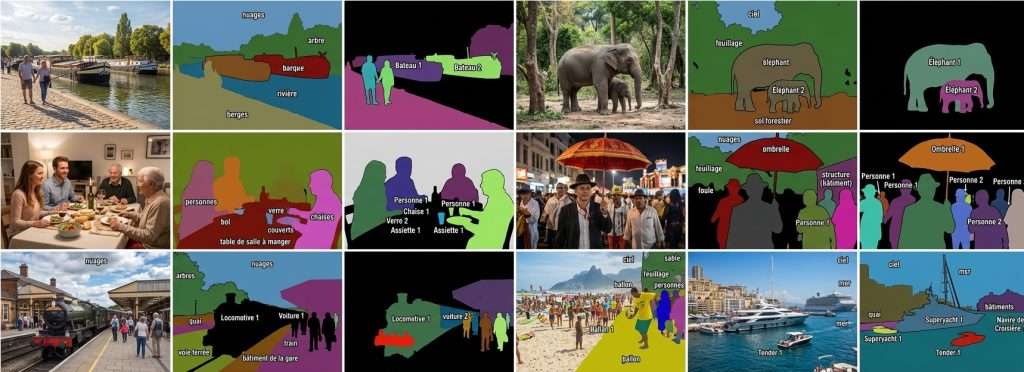
Three ways of carrying a region coexist in image segmentation. The raster mask, an image where every pixel carries an identifier. The vector contour, a sequence of vertices describing a boundary. And the compact encoding, which describes the regions without storing each pixel individually. One important practical consequence follows. Those three families do not carry the same information, conversion from vector to raster being immediate while the reverse stays approximate.What the mask permits and costs
Four properties characterise this image segmentation format. It represents any shape, including openwork or multiply connected ones. It compares directly, two masks superimposing pixel by pixel. It corrects locally but heavily, a retouch requiring the image to be re-edited. And it fixes the resolution, a mask not regenerating at another fineness. One important observation follows. The last property is the most constraining in the long run, a corpus delivered only as masks being unable to serve a use requiring a higher resolution.What the vector permits and costs
Four properties distinguish it from the mask in image segmentation. It modifies easily, a vertex moving without the tracing being redone. It regenerates at any resolution, which preserves future uses. It is compact, a few dozen values describing a region. And it represents openwork shapes badly, foliage then requiring an impracticable contour. One practical consequence follows for an image segmentation project. Those four properties lead to a simple recommendation, keeping the vector where it exists and delivering the mask, which preserves modifiability without complicating exploitation.What formats do not carry
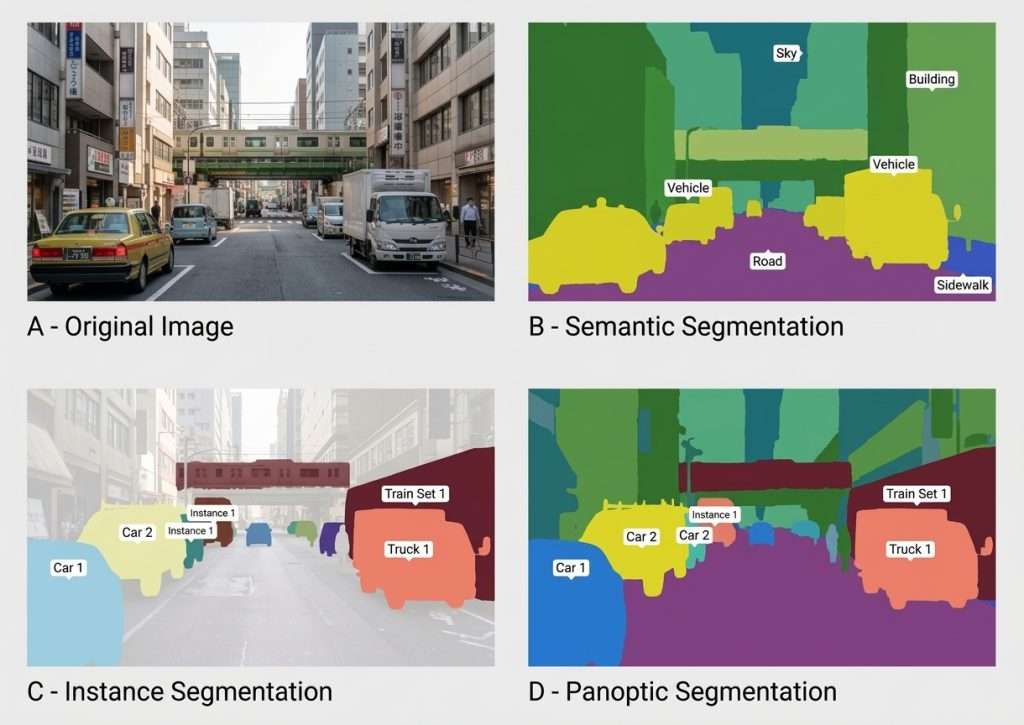
Six pieces of information condition the exploitation of an image segmentation corpus. They belong to no format. The formulation used, semantic, instance or panoptic. The contour placement rule in uncertain transitions. The contour tolerance adopted. The size threshold below which a region was not annotated. The distinction between the catch-all class and an unannotated zone. And the production method, manual or assisted, with the tool used. One important observation follows. Those six pieces determine the comparability of two image segmentation corpora, and their absence explains most of the difficulties met during a merge.The file that travels alongside
A simple solution handles what formats do not carry. A document attached to the corpus records the conventions the geometry does not express. Four properties make this file useful in image segmentation. It is readable with no particular tool, which guarantees it survives changes of platform. It fits on one page, which makes writing it practicable and reading it likely. It accompanies every delivery rather than the first batch alone, conventions evolving. And it carries a date, which permits attaching each batch to the version of convention that produced it. One important practical consequence follows. The last property resolves a frequent problem, a corpus built over several months carrying different rules across batches with nothing to signal it.The losses at conversion
Four operations silently degrade an image segmentation annotation. Resampling, which shifts the boundaries without signalling it. Conversion from vector to mask, which fixes the fineness. Conversion from mask to vector, which invents a smooth contour where the mask was irregular. And class merging, which definitively removes a distinction nothing will permit restoring. One important practical consequence follows. The first operation is the most frequent and the most damaging, a mask resized independently of its image introducing a shift nobody notices before training.The class identifiers
This banal and expensive difficulty deserves setting out. A mask carries numbers, not class names. Three consequences follow for an image segmentation project. The correspondence table must accompany the corpus, failing which the values mean nothing. Two corpora from the same domain rarely use the same identifiers. And a merge without verification produces a perfectly silent confusion between classes. One observation follows. The third consequence is the most insidious, two corpora merged with different tables producing a corpus coherent in appearance and wrong underneath.What the tool must permit
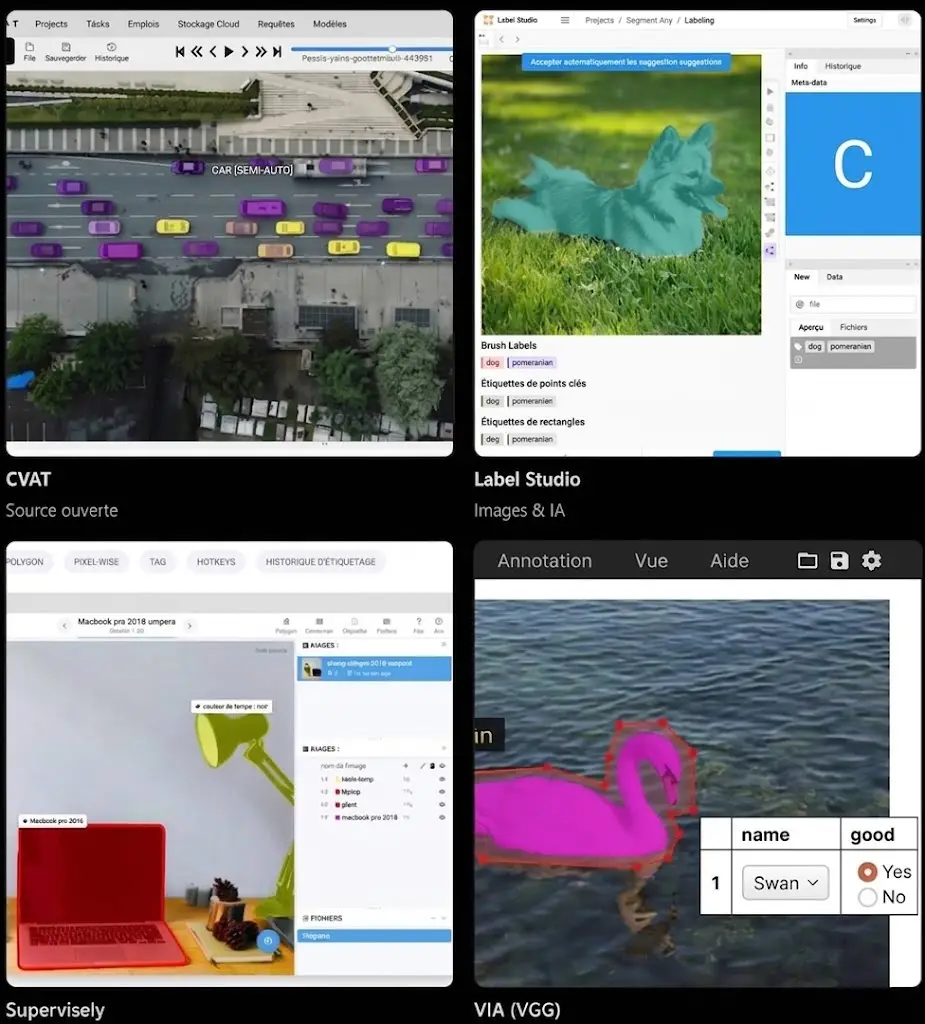
Six tooling functions condition production in image segmentation. The four tracing methods, polygon, brush, selection and assisted designation. Fine adjustment of brush width, down to the pixel. Temporary masking of the classes already traced. Display of the contour overlaid rather than as an opaque fill. Conversion between polygon and mask mid-work. And an export preserving the convention information the format does not provide for. One practical consequence follows. The last function is the rarest, most platforms exporting a correct geometry and losing the conventions that make it interpretable.What the tool must permit a team
Five functions concern the organisation of an image segmentation team. They bear on organisation rather than on the gesture. Assignment of images to annotators with progress tracking. The validation circuit, which distinguishes an annotated batch from a verified one. Version management, without which a correction overwrites the earlier state. Activity logs, the only source of real throughput. And rights management, which restricts access to the most sensitive data. One observation follows for an image segmentation project. The fourth function is the most underestimated, the logs supplying the data feeding every later costing and not reconstituting afterwards.What assistance changes in the tooling
Four requirements appear where assisted designation is used. Display of the proposal before validation, rather than its immediate application. The ability to discard a whole proposal in one gesture. Constraining the designation with a box rather than an isolated point. And a record of each region’s origin, assisted or manual. One important practical consequence follows for an image segmentation project. The last requirement is the rarest and the most useful, it permits comparing area distributions between assisted and manual regions, the only method that detects a systematic shift by the assisting model.Self-hosted or hosted
Four criteria settle this question in image segmentation. The processing location, a disqualifying requirement on sensitive medical or industrial data. The operating burden, which self-hosting transfers to the client or the provider. Control of access, each consultation being logged on a controlled infrastructure. And independence from a supplier, a change of pricing then not affecting a project under way. One practical consequence follows. The first criterion is often the only one that counts, a contractual requirement on processing location ruling out from the start the platforms that do not offer it.The checks to run on an export
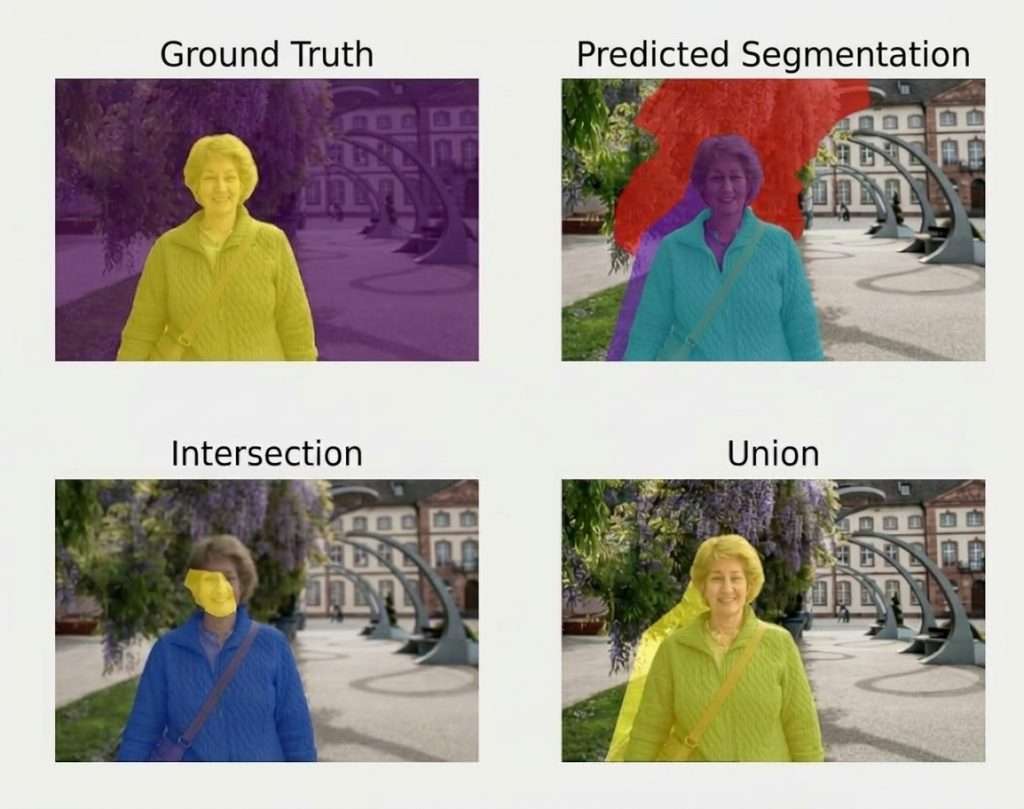
Six verifications qualify an image segmentation file once delivered. The presence of the class table and its correspondence with the values actually encountered. Dimensional alignment between each mask and its source image. The absence of pixels without a class in a corpus declared exhaustive. The absence of overlaps in a formulation that forbids them. The presence of regions of a few pixels, the signature of conversion slivers. And consistency between the number of distinct classes and the declared nomenclature. One practical consequence follows. The second verification is the most worthwhile, it is programmed in a few lines and it catches this field’s most frequent and most silent degradation.Merging two corpora
A frequent operation deserves separate treatment since it regularly fails. Six verifications precede any corpus merge in image segmentation. The correspondence of the class tables, identifier by identifier. The identity of the formulations, a semantic corpus and an instance corpus not merging directly. The compatibility of the placement rules, a systematic shift between the two introducing an inconsistency. The homogeneity of the size thresholds, one corpus having ignored the small regions the other annotates. Consistency in the treatment of unannotated zones. And alignment of the resolutions, or failing that retention of the metadata distinguishing them. One important observation follows. The third verification is the hardest since it reads in no file, it is measured by comparing the area distributions of the classes common to both corpora.What interoperability really costs
One observation qualifies the idea that a standard format suffices. Three costs persist despite using a widespread format in image segmentation. Remapping the class identifiers, which requires a correspondence table established by hand. Aligning the conventions, which reads in no file and is measured on the distributions. And verifying the image-mask correspondence, which a transfer between systems frequently breaks. One practical consequence follows. Those three costs mean a common format eases reading without guaranteeing exploitation, a distinction discussions about interoperability regularly neglect.What storage imposes
Four constraints weigh on the storage of an image segmentation corpus. The volume of the masks, which approaches that of the source images on an exhaustive corpus. Retention of the source images at original resolution, without which no rework is possible. Maintaining the correspondence between each image and its mask, which a renaming breaks. And retention of the vector representation alongside the mask delivered. One observation follows. The third constraint produces a banal and expensive failure, a naming convention changed mid-project dissociating pairs nothing permits reconstituting automatically.Evaluating a tool before committing
Five trials suffice. They take a day. Load a real image from the project rather than a demonstration example. Trace an openwork region with the brush and check the width adjustment. Place an assisted region and examine its conformity with the convention rather than its sharpness. Export and read back the file, looking for the six pieces of information set out above. And have an annotator use the tool for a full working session. One important observation follows. The fourth trial rules out the most candidates, a platform comfortable in use frequently producing an export stripped of the project’s conventions.The pilot batch as a tooling test
Four trials in the pilot batch bear on the tool rather than on the method. Tracing an openwork region, which verifies the availability and adjustment of a fine brush. Exporting a complete batch, which reveals what the platform keeps and what it loses. Reading that export back in an independent environment, which verifies real legibility. And modifying an already validated annotation, which tests version management. One observation follows for an image segmentation project. The third trial rules out platforms whose export is usable only by themselves, a situation more frequent than a format announced as standard suggests.Migrating from one tool to another
Four difficulties accompany a change mid-project. Converting the existing annotations, whose identifiers and conventions must be remapped. Loss of the histories, logs and versions generally not migrating. Retraining, the shortcuts and reflexes being tool-specific. And temporary coexistence, two tools producing exports in parallel that must be harmonised. One practical consequence follows for an image segmentation project. The fourth difficulty produces a lasting defect, a corpus part of which comes from one tool and the rest from another showing a difference in contour regularity nothing signals.What the format must permit downstream
Four uses after delivery condition the format choice in image segmentation. Point correction, which gains from the vector and suffers from the mask. Extension to new classes, which presupposes finding the regions already traced. Change of formulation, which is possible only from panoptic towards the simple formulations. And resampling to another resolution, which requires the vector or retention of the sources. One observation follows. The second use is the most frequent and the least anticipated, a nomenclature almost always growing after the first results, which makes the corpus’s modifiability more useful than its compactness.The delivery format to negotiate
Four elements compose a complete image segmentation delivery. The masks in the format the client requested, with their class table. The vector representation where it exists, which preserves future uses. The dated conventions file, which makes the corpus interpretable. And the control report, accompanied by the calculation method used. One commercial consequence follows. The second element negotiates badly after the fact, a client who asked only for masks discovering later they would have wanted the modifiable source, which argues for offering it upfront rather than billing it afterwards.What makes a corpus durable
Five properties determine whether an image segmentation corpus survives its initial project. Retention of the source images at original resolution. Retention of the vector representation where it exists. The class table fixed and delivered with every batch. The dated conventions file, which makes each batch interpretable. And a stable naming convention, which preserves over time the correspondence between image and mask. One observation follows. Those five properties cost little at the time of building and cannot be added later, which brings them closer to scoping decisions than to technical choices.Approaching the choice of format and tool
Five questions scope this choice in image segmentation. Can the data leave the client’s infrastructure. That answer settles the hosting. Does the corpus contain openwork shapes. Their presence requires the mask and a fine brush. Will the corpus be corrected or extended. That answer argues for keeping the vector. Does the export carry the conventions. Its absence makes the corpus hard to reuse. And is a merge with an existing corpus planned. It requires verifying the class tables. Those five answers determine the choice and its consequences. Asking them before starting avoids a corpus technically conforming and practically unusable.The question that settles the format
One question determines the representation to adopt. Will the corpus be consumed once or corrected several times. An answer oriented towards single consumption, one training run then archiving, is satisfied by the mask and its compactness. An answer oriented towards rework, nomenclature enrichment or progressive correction, argues for keeping the vector, modifiability then being worth more than simplicity. That question is asked in one sentence, it belongs to the corpus’s life cycle and not to the technique, and it avoids this field’s commonest regret, a modifiable source deleted after export.Three decisions before producing
Three decisions commit the usability of an image segmentation corpus. Fixing the class table and freezing it, any later change requiring the existing work to be remapped. Deciding whether to keep the vector representation, a choice that cannot be recovered after export. And planning the conventions file from the first batch, since its absence makes the earlier batches hard to interpret. Those three decisions cost one meeting, they precede the first image, and their absence produces a technically conforming corpus whose exploitation will require a piece of archaeology.What this chapter leaves to the next
The defects set out here share a property with those of the preceding chapters. Three of them deserve flagging in image segmentation. They occur silently, no error message accompanying them. They pass visual checks, a shifted annotation appearing correct on screen. And they are all detected by a programmed check of a few lines. Those three properties hold beyond questions of format, and they justify a chapter devoted to the commonest image segmentation mistakes and to the means of intercepting them.What this chapter teaches
One cross-cutting observation deserves closing this examination. The format carries the geometry and not what makes it interpretable. Three findings compose it. Six pieces of information determine the comparability of two corpora and belong to no format. Resampling shifts the boundaries without signalling it, which makes it the most discreet degradation. And two corpora merged with different class tables appear coherent and are wrong. That finding extends the preceding chapter, a measurement presupposing a comparability the format alone does not guarantee.The clause worth writing into a delivery
One sentence in a contract prevents most of the disputes this chapter describes. State that the delivery includes the conventions file and the class table, not the masks alone. Three things follow from having it in an image segmentation engagement. The provider is obliged to write down what they were doing anyway, which costs an afternoon. The client receives something they did not know to ask for and will need at the first merge. And a later dispute about what the corpus contains has a document to refer to. One practical consequence follows for an image segmentation provider. This is among the cheapest differentiators available on this task, since most competitors deliver correct geometry with none of the context that makes it reusable, and the difference only becomes visible to the client once they try to use both.The two files worth keeping forever
One retention decision outlasts every tooling choice on this task. Keep the source images at original resolution and the vector representation where it exists. Three reasons make this the decision that matters in image segmentation. Everything else can be regenerated from those two, including masks at any resolution and in any format. Neither can be reconstituted from a delivered mask, since both carry information the mask discarded. And the storage cost is trivial against the cost of re-annotating a corpus whose source was not kept. One practical consequence follows. Providers who make this a default rather than a client option end up holding the only complete copy of corpora their clients later need to extend, which is a position worth occupying.Common mistakes
These failures recur often enough that naming them is usually enough to avoid them.- Delivering a mask without the class correspondence table.
- Resizing a mask independently of its image.
- Converting a mask to vector and believing an original contour is recovered.
- Deleting the vector representation after exporting the mask.
- Merging two corpora without verifying the class identifiers.
- Choosing a tool without having read back its export.
- Neglecting activity logs as a source of throughput data.
- Omitting to declare the formulation and the placement rule.
- Confusing catch-all class and unannotated zone in the format.
- Mixing two tools in one corpus without signalling it.