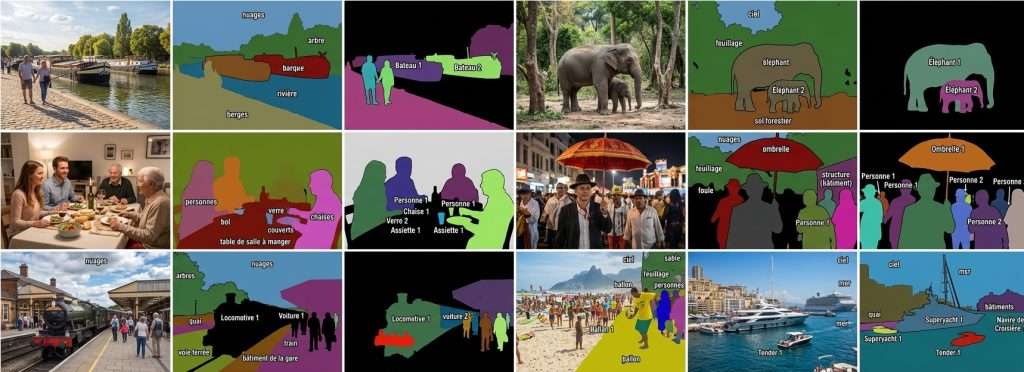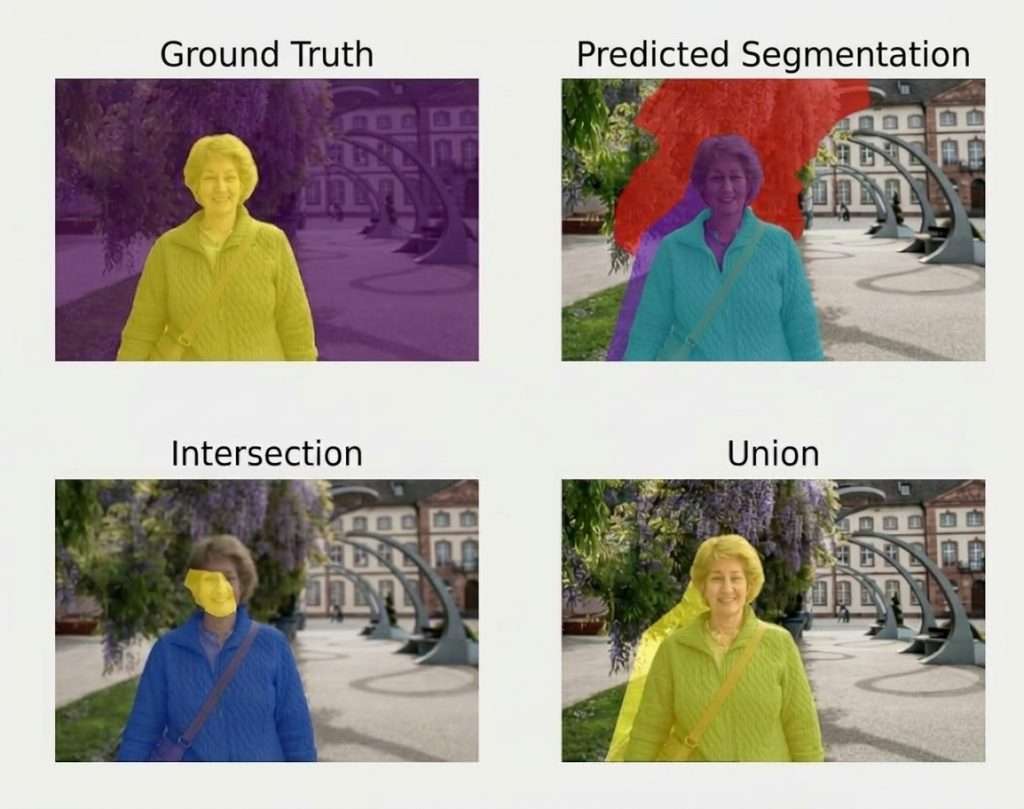

The cost of a segmentation project follows neither from the number of images nor from the number of objects. It depends on the length of boundary to be traced, a quantity nobody measures and which varies by an order of magnitude between two corpora of identical size.
This article breaks down that cost. It extends the article on segmentation for autonomous driving.
Why the image is not a unit
Four reasons make the image misleading as a unit of image segmentation. The number of regions varies strongly from one image to another. Contour complexity changes the time per region by a substantial ratio. The exhaustiveness requirement imposes handling the background, whose extent does not depend on the object count. And the formulation adopted alters the work on the same regions. One important practical consequence follows. Those four reasons mean two corpora with the same number of images can differ by an order of magnitude, which makes costing by the image defensible only after those parameters have been measured.The unit that works
One quantity predicts image segmentation work better than any other. The cumulative length of the boundaries between regions constitutes the real unit. Three observations justify that choice in image segmentation. A large homogeneous region is handled almost as fast as a small one. A fragmented object costs far more than a compact one of the same area. And disagreement between annotators concentrates entirely on those boundaries. One important observation follows. That quantity is measured on a few annotated images rather than estimated, which turns an intuitive costing into a verifiable calculation.The seven lines of a budget
Separating them conditions any realistic image segmentation estimate. Scoping, which fixes the formulation, the precision and the nomenclature. Writing the conventions, in particular those handling uncertain boundaries. The pilot batch, which measures the real throughput per contour type. Annotation itself, the dominant line by volume. Quality control, distinct from annotation and regularly absorbed into it. The evaluation corpus, whose requirement exceeds that of the training corpus. And documentation, covering written conventions and quality report.What the formulation changes
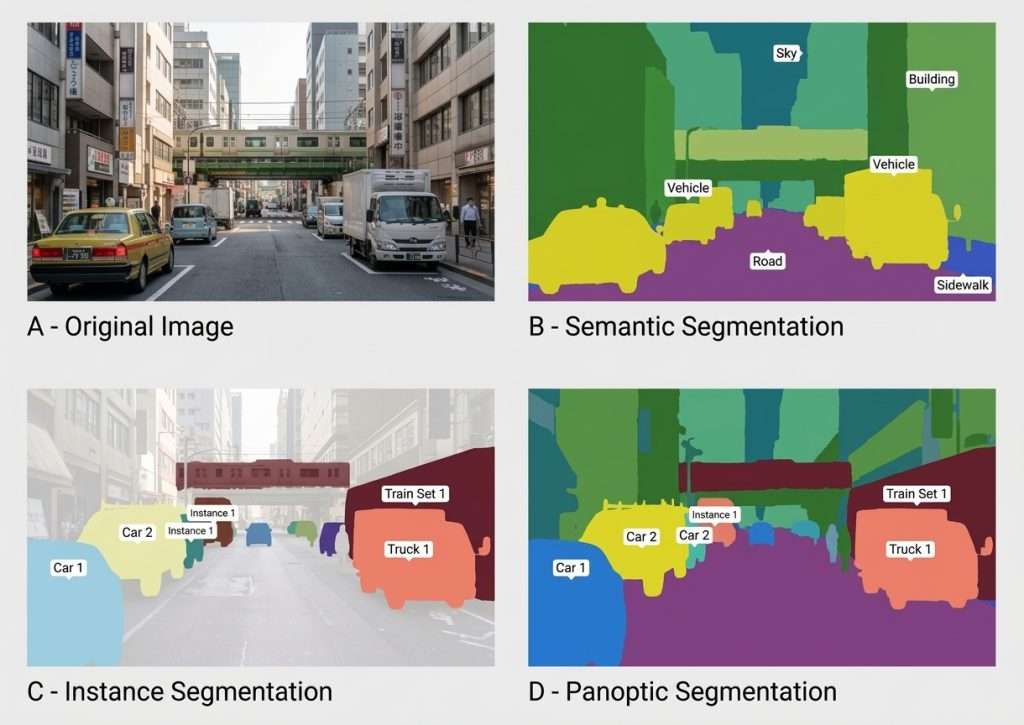
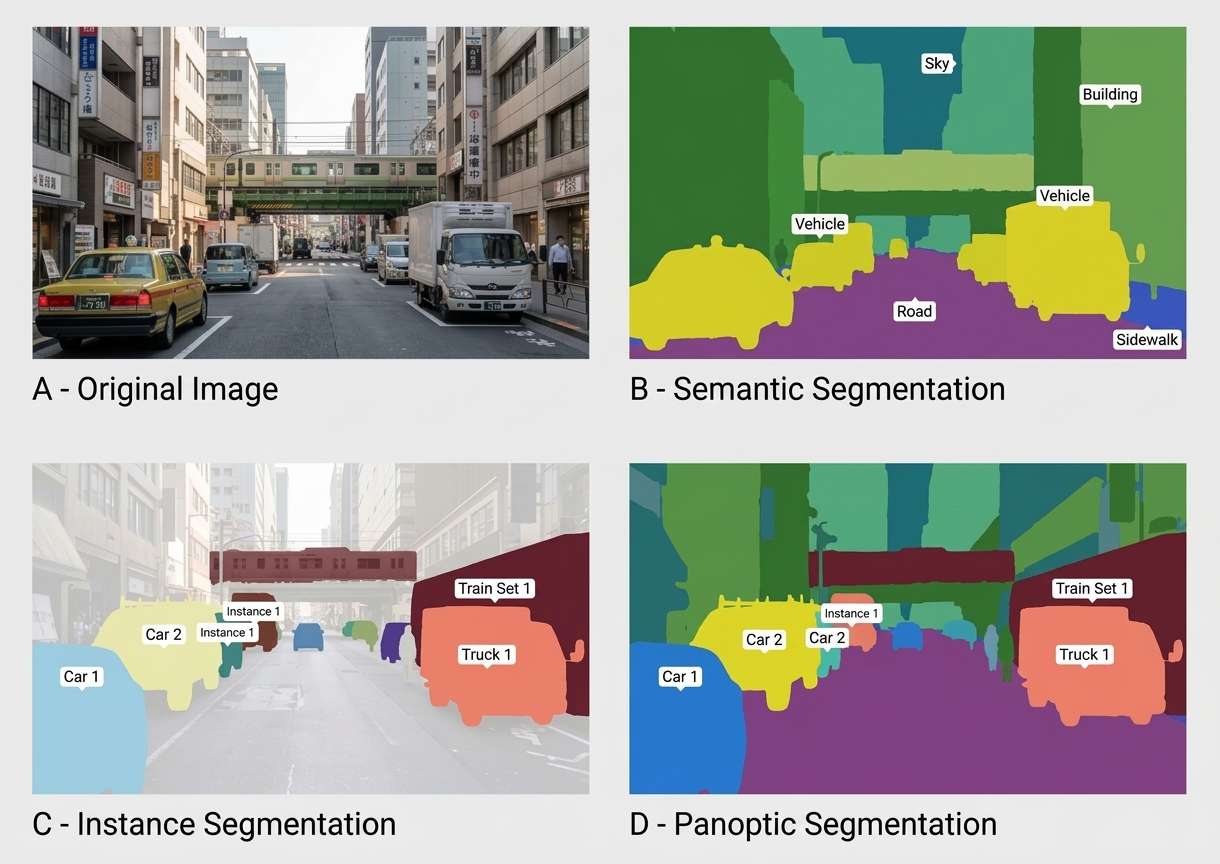
Three levels of image segmentation differ in cost. Semantic segmentation, the cheapest at equal coverage. Instance segmentation, which adds a surcharge only in the contact zones between objects of the same class. And the panoptic formulation, which adds background exhaustiveness and the resolution of overlaps. One practical consequence follows for an image segmentation project. Moving to panoptic produces the largest variation, not through the difficulty of the objects but through the obligation to describe everything that is not one.What precision changes
Four levels of requirement occur in image segmentation. Their cost varies considerably. The coarse contour, sufficient where only position counts. The fitted contour, the standard for most projects. The pixel-level contour, which follows the slightest irregularity. And the sub-pixel contour, reserved for metrological uses. One important observation follows. Moving from the second to the third level produces a considerable variation and it is justified only where the downstream use genuinely exploits that fineness, a condition few projects verify.What the nomenclature changes
Four properties affect cost in image segmentation. The number of classes, which multiplies the decisions. Granularity, a fine category multiplying the cases of hesitation. The number of frequently adjacent classes, each contact producing a boundary. And the presence of categories defined by a function rather than by an appearance. One practical consequence follows. The third property predicts cost better than the class count itself, two rarely adjacent classes costing far less than two classes that abut everywhere.The pilot batch as the only estimate
This method turns those factors into a defensible figure. A few real images annotated supply what no estimate produces. Four usable pieces of information follow. The throughput observed per contour type, which replaces any assumption. The mean boundary length per image, the real basis of sizing. Disagreement between annotators, which bounds what can be promised. And the feasibility of the conventions, including the edge cases revealed. One important practical consequence follows. The throughput gap between an image with sharp contours and one with fragmented contours reaches a factor nobody anticipates, which makes a costing without a pilot arbitrary rather than imprecise.Measuring boundary length
One operation turns this abstract quantity into a usable figure. Four stages compose that measurement in image segmentation. Annotating a few representative images according to the formulation adopted. Computing the total length of the boundaries between regions on each. Relating the time spent to that length, which gives a throughput per unit of boundary. And applying that throughput to the length estimated across the full corpus. One important practical consequence follows. The fourth stage presupposes estimating the length across the whole corpus, which is done by sampling rather than exhaustive computation, a few dozen images sufficing to bound the value precisely enough for a quote.What genuinely reduces cost
Five levers work in image segmentation. They act before production. Choosing the simplest formulation that serves the use. Fixing a contour precision verified against a real use. Grouping the classes rarely distinguished downstream. Limiting exhaustiveness to the zones the processing will consult. And using assisted designation on the classes that lend themselves to it. One observation follows. Those five levers act on the scope and degrade nothing, whereas attention naturally goes to accelerating production, which produces a smaller gain.What assistance changes in the budget
Four effects modify an image segmentation estimate where assisted designation is used. Time per region falls sharply on compact contrasted objects. It does not fall on continuous materials, which often constitute most of the surface. Control becomes more expensive, conformity with the convention replacing the examination of sharpness. And setup stays cheap, these tools requiring no prior corpus. One important practical consequence follows. The second effect requires costing the gain per class rather than globally, a gain announced across the whole being systematically higher than the gain realised as soon as the corpus holds a substantial share of background.The false economies
Four apparent reductions cost more than they save. Skipping the pilot batch, which saves a day and produces a costing whose gap is paid in production. Omitting the placement rule, which produces area variability between annotators. Absorbing control into annotation, which hides a line rather than removing it. And choosing the semantic formulation to save money, which closes the door to counting. Those four reductions share a common structure. Each removes a cost visible now and creates an invisible one later.What the evaluation corpus costs
One distinction deserves stating since this corpus does not follow the same rules. Four differences characterise this corpus in image segmentation. The volume needed is far smaller, a few dozen images sufficing to measure. Exhaustiveness becomes imperative, an omitted region counting as a false detection by the system evaluated. Double annotation is required on the classes with high variability, which doubles the cost on those. And stability over time conditions comparison between two versions. One important practical consequence follows. The second difference makes this corpus disproportionately expensive per image, which justifies costing it separately rather than as a proportion of the training corpus.Relative orders of magnitude
Four ratios help at scoping without quoting a rate and they are verified on a pilot batch. An image with fragmented contours costs a multiple of one with sharp contours at equal area. Instance segmentation adds a surcharge only in the contact zones between objects of the same class. Background exhaustiveness can double the work on a scene where objects occupy a small share of the surface. And a pixel-level requirement lengthens the time per region by more than an additional class would. One observation follows for an image segmentation project. Those four ratios are measured on a single pilot batch and they supply the client with a grid they apply themselves to their trade-offs, which shifts the discussion from price to scope.The line nobody budgets
One cost appears after the first delivery and it rarely features in a proposal. Three elements compose that line in image segmentation. Enrichment on the failures observed, which presupposes a collection arrangement decided upfront. Extension to new conditions, a replaced sensor or a different site producing data the initial corpus does not cover. And convention rework, an evolution of the downstream use invalidating a rule applied across a whole corpus. One commercial consequence follows. A proposal presenting only the build understates the client’s real spend, and separating build from operation prevents a competitor appearing cheaper with an incomplete figure.The spending calendar
A cash-flow observation completes the estimate in image segmentation. Scoping and conventions occupy the first days and determine everything after. The pilot batch precedes production and supplies the costing. Annotation spreads out and is a regular charge. Control and documentation arrive at the end of production, when the budget is already committed. And the evaluation corpus is often produced last, although it conditions every measurement. One practical consequence follows. The last two lines fall at the moment a budget has least flexibility, which explains why they are precisely the ones compressed.The billing models
Four modes coexist in image segmentation. Their choice redistributes risk. Billing per image, legible and strongly exposing the provider to contour variability. Billing per region, more faithful on an object corpus and misleading on an exhaustive one. Billing by time, suited to work whose difficulty is poorly known. And a fixed price, which gives the client full visibility and transfers risk to the provider. One recommendation follows for an image segmentation project. A billed pilot batch followed by a fixed price combines the advantages, the pilot removing the uncertainty about boundary length that made the fixed price risky.What variability imposes on the contract
A property of this domain deserves translating into a clause. The load varies by an order of magnitude between two images of the same corpus. Three contractual formulations follow. A fixed price established on an estimated boundary length, with revision if the real corpus diverges sharply. A unit price indexed on a complexity measure rather than on the image count. And a volume commitment with a review clause after the first production batch. One observation follows for an image segmentation project. The third formulation protects both parties, a first real batch revealing the effective complexity far better than a sample the client chose to illustrate their need.Comparing two proposals
Six questions make two image segmentation offers comparable. Which formulation, class by class. What contour precision, expressed as a quantified tolerance. Is exhaustiveness included and over which zones. What placement rule on blurred transitions. Does control feature as a distinct line. And is the evaluation corpus included. One observation follows. The third question is the one where answers diverge most, exhaustiveness often representing half the work and appearing in no quote.Signals of a fragile costing
Five signs indicate an image segmentation cost estimate will not hold. The scope is expressed in number of images with no mention of contour complexity. The formulation is not specified class by class. Contour precision is described by an intention rather than by a quantified tolerance. The fate of the background is not explicit. And no pilot batch has been run on the client’s real images. One observation follows. Those five signs are verified by reading a proposal, they require no technical competence, and their presence predicts an overrun better than any analysis of the headline price.Presenting a budget to a client
Four framings allow an image segmentation budget dominated by human work to be accepted. Showing an annotated image with its boundaries highlighted, which makes visible the work the image count was masking. Setting out what the pilot batch revealed on their own images rather than a rate card. Separating build from operation, which avoids the distorted comparison with an incomplete offering. And proposing a costed reduction in scope, formulation or exhaustiveness, which demonstrates the objective is a usable result. One observation follows for an image segmentation provider. The first framing is the most effective, a client frequently discovering that what they took for a simple image contains several hundred metres of boundary to trace.What the corpus is worth afterwards
Four properties determine whether an image segmentation corpus behaves as an asset. Retention of the source images at their original resolution. Declaration of the formulation and of the contour placement rule. Retention of the vector representation where it exists, which permits regenerating the masks. And a clear separation between the catch-all class and the genuinely unannotated zones. One observation follows. Those four properties cost little at the time of building and cannot be added later, which places them in the same category as the scoping decisions set out above.Approaching the costing of a project
Five questions produce a defensible estimate for an image segmentation project. What formulation does the use actually require. That answer is the principal lever. What is the mean boundary length per image. That answer replaces counting images. What contour precision is necessary. That answer changes the time per region. Must the background be described. That answer can double the volume. And is a pilot batch accepted. Its refusal makes any fixed price imprudent. Those five answers determine the volume and the structure of the offering. Asking them before costing avoids committing to a scope whose extent surfaces in production.Three questions that halve the budget
Three questions asked in one meeting frequently reduce the cost by half. Would a box suffice for this class. A positive answer removes the line entirely. Must the background be described. A negative answer can halve the volume. What contour precision does the downstream process actually exploit. A finer trace than needed is pure spend. Those three questions concern the use and not the technique, they are asked before any price discussion, and a client answers them readily once they understand what each answer costs.The question that frames the costing
One question determines a project’s extent better than the image count does. What proportion of each image’s surface must receive a class. A low answer, a few objects on an ignored background, places the project in a regime where the region count correctly predicts the work. A total answer, every pixel having to be attributed, places the project in a regime where the background dominates and where only boundary length predicts the load. That question is asked in one sentence, it belongs to the downstream need and not to the technique, and it separates two cost regimes the same image count covers.Three decisions before costing
Three decisions make an image segmentation estimate defensible. Measuring boundary length on a real sample, which replaces an intuition with a calculation. Explicitly settling the fate of the background, a line that can double the volume and that appears in no request. And obtaining a quantified contour tolerance, which bounds the time per region and removes the variability in finish. Those three decisions cost a day of preparation, they precede the quote, and their absence produces a costing production will contradict.What this chapter teaches
One cross-cutting observation deserves closing this examination. The cost of this task is determined by scope decisions rather than by the quantity of images. Three findings compose it. The cumulative length of the boundaries constitutes the real unit and is measured rather than estimated. Formulation and exhaustiveness multiply against one another and determine the budget more than the image count. And those decisions belong to the downstream use rather than to annotation technique. That finding matches the preceding clusters, a provider’s value lying in scoping as much as in production.The measurement worth building once
One capability separates a provider who quotes from one who guesses on this task. Computing boundary length from a delivered mask is a short script, not a project. Three things follow from having it in an image segmentation practice. Any client sample can be characterised in minutes, which turns a quote request into a measured answer. The same script runs on delivered batches, which tracks whether the corpus’s complexity is drifting from the pilot. And the figure travels between projects, building a reference base of throughput per unit of boundary that improves every later estimate. One practical consequence follows for an image segmentation provider. This is the rare piece of tooling that pays for itself on the first quote and keeps paying, since it converts the one variable that actually drives the budget from an argument into a number.Common mistakes
These failures recur often enough that naming them is usually enough to avoid them.- Costing by the image without having measured boundary length.
- Costing by the region on an exhaustive corpus.
- Omitting the background from a panoptic corpus estimate.
- Requiring pixel-level precision with no use that exploits it.
- Neglecting the effect of frequently adjacent classes.
- Absorbing quality control into the annotation line.
- Comparing two proposals on the per-image price.
- Committing to a fixed price with no prior pilot batch.
- Choosing semantic to save money without measuring what is lost.
- Announcing a global assistance gain rather than one per class.