
The defects that survive a delivery share one property: they pass visual inspection. A shifted mask, a systematically confused class or a missing region all look correct on screen, and only a programmed check intercepts them.
This article catalogues them. It extends the article on segmentation formats and tools.
The five families of error
Five families cover the defects met in an image segmentation project. Scoping errors, decided before production and paid for afterwards. Convention errors, where the rule is missing or stays ambiguous. Tracing errors, where the gesture does not respect the rule. Processing errors, introduced by a conversion or a transfer. And control errors, where the arrangement does not look for what it should. One important practical consequence follows. Those five families do not call for the same corrections, and mistaking a convention error for a tracing error leads to training a team where a rule needed writing.Scoping errors
Four initial decisions produce lasting defects in image segmentation. Asking for segmentation where a box would have sufficed, which multiplies the cost without improving the use. Choosing the semantic formulation when counting will be needed. Requiring pixel-level precision with no downstream process that exploits it. And leaving the fate of the background implicit, which produces a scope disagreement at the moment of delivery. One important observation follows. Those four decisions are taken in one meeting and commit the whole project, which makes them more expensive than any execution error.Convention errors
Five missing rules produce most of the variability in image segmentation. The contour placement rule in a blurred transition. The treatment of cast shadows and reflections. The fate of fine structures, included or excluded. The separation rule between identical objects in contact. And the size threshold below which a region is simply not annotated. One practical consequence follows for an image segmentation project. Those five rules are detected by their symptom, variability between annotators on the same configuration signalling an absent rule rather than an inattentive team.Tracing errors
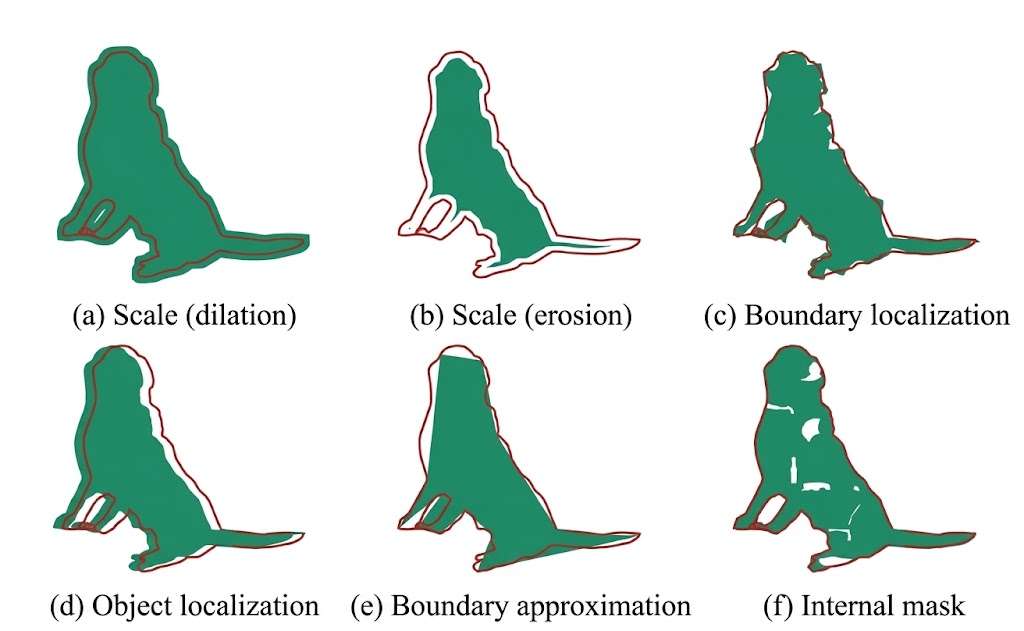
Five defects characterise the image segmentation gesture itself. The systematically inner contour, produced by caution. The stair-stepped contour, the signature of too wide a brush on an oblique edge. Slivers, regions of a few pixels left between two neighbouring zones. Unintentional holes inside a region. And propagation spillovers, a region having invaded its neighbour without being noticed. One observation follows. Only the first defect is systematic, which makes it detectable by comparing mean areas while the others require inspection.Processing errors
Four operations introduce defects with no human involvement. Resampling a mask independently of its image. Conversion from vector to mask, which fixes the fineness. Merging corpora with different class tables. And file renaming, which dissociates an image from its corresponding mask. One important practical consequence follows. Those four operations produce defects neither the annotator nor the reviewer committed, which makes them undiscoverable by any inspection of the human work.Control errors
Four defects in the control arrangement let all the others through. Computing agreement over the whole surface rather than at the boundaries. The single average, which masks the difficult classes. Uniform sampling, dominated by the easy regions. And the absence of area distribution tracking, which lets every systematic bias through. One important observation follows. Those four defects produce a reassuring report on a defective corpus, a situation more dangerous than no control at all since it installs an unjustified confidence.The most expensive defect
One image segmentation defect deserves isolating since it exceeds all the others. Systematic confusion between two neighbouring classes produces a corpus that is coherent and wrong. Three properties make it formidable in image segmentation. It passes every formal check, the geometry being correct. It passes visual inspection, the confusion being plausible. And it teaches the model an inverted distinction rather than an imprecision. One practical consequence follows for an image segmentation project. Only double annotation of a sample reveals it, which justifies maintaining that even where production appears settled.The commonest defect
One defect dominates by frequency in image segmentation. It is fortunately easy to correct. The contour systematically placed inside the object. Three causes produce it in image segmentation. The annotator’s caution, which prefers not to overrun. The absence of a placement rule in transitions. And an opaque fill display, which masks the zone to examine. One observation follows. Those three causes call for distinct corrections, an instruction, a written rule and a tool setting, which shows one symptom can belong to three different families.Diagnosing before correcting
A four-question method attaches a symptom to its family. Does the defect appear across all annotators. A positive answer rules out individual error and points to the convention. Does the defect appear on a specific configuration. A positive answer points to a missing rule rather than to inattention. Does the defect exist in the tool before export. A negative answer points to a processing step. And should the defect have been caught by a check already in place. A positive answer points to the arrangement rather than to production. One important practical consequence follows for an image segmentation project. Those four questions are asked in minutes on a sample of cases, and they avoid the commonest and least effective correction, an additional instruction addressed to a team that was correctly applying an absent rule.The defects that show and those that do not
One distinction governs the control arrangement. Three image segmentation defects show on visual inspection. The contour manifestly misplaced on a sharp contrast. The region forgotten on an obvious object. And the frank, visible spillover of one class onto its neighbour. Four image segmentation defects do not show at all. The systematic shift of a few pixels. The coherent confusion between two classes. The mask misaligned with its image. And the complete omission of a rare class across a whole batch. One important practical consequence follows. That second list alone justifies programmed control, those four defects surviving any volume of human inspection.The checks that intercept
Six automatic verifications cover most of the invisible image segmentation defects. Dimensional alignment between each mask and its image. The presence of pixels without a class in an exhaustive corpus. Detection of regions of a few pixels. Detection of undeclared holes. Comparison of area distributions between annotators. And counting occurrences per class, which reveals a class entirely absent from a batch. One important observation follows for an image segmentation project. Those six verifications are programmed in a day and apply thereafter to every batch, which makes them the best ratio of effort to defects intercepted in the whole arrangement.What remains for human control
Four image segmentation defects escape any programmed verification. The omission of a region, which produces no formal anomaly. Systematic confusion between two classes. The contour following the contrast rather than the convention. And the perfectly faithful application of a rule that had been misunderstood. One practical consequence follows. Those four defects share one property, they produce a formally valid result, which makes human control irreplaceable and requires concentrating it where the automatic does not reach.The errors specific to assisted corpora
Four defects appear where assisted designation produces most of the regions. The contour following the contrast rather than the project’s convention. The voids filled in openwork structures. Fine structures omitted, assistance smoothing what it does not distinguish. And the assisting model’s systematic shift, wholly invisible region by region. One important observation follows. Those four defects share a property that makes them formidable, they produce sharp contours, which makes them look like careful work to a reviewer used to looking for imprecision.The nomenclature errors
Five image segmentation defects originate in the class list itself. Two categories whose definitions partly overlap. A class defined by a function the image does not show. A catch-all class with no definition, which absorbs everything that hesitates. A granularity finer than the resolution permits distinguishing. And a category absent from the reference, which forces annotators to file an object into a neighbouring class. One practical consequence follows for an image segmentation project. The last situation produces the defect hardest to find later, an object filed into a neighbouring class by default leaving no trace of the hesitation that put it there.The errors that appear over time
Four defects do not exist at the first batch and install themselves later. Convention drift, a rule being progressively interpreted differently. Heterogeneity between annotators recruited at different moments. The change of tool or version, which subtly alters contour regularity. And relaxation under schedule pressure, the finish degrading at the end of a project. One important observation follows. Those four defects are detected only by comparison between batches, which makes indispensable keeping a constant sample that is periodically re-annotated.What each family costs to correct
Five orders of magnitude guide the priority in image segmentation. A scoping error requires redoing the corpus, the maximum cost. A convention error requires reworking the batches produced under the old rule. A tracing error is corrected region by region, a cost proportional to the number of cases. A processing error is corrected by rerunning the operation properly, a low cost if the sources exist. And a control error costs nothing to correct, but it reveals everything that got through meanwhile. One important practical consequence follows. The fourth case depends entirely on the sources having been kept, which turns an archiving decision taken at the outset into a determining factor of the correction cost.What a corpus takeover reveals
A frequent situation puts the installed defects on display. A provider receives a corpus produced elsewhere and must extend it. Four findings recur in image segmentation. No written convention accompanies the corpus, the rules having to be deduced from the annotations. The internal variability exceeds what the new batch will have to respect, which makes consistency impossible. Some classes show a definition that changed during production. And the modifiable sources were not kept, which now forbids any fine correction. One practical consequence follows. The second finding raises a contractual question before it raises a technical one, a new batch more consistent than the old creating a heterogeneity the complete corpus will carry.What the pilot batch intercepts
Four defect families surface before production rather than after. Scoping errors, which a first result makes tangible to the client. Missing convention rules, which the edge cases bring out. The tool’s limits, which an openwork class or a soft transition exposes. And export defects, which a simple read-back of the delivered file reveals immediately. One observation follows for an image segmentation project. Those four families represent this chapter’s most expensive corrections, and the pilot batch intercepts them for the price of a few annotated images.What the defect report must say
Five elements make an anomaly report usable in image segmentation. The originating family of each defect, scoping, convention, tracing, processing or control. Its frequency, which distinguishes an isolated case from a systematic phenomenon. Its distribution across annotators, which decides between an absent rule and an imprecise gesture. The correction proposed, attached to the family identified. And an estimate of what that correction implies concretely for the batches already produced. One observation follows. The last element is the one most often missing and the one that decides, a convention correction being able to require reworking everything or merely changing the rule going forward, according to what the use tolerates.What an experienced team does differently
Five habits distinguish a seasoned image segmentation team. It flags a case the convention does not cover rather than deciding alone. It checks for holes and slivers before validating a region. It recognises the configurations where assistance fails and switches to manual tracing. It applies the placement rule rather than following the apparent contrast. And it systematically reads back its own work on the classes it knows are difficult. One observation follows. The first habit is the most distinguishing, a flag costing seconds while a silent individual decision propagates across a whole batch before being discovered.Approaching the prevention of errors
Five questions scope a prevention arrangement in image segmentation. Are the five convention rules written down. Their absence produces the variability. Are the six automatic checks in place from the first batch. Adding them late lets the first batches through. Is double annotation maintained. It alone reveals systematic confusions. Does control bear on the boundaries. Elsewhere it measures what causes no trouble. And are area distributions tracked. Their absence lets every bias through. Those five answers determine what will be intercepted. Asking them before production avoids discovering at the end of a project a defect present since the first batch.The question that directs the correction
One question determines where to place the effort. Does the defect appear across all annotators or only some. A general answer points to the convention or the scoping, and the effort goes into writing a rule or renegotiating the scope. A partial answer points to training or tooling, and the effort goes into a refresher session or a setting. That question is answered by comparing two annotators on the same images, it takes an hour, and it avoids engaging the most expensive correction on a problem the other one would have handled.Three decisions that prevent most of it
Three decisions intercept most image segmentation defects. Writing the five convention rules before the first image, which removes the variability at source. Programming the six automatic checks before the first batch, which catches the invisible defects from the start. And keeping a constant sample that is periodically re-annotated, the only arrangement revealing a drift. Those three decisions cost a few days in total, they precede production, and their absence leads to discovering at the end of a project defects present since the first batch.What this catalogue shows
One regularity runs through the five families set out. Three observations compose it in image segmentation. The most expensive defects are decided before production and paid for after. The most frequent defects belong to an absent rule rather than to an imprecise gesture. And the most lasting defects are those no check was looking for. One important practical consequence follows. Those three observations move the effort upstream, a day of scoping and of programming checks intercepting more defects than a month of reinforced verification downstream.What this chapter leaves to the next
One category of difficulty recurs across nearly every family set out here. Small objects and fine structures concentrate the defects. Three reasons explain that in image segmentation. They escape overlap metrics, which are dominated by the large regions. They are omitted by assistance, which smooths what it does not distinguish. And tracing them frequently exceeds what the tool permits, the brush’s minimum width exceeding their own thickness. Those three reasons make this category a distinct problem rather than a special case, and they constitute the subject of the following chapter.What this chapter teaches
One cross-cutting observation deserves closing this examination. The defects that survive are the ones that look correct. Three findings compose it. One symptom can belong to three distinct families, which requires diagnosing before correcting. The defects introduced by a processing step escape any inspection of the human work. And systematic confusion between classes is the only defect that teaches the model an inverted distinction rather than an imprecision. That finding extends the preceding chapters, verification having to look for what does not show rather than confirm what does.What to check on a corpus before quoting to extend it
One inspection decides whether an extension job is worth taking. Run the six automatic checks on the existing corpus before agreeing to add to it. Three outcomes follow in image segmentation. The corpus is clean, and the extension is a normal job priced normally. The corpus has processing defects, misalignment or class table gaps, which are cheap to fix and worth raising as a separate line. And the corpus has convention drift, where the internal variability exceeds what any new batch can match, which is the case to price differently or decline. One practical consequence follows for an image segmentation provider. This inspection takes an hour on a delivered corpus, and it separates the extension jobs that go well from the ones where the provider inherits somebody else’s inconsistency and gets blamed for the result.The habit worth building into the workflow
One practice turns this chapter’s catalogue into something operational. Run the six checks on every batch before it leaves, not on the batches a client questions. Three things follow from that in image segmentation. Defects get caught while the annotator who produced them is still on the project. A drift shows as a trend across batches rather than as a surprise at the end. And the client’s own checks find nothing, which is the only version of a quality claim that survives contact. One practical consequence follows for an image segmentation provider. The checks cost minutes per batch once written, so the barrier is habit rather than effort, and the difference between running them always and running them when asked is the difference between catching defects and explaining them.Common mistakes
These failures recur often enough that naming them is usually enough to avoid them.- Correcting a symptom without identifying its originating family.
- Training a team where a rule needed writing.
- Relying on visual control to detect a systematic shift.
- Dropping double annotation once production is settled.
- Adding the automatic checks after the first batches.
- Measuring agreement over the whole surface rather than at the boundaries.
- Reporting a single average that masks the difficult classes.
- Neglecting to count occurrences per class.
- Ignoring the defects introduced by conversions.
- Mistaking a reassuring report for a correct corpus.