
Generalist models have cut the cost of tracing without touching the decisions that give a corpus its value. That split between what automates and what stays human governs the coming developments in this work.
This article examines them. It extends the article on building a segmentation dataset.
What has changed recently
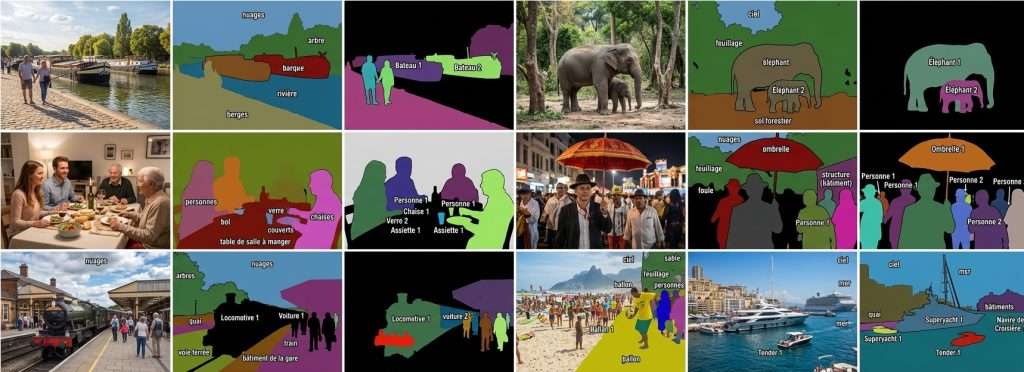
Four developments have already altered image segmentation work. Assisted designation produces a region from a click on contrasted objects. Generalist models work on categories they have never encountered. Propagation between successive images sharply reduces the load on sequences. And the volume needed falls appreciably on common and well documented classes. One important practical consequence follows. Those four developments touch the production of the contour and leave intact the category decision and the placement convention, which moves the work without reducing it proportionally.What automation does not touch
Five decisions stay entire in an image segmentation project. The definition of the classes, which belongs to the business need. The placement rule in uncertain transitions. The fate of the background and of zones with no apparent interest. The threshold below which a region is not annotated. And the composition of the corpus, which alone bounds the domain of use. One important observation follows. Those five decisions bear on information the image does not contain, which makes them insensitive to gains in performance and sensitive only to gains in tooling.How the human work shifts
Four effects accompany the growing automation of tracing in image segmentation. Production falls and verification rises. The competence demanded shifts towards judgement rather than towards the gesture. Control bears on conformity with the convention rather than on sharpness. And a provider’s value shifts towards scoping and towards guarantee. One practical consequence follows for an image segmentation project. The second effect changes the profile sought, an annotator becoming a verifier who must know the convention better than they had to master the tracing.What verification becomes
Three observations situate this activity in image segmentation. It takes less time per region but more attention. It bears on defects that do not show, a systematic shift or an omission of fine structures. And it produces an acceptance bias no instruction ever entirely removes. One important observation follows. The third finding requires maintaining a share of unassisted production, the only arrangement that reveals a drift verification lets through.What assistance really moved
Three observations sum up its effect in image segmentation. It cut the time of tracing on the objects that were already traced fast. It raised verification time, conformity with the convention becoming a check in its own right. And it left the category decision intact, where the expensive errors concentrate. One important practical consequence follows. Those three observations explain the gap between the announced gain and the observed one, a real project seeing its load redistribute rather than fall by the proportion a demonstration leads one to expect.The corpora that keep their value
Four characteristics distinguish the image segmentation corpora automation does not devalue. Domains where the definition of the categories belongs to knowledge outside the image. Rare conditions, which generalist models have not encountered. Particular sensors, whose appearance differs from the public corpora. And reproducibility requirements, where variability itself is the quantity that counts. One important practical consequence follows for an image segmentation project. Those four characteristics describe precisely the industrial and medical projects, which explains why automation shrinks the market for general corpora without touching that for specialised ones.What the falling cost triggers
A counter-intuitive consequence accompanies automation. Cheaper tracing makes practicable projects that were not. Four effects follow for the image segmentation market. Exhaustive corpora become conceivable where only the box was. Finer nomenclatures become affordable on the same budget. Low-margin domains gain access to this technique. And the total volume annotated rises despite the falling unit cost. One important observation follows. Those four effects explain why demand does not contract as tracing automates, it shifts towards more ambitious projects whose share of scoping and control is higher.What the new tasks demand
Four emerging uses go beyond describing an isolated image in segmentation. The relation between objects, which a segmentation does not carry. The description of an action or a sequence. The state of an object rather than its category alone. And intention or context, which both belong to an interpretation. One observation follows. Those four uses add layers of annotation to segmentation rather than replacing it, delimitation remaining the support these pieces of information attach to.What synthetic data changes
Three observations situate synthetic data in image segmentation. It produces perfect and free annotation, the scene being known. It covers rare configurations collection does not encounter. And it always shows a gap in appearance with real images. One practical consequence follows. The third finding bounds its use, synthetic data usefully completing a real corpus and not replacing it, which places it among the complements rather than the substitutes.What does not progress
Four image segmentation limits resist technical developments. The absence of a shared convention between projects, each defining its own classes. The irreducible variability on blurred boundaries and fine structures. Disagreement between experts in domains of judgement. And the gap between what the image shows and what the reference asks for. One important observation follows. Those four limits bear on the nature of the task rather than on the maturity of the tools, which distinguishes them from the difficulties a following version will correct.What remains to be invented
Four gaps persist in image segmentation. A way of declaring a convention in a form a tool can read, which would make two corpora comparable automatically. A representation of the uncertainty on a boundary, rather than a single sharp contour. A method for measuring a corpus’s coverage without annotating all of it. And a quality measurement that would natively distinguish the three defect families. One observation follows. Those four gaps belong to a work of formalisation rather than of performance, which makes them reachable without major technical progress and partly explains why they persist, no single party having an interest in addressing them alone.What this changes for a client
Four practical consequences follow in image segmentation. The budget shifts from volume towards scoping and control. A corpus’s value lies in its coverage rather than in its count. Written conventions become the principal asset, transferable where the corpus ages. And the choice of a provider bears on their ability to scope more than to produce. One practical consequence follows for an image segmentation project. The third is the least anticipated, a corpus losing value as sensors are replaced while the conventions that produced it stay valid.What this changes for a provider
Five shifts characterise the image segmentation trade. Production loses relative weight in the value delivered. Scoping and defining the conventions gain in importance. Programmed control becomes a differentiator rather than a formality. Specialisation in a domain takes precedence over volume capacity. And the guarantee of reproducibility becomes the central contractual commitment. One important observation follows. The fourth shift is the most structural, the ability to absorb a large volume ceasing to be an advantage once assistance puts it within everyone’s reach.What the annotator’s job becomes
Five developments characterise this role in an image segmentation project. The gesture loses importance in favour of the decision. Knowing the convention becomes the central competence. Flagging a case the convention does not cover takes precedence over speed of execution. Recognising the situations where assistance fails becomes operational knowledge. And stability over time gains a great deal of value, knowledge of a domain not transmitting quickly. One important practical consequence follows. The last development favours stable teams over ad hoc ones, a domain convention being acquired over months while a tracing gesture is learned in days.What the corpus becomes in the chain
Four observations situate annotation within a wider cycle. The first corpus serves to obtain a system that partly works. That system then serves to identify what it lacks. The following batches target those gaps rather than increasing the corpus uniformly. And the corpus thus becomes a living object rather than a one-off delivery. One important practical consequence follows for an image segmentation project. That reading changes the commercial relationship, an initial corpus followed by ongoing support replacing the one-off delivery, which presupposes stable conventions and an organisation able to resume the work months later.What the client relationship becomes
Four shifts characterise this relationship in image segmentation. The discussion opens on the domain of use rather than on a volume. The pilot batch becomes a service in its own right rather than a commercial gesture. The delivery includes the conventions and the control report as much as the masks. And support for a living corpus gradually replaces the one-off delivery. One observation follows. The second shift is the hardest to install and the most useful, a billed pilot batch being the one actually exploited, while a free pilot is treated as a demonstration and does not deliver the measurements that justified running it.What will set providers apart
Five capabilities will durably distinguish an image segmentation provider. Running a scoping exercise that turns a business need into a workable reference. Measuring disagreement between annotators, which grounds any tenable requirement. Programmed control, run on every batch rather than on request. Documenting the conventions, which makes the corpus interpretable and extensible. And knowledge of a domain, which permits recognising what an image does not show. One observation follows. Those five capabilities belong to method and specialisation rather than to technology, which makes them reachable by a modest organisation and hard to replicate through volume.What will stay true
Four image segmentation propositions depend on no technical development. A boundary the image does not carry belongs to a decision and not to an effort. Two reasonable annotators diverge on soft transitions, and that divergence bounds any requirement. A corpus prepares only for the situations it has presented. And a defect that looks correct survives any visual inspection. One practical consequence follows. Those four propositions belong to the nature of the task and not to the state of the tools, which makes them the base a method is built on and explains why the preceding chapters return to them from different angles.Three signals to watch
Three developments would indicate a fundamental change in image segmentation. The emergence of a shared convention between projects, which would make corpora mergeable without verification. A standard representation of boundary uncertainty, which would change measurement and the contractual requirement. And models able to apply a placement rule supplied in language rather than a contrast. One observation follows. The third signal is the nearest and the most transformative, it would move the convention from the document into the tool and alter what human work contributes, without removing the need to decide the rule.What the fifteen chapters established
Five findings run through this image segmentation series. The cumulative length of the boundaries is the real unit of cost, and it is measured rather than estimated. Part of the boundaries does not exist in the image and belongs to a convention that must be written. Exhaustiveness distinguishes this family of tasks and is the most underestimated line. The defects that survive are those that look correct, which requires programmed control. And a corpus’s value lies in its coverage and its conventions rather than in its volume. One observation follows. Those five findings all bear on decisions taken before production, which explains why faultless execution does not suffice to produce a useful corpus.Approaching the coming years
Five questions scope this development for an image segmentation project. Do the project’s classes belong to knowledge outside the image. That criterion bounds automation. Are the conventions written and transferable. They will outlast the corpus. Is the control arrangement programmed. It becomes the core of the work. Is an unassisted share maintained. Its absence makes drift invisible. And does the corpus cover conditions generalist models ignore. That is precisely what gives it its value. Those five answers determine the durable value of the work undertaken. Asking them today avoids investing in what automation will soon handle alone.The question that decides the investment
One question determines whether a corpus is worth building today. Do its classes belong to knowledge outside the image or to an appearance any model distinguishes. An appearance-oriented answer, on common and well documented categories, exposes the corpus to becoming superfluous, a generalist model soon handling the task without it. An answer oriented to domain knowledge, on categories defined by a function or by a clinical reference, protects the investment, no gain in performance supplying that information. That question is asked in one sentence, it belongs to the nature of the classes and not to the technique, and it separates the corpora that will age from those that will keep their value.Three decisions to take now
Three decisions protect an investment in image segmentation. Writing and dating the conventions, an asset that outlasts the corpus and the replacement of sensors. Programming the control rather than entrusting it entirely to inspection, since the defects that survive are those that look correct. And concentrating the effort on the classes no generalist model handles, those whose definition belongs to domain knowledge. Those three decisions cost little and are taken today, they depend on no future technical development, and their absence produces a corpus whose value falls at the pace of the models’ progress.What this chapter does not predict
Three cautions accompany this examination. The pace of progress stays uncertain, an announced capability often taking years to become usable in production. Uses emerge from tools as much as they precede them, which makes any projection of demand fragile. And the decisions set out here hold precisely because they depend on none of those uncertainties. One practical consequence follows for an image segmentation project. The third point is the only one that matters for acting, writing your conventions and programming your checks being justified whatever the trajectory of the tools, which distinguishes them from a bet on one particular development.What this series meant to show
One intention runs through these fifteen image segmentation chapters. Three observations compose it. The difficulties of this task are known, recurrent and for the most part avoidable. The decisions that avoid them cost hours and are taken before production. And their absence produces careful corpora whose exploitation reveals defects installed since the first batch. One practical consequence follows. Those three observations explain why this series gave as much room to scoping as to execution, a successful project differing from an expensive one through choices made before the first image was opened.What this chapter teaches
One cross-cutting observation deserves closing this series. Automation touches the tracing and leaves intact the decisions that make the value. Three findings compose it. The decisions that stay human bear on information the image does not contain, which makes them insensitive to gains in performance. Value shifts from volume towards scoping, coverage and the guarantee of reproducibility. And the corpora that keep their value are those whose categories belong to domain knowledge or whose conditions escape generalist models. That finding closes the fifteen chapters, the boundary having remained from first to last the place where convention decides what technique cannot settle.What to do with this in the next quarter
One short list turns this chapter into action. Three moves cost days rather than months in an image segmentation practice. Write the conventions for the domains already worked in, since those documents outlast every corpus produced under them. Program the six checks and run them on every batch, which converts a quality claim into something a client can verify. And measure annotator disagreement once per domain, which grounds every requirement negotiated afterwards. One practical consequence follows for an image segmentation provider. None of these depends on a technical development, a budget approval or a client’s agreement, which makes them the rare improvements available to whoever decides to make them.The position worth building towards
One shape of business follows from everything above. The durable position in image segmentation is narrow and deep rather than broad and large. Three reasons make that so. Volume capacity stops distinguishing once assistance puts it within everyone’s reach. Domain knowledge takes months to build and cannot be bought quickly by a competitor. And the corpora that keep their value are exactly the ones a domain specialist is equipped to produce. One practical consequence follows for an image segmentation provider. This favours organisations that pick two or three domains and go deep over those that take whatever arrives, which is a strategic choice available to a modest team and largely unavailable to a large generalist one.Common mistakes
These failures recur often enough that naming them is usually enough to avoid them.- Expecting automation to cut cost in proportion to the tracing gain.
- Assuming models know the domain definition of the categories.
- Dropping the share of unassisted production.
- Investing in volume capacity rather than in specialisation.
- Neglecting to write the conventions, which outlast the corpus.
- Substituting synthetic data for real images.
- Believing a shared convention will eventually emerge.
- Keeping an annotator profile centred on the gesture rather than on judgement.
- Treating programmed control as a formality.
- Building a corpus on classes generalist models already handle.