
A handful of weeds concentrate most of a project’s difficulty on their own. They are damaging, they are confused with something else, and recognising them rests on morphological details an untrained annotator misses.
This article treats the most problematic species one by one, setting out what makes each difficult and what a reference must contain to cover it. It extends the article on the classes to distinguish.
Why some species deserve separate treatment
Three criteria make a weed a subject in its own right in a weed detection project, and they deserve stating before examining the species. Its harmfulness is disproportionate, a small number of plants justifying intervention where other species are tolerated at far higher density. Its detection calls for a particular treatment, a specific product or hand-pulling, which presupposes identifying it and not merely locating it. And its confusion with another plant is frequent, which makes its boundary a major source of disagreement between annotators. One practical consequence follows. Those three criteria do not always coincide: a highly damaging and easily recognised species poses no annotation problem, where a moderately damaging and hard to distinguish species will cost more to handle correctly.Thorn apple, a case of extreme harmfulness
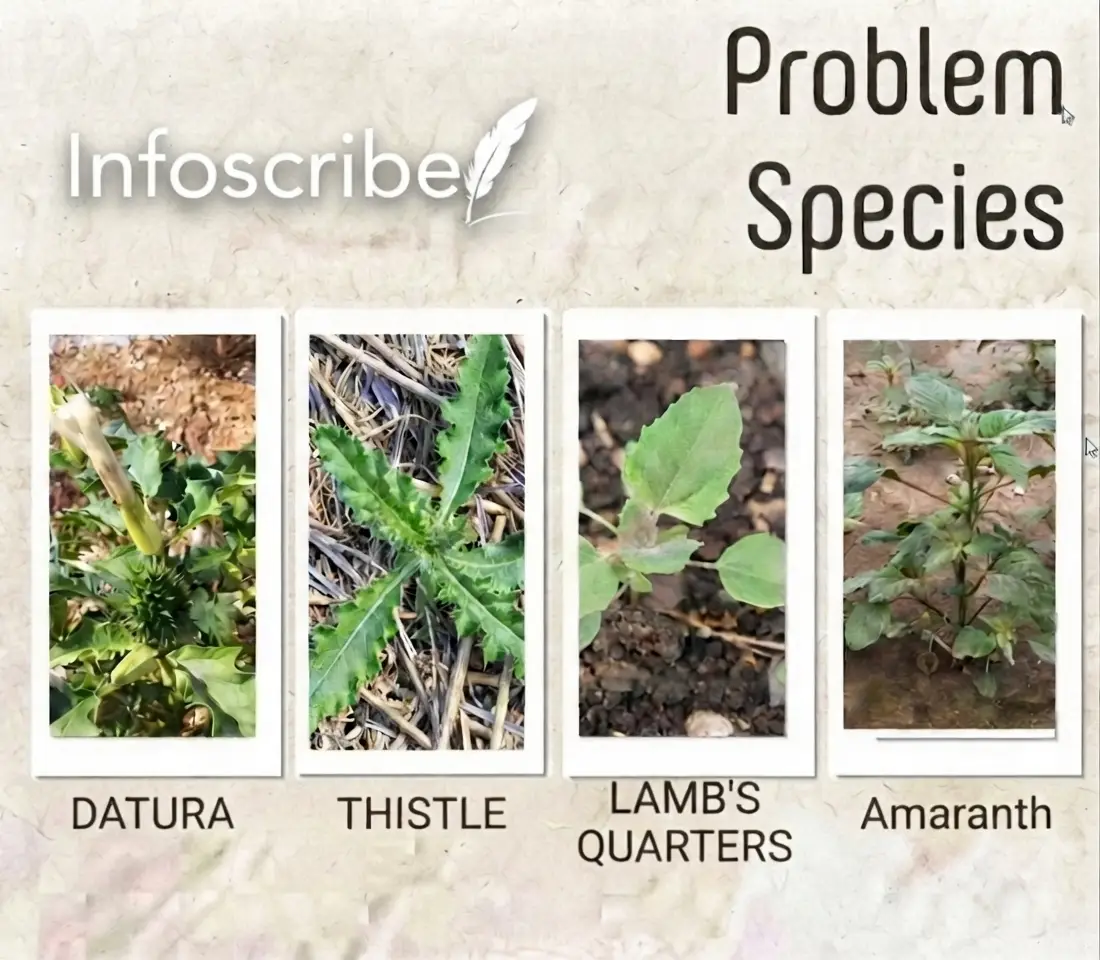
This species illustrates the first criterion at its maximum. It has been the subject of dedicated weed detection work. Thorn apple is a toxic plant whose presence in a harvest destined for food causes the batch to be downgraded, which makes its detection economically critical even at very low density. Four difficulties characterise its annotation in particular. Its morphology changes strongly with stage, the toothed leaf edges becoming pronounced then wilting, which produces a class with high internal variability. It appears isolated within a dense canopy, which makes it visually inconspicuous in an image saturated with vegetation. Its size at the detectable stage stays modest against the resolution available, which limits the number of pixels carrying information. And tolerance to omission is close to zero, one missed plant potentially sufficing to contaminate a batch, which strongly unbalances the trade-off between omissions and false detections. One important observation follows for a weed detection project. That last property changes how the corpus is built: the target species must be deliberately over-represented relative to its real field frequency, failing which the model learns that it is rare and favours omission.Thistle, a case of confusion
This species illustrates the third criterion. It is the textbook case of disagreement between annotators in weed detection. Thistle is a perennial several of whose neighbouring species share the general leaf shape, the lobing and sometimes the colour. Three confusions recur systematically. Confusion with other lobed-leaf perennials, which call for a different treatment and whose distinction rests on details of venation and hairiness. Confusion between stages, a young rosette not presenting the characters that make the plant identifiable once developed. And confusion with certain lobed-leaf crops, in fields where the crop itself presents pronounced leaf division. One practical answer follows. An intermediate class named perennial, distinct from thistle and grouping neighbouring species not identifiable with certainty, resolves most of the problem: it offers the annotator a legitimate exit and it preserves the information usable downstream, since an unidentified perennial often calls for the same treatment.Dock, a case of persistence
This species poses a different difficulty. It follows from its cycle rather than from its appearance. Dock is a deep-rooted perennial whose shallow mechanical destruction is ineffective, which shifts what detection is for. Three consequences follow for annotation. Tracking between passes becomes relevant, a plant detected and treated that reappears signalling a treatment failure rather than a new emergence. Precise localisation takes precedence over mere detection, targeted pulling requiring the plant to be found again. And the distinction with regrowth of the same plant matters, regrowth after cutting presenting a different morphology from a seedling. One observation follows. This species is one of the rare cases where a corpus gains value through repetition over time, which matches the finding the preceding series established on the value of time series against isolated states.Grass weeds, the structural difficulty
This family poses the hardest problem in weed detection and it deserves setting out for itself. A grass weed and a cultivated cereal belong to the same botanical family, present the same leaf architecture and the same colour. Four consequences follow. The distinction rests on characters the image does not always carry, ligule and vernation notably, visible at close range and absent from a drone image. The early stage is almost undecidable, two seedlings of different grasses resembling one another to the point that an expert hesitates. Position relative to the row becomes the principal information, sowing geometry substituting for morphology. And density information takes over from individual identification, a zone containing more plants than the sowing rate provides for signalling an infestation with no plant being individually qualified. One important practical consequence follows. On this family, aiming at species recognition is generally a scoping error, and the approach by departure from expected sowing produces a usable result where the morphological approach fails.Ragweed and species with a health stake
One particular category justifies detection independent of any yield objective. Some weeds produce a strongly allergenic pollen, which makes their presence a public health problem rather than an agronomic one. Three consequences follow for a weed detection project. The useful detection window precedes flowering, the point being to prevent pollen emission rather than to protect the crop. The perimeter extends well beyond the cultivated field, roadsides, wasteland and construction sites concentrating a substantial share of populations. And the client is not necessarily a grower, local authorities and infrastructure managers being among those asking. One commercial observation follows. This segment calls for corpora acquired in contexts very different from the agricultural one, spontaneous vegetation on disturbed soil rather than a row crop, and an agricultural corpus does not transpose to it.Invasive and regulated species
A particular category escapes ordinary agronomic logic. Some species are subject to control obligations, independently of their harmfulness to the crop in place. Three consequences follow for a project. Detection must be exhaustive rather than economically optimal, the obligation bearing on the species and not on a density threshold. Traceability of the detection acquires value of its own, a grower potentially having to demonstrate that they searched and treated. And the domain of use extends outside cultivated fields, field margins, tracks and non-productive areas being concerned. One observation follows. This category shifts weed detection from the field of economic optimisation to that of compliance, which changes the evaluation criteria and makes documenting the method as important as performance.What a reference must contain per species
Six elements compose a sheet usable by an annotator in weed detection. The name adopted in the nomenclature, which is not necessarily the botanical name. The recognition criteria stated in terms observable on the image, leaf shape, arrangement, colour, visible hairiness. The reference images at each stage covered, several per stage. The species with which confusion is frequent, named and illustrated. The criterion that decides in case of doubt, where one exists. And what to do when no criterion decides, which must refer explicitly to the undetermined object class rather than leave the annotator to settle it. One practical consequence follows for a weed detection project. The fourth and fifth elements are the ones most often missing, and they are what makes the difference between a decorative reference and one that genuinely reduces disagreement.Training an annotator on species
A four-stage progression makes them operational. It takes a few days. Recognising the crop first, the most frequent and most regular class, whose mastery secures most of the volume. The binary distinction next, crop against non-crop, without naming the weeds. Introducing the target species one at a time, with their associated confusions, rather than presenting the complete nomenclature at once. And training on edge cases, where the annotator mainly learns to recognise that they do not know. One important observation accompanies that progression. The fourth stage is the most important and the most neglected: an annotator who declares uncertainty produces a more useful corpus than one who settles quickly, and that disposition is taught rather than assumed.Measuring a species’ difficulty
Three indicators place it on a scale. They are measured on a weed detection sample annotated twice. The agreement rate between two annotators on that class, which bounds the performance achievable. The proportion of objects of that species classed as undetermined, which measures the genuinely undecidable share. And the confusion matrix, which indicates which classes the species drifts towards and therefore where to direct the reference effort. One practical consequence follows. Those three indicators are produced in a day on a doubly annotated sample, and they permit deciding species by species whether to refine the reference, merge with a neighbouring class or abandon the distinction.Class imbalance and its correction
A statistical difficulty accompanies low-frequency species and it calls for distinct responses. A class representing a tiny fraction of annotated objects is learned with a performance unrelated to that of the majority classes. Four corrections exist and they intervene at different moments. Targeted sampling when building the corpus, deliberately selecting images containing the rare species rather than drawing at random, the most effective correction and the only one that genuinely increases the information available. Rebalancing at training, which weights the classes, a useful correction that creates no new data. Adjusting the decision threshold, which shifts the trade-off between omissions and false detections without touching the model. And merging with a neighbouring class, a legitimate retreat where the use does not require the distinction. One practical consequence follows. The first correction belongs to the annotation provider and the other three to the modelling team, which makes sampling a decision to be taken jointly rather than a production parameter.The cost per species added
Four factors determine it. The difficulty of distinction from the classes already present, the dominant factor and out of all proportion to the others. The species’ frequency, a rare species requiring a larger volume of images to be reviewed to build a sufficient count. The number of stages to cover, a species whose morphology changes strongly requiring coverage per stage. And the associated reference work, reference images, illustrated confusions and deciding criteria. One important observation follows for a weed detection project. The first factor explains why two equally damaging species can differ by an order of magnitude in annotation cost, and it follows from no agronomic consideration, which makes measuring agreement on a sample indispensable before committing to a nomenclature.The easy species, a project blind spot
Attention naturally goes to the difficult cases in weed detection. An inverse observation nonetheless deserves making. Some weeds are recognised without difficulty, through a distinctive colour, shape or size. Three consequences follow and they are underexploited. They can be annotated by less trained annotators, which permits distributing the load by difficulty rather than uniformly. They lend themselves to effective automatic pre-annotation, a first model trained on those classes appreciably reducing the volume to handle manually. And they constitute a measurable quality baseline, weak agreement on an easy species signalling a method problem rather than intrinsic difficulty. That third consequence is the most useful in quality control. Tracking the agreement rate on a species reputed easy provides a witness: its degradation indicates a production drift that the difficult classes, noisy by nature, would not reveal.Deciding which species to name
Five questions settle the case of each species. They determine whether it deserves a class of its own in a weed detection nomenclature. Does a distinct decision depend on it. A species treated like all the others need not be named. Is it present in sufficient quantity in the area covered. A species absent from the corpus will produce an empty class. Do two trained annotators agree on it. Weak agreement with no pattern indicates the distinction is not available on this data. Does its most frequent confusion call for a different treatment. If both plants are treated the same, the confusion is inconsequential and the distinction worthless. And is there competence to arbitrate doubtful cases. Its absence caps the nomenclature at the level trained annotators can hold alone. Those five answers produce a short list rather than an inventory. Asking them species by species avoids this field’s commonest error, transposing into a nomenclature the weed flora of a region as an agronomic reference describes it.The reference as a deliverable
One practical consequence closes this examination and it has contractual reach. The species reference produced during a project has value of its own, distinct from the annotated corpus itself. Three reasons justify that. It permits extending the corpus later without rebuilding the knowledge, which conditions any re-annotation or added batch. It documents the decisions taken, which lets a third party understand what the corpus describes and audit it. And it survives the departure of those who established it, where unrecorded knowledge disappears with them. One observation follows. This document is written during production at marginal cost and cannot be reconstituted afterwards, which makes it a deliverable to inscribe in the scope rather than a by-product, in line with the principle every preceding series established about documentation.What this chapter teaches
One cross-cutting observation deserves closing this examination because it matches a finding of the preceding series. A species’ difficulty in weed detection does not follow from its botanical description. Three findings compose it. A species perfectly described in a flora reference can remain indistinguishable on the images the project holds, the description presupposing a close observation the acquisition does not permit. Real difficulty is measured and not forecast, the agreement rate between annotators being the only indicator that gives it. And that measurement depends on the corpus, the resolution and the stage, which makes it specific to a project and not transferable. That finding matches exactly the one the series on satellite image segmentation and aerial LiDAR established: the performance bound sits not in the definition of the class but in an observer’s effective capacity to apply it on the data available.What the botanical name hides
One recurring misunderstanding deserves naming, because it survives even in well-run projects. A species name feels precise. It refers to a real organism, it appears in floras, and it carries the authority of a taxonomic system. That precision is real botanically and misleading operationally. Three gaps separate the name from what an annotator handles. The name covers every stage of the plant’s life, where an annotator sees one stage and often the least characteristic one. The name is defined by characters including some that are not visible from above, root system and flower structure notably, where the image offers a top view of leaves. And the name is shared across regions where the plant grows differently, a species in one soil and climate presenting an appearance a reference photographed elsewhere does not match. One practical consequence follows for a weed detection project. What the reference must define is not the species but the visual class, meaning what is recognisable on these images at these stages in this region, and giving that class the botanical name is a convenience rather than a definition. That distinction sounds pedantic and it has a concrete effect. A team that keeps it in mind writes references in observable terms; a team that forgets it writes references that read like a flora and that annotators cannot apply.Common mistakes
These failures recur often enough that naming them is usually enough to avoid them.- Aiming at species recognition on grass weeds in cereals.
- Building a corpus respecting the real frequency of a species that is very rare and highly damaging.
- Omitting the intermediate class grouping unidentifiable neighbouring species.
- Illustrating a species reference without showing the associated confusions.
- Not stating what to do when no criterion decides.
- Presenting the complete nomenclature to an annotator all at once.
- Expecting an annotator to settle systematically rather than declare uncertainty.
- Measuring global agreement without breaking it down by species.
- Neglecting a species’ morphological variability between its stages.
- Asking an agronomist to annotate rather than to establish and arbitrate.