
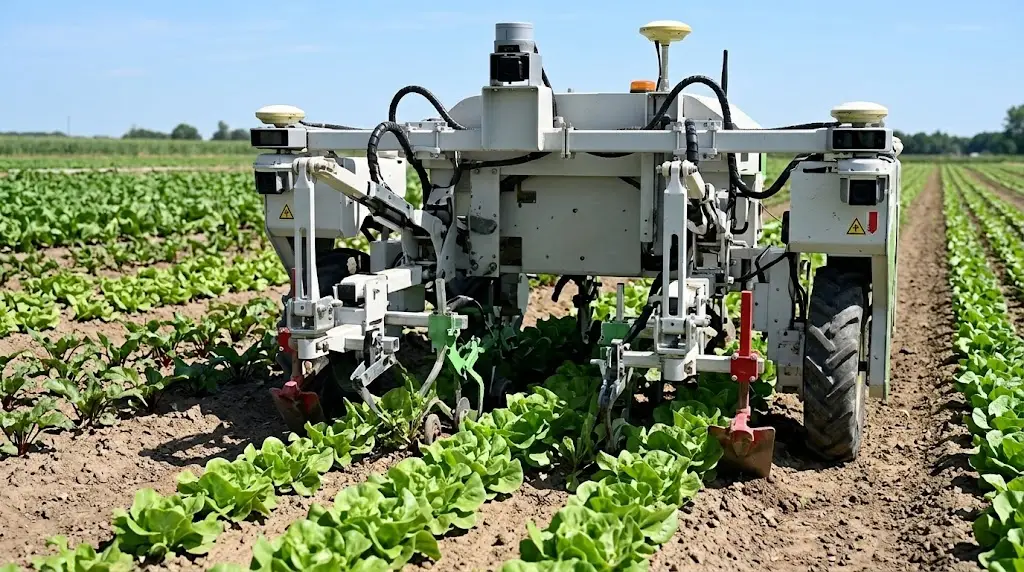
Robotic mechanical weeding inverts the trade-off of spraying. A missed weed will be seen again on the next pass; an uprooted crop plant cannot be replaced. That irreversibility governs the whole design of such a system.
This article sets out what that constraint imposes on weed detection, on annotation conventions and on evaluation. It extends the article on targeted spraying.
What distinguishes this use
Four properties separate it clearly from spraying. The action is irreversible, a plant uprooted or severed not being restorable, which precludes error on the crop. The action is mechanical, which imposes a physical positioning precision where a nozzle tolerates a few centimetres of offset. Forward speed is low, a mechanical weeding implement working at a pace unrelated to that of a sprayer, which strongly relaxes the latency constraint. And the pass is repeatable, the absence of a consumable product permitting a return with no material cost, which makes an omission less final. One important practical consequence follows. The first two properties tighten the requirement and the last two relax it, which produces a constraint profile very different from that of spraying rather than a harder version of the same problem.The inversion of the trade-off
This inversion determines every setting of a weed detection system. It is the defining characteristic of the use. In spraying, a false detection costs a dose of product. In mechanical weeding, it can cost a crop plant. Three consequences follow. The decision threshold shifts towards caution, the system having to abstain when in doubt rather than act. The crop class becomes the critical class, where in spraying attention goes to the weeds. And evaluation must report errors touching the crop separately, a global indicator drowning them in a far larger volume of weeds. One important observation follows for a weed detection project. This inversion explains why a system trained for spraying does not transpose to mechanical weeding without retraining, even on the same crop and the same corpus, parameter settings not being the only issue.The families of implement
Four destruction technologies coexist. Their precision requirements differ markedly. The guided hoe works the inter-row with blades, requiring a location of the row rather than a detection of plants, which makes it the simplest application. Retractable fingers or discs work on the row, moving aside as a crop plant passes, which requires detecting the crop and not the weed. Point destruction implements, mechanical or thermal, target the individual weed and demand the highest precision. And directed energy systems, laser or electrical, whose required precision is the finest since the action zone is reduced to a few centimetres. One practical consequence follows. The second family completely inverts the question put to the system: it is no longer a matter of detecting what to destroy but of detecting what to spare, a formulation that considerably simplifies the corpus.Detecting what to spare
This formulation is the best suited to weed detection in mechanical weeding. It deserves developing. An implement destroying by default and retracting on detection needs only to recognise the crop. Four advantages follow. The target class is single and highly homogeneous, a sowing producing plants of the same variety and the same stage. An unknown weed is destroyed by default, which makes the system robust to a flora the corpus does not cover. The default error is the least costly, a doubt leading to no retraction and therefore to destroying a plant that might have been a weed. And the corpus reduces to a single annotated class, which divides the cost against a weed nomenclature. One caveat accompanies those four advantages. This arrangement presupposes that the implement destroys selectively in time rather than in space, a mechanical capability not every machine possesses, which makes this formulation equipment-dependent rather than universally available.Positioning precision
This physical requirement bounds feasibility. It exceeds that of spraying. A mechanical part must reach a ground position within a tolerance of a few centimetres. Four factors contribute and they compound. Detection precision in the image, the only factor belonging to annotation. Geometric calibration, which projects the detection into the implement’s frame. Tracking of the machine’s trajectory, whose deviations displace the implement between detection and action. And the mechanical precision of the part itself, whose play and inertia limit what the command can achieve. One important observation follows. The first factor is rarely the limiting one, which means improving annotation beyond a certain point no longer improves the result, a finding that should feature in any specification discussion and that protects a provider from a disproportionate requirement.What annotation requires in this context
Five requirements characterise weed detection for a mechanical implement. Crop plants must be annotated systematically, they constitute the critical class and not a contextual element. Localisation must designate an action point rather than an extent, a plant centre or a collar according to the implement. Atypical crop plants must be covered, a weak or lodged plant having to be recognised on the same footing as a normal one. Proximity configurations must feature, a weed touching a crop plant constituting the case where the implement must abstain. And the plant to protect class must be handled with the same care as the crop, irreversibility applying to it too. One practical consequence follows for a weed detection project. The third requirement is regularly neglected: a corpus built on well-grown plants produces a system that does not recognise weak plants, and those are precisely the ones destruction would finish off.The case of proximity
This configuration dominates the difficulty of this use. It deserves separate treatment. A weed sitting a few centimetres from a crop plant cannot be destroyed mechanically without risk. Three answers exist and they are settled at scoping. Abstention, the implement not treating within a guard zone around each crop plant, a simple solution that leaves a share of the weeds in place. Complementary treatment, another technique taking on the guard zone, localised chemical or manual. And fine selective destruction, reserved for directed energy implements whose action zone is sufficiently small. One observation follows. The first answer is the most widespread and it has a direct consequence for annotation: the guard zone must be defined and the weeds within it can be excluded from the corpus, which reduces the volume to annotate and must be decided before starting.What slowness permits
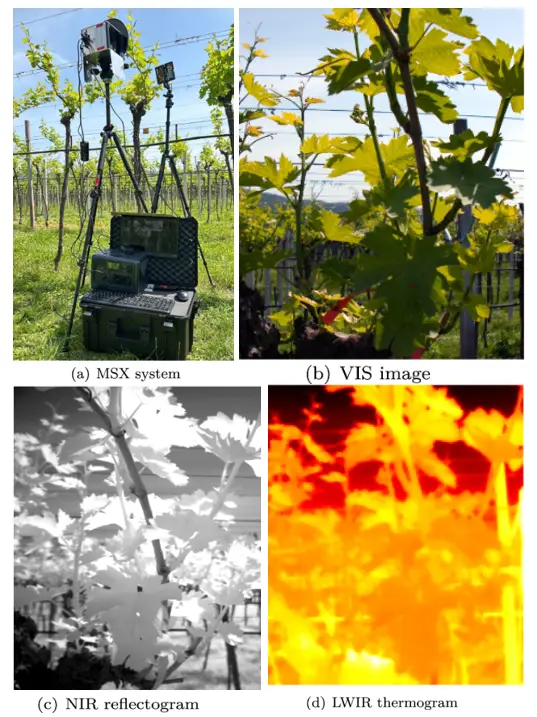
A constraint often presented as a handicap in fact opens possibilities spraying does not have. A mechanical weeding implement advances slowly, which frees computation time between two decisions. Four exploitations follow for weed detection. A heavier model becomes usable, which improves performance on difficult configurations without compromising operation. Several views of the same object become available, slow advance producing successive images overlapping substantially, which permits confirming a detection before acting. A second modality can be integrated, source fusion requiring a processing time spraying speeds preclude. And abstention becomes a practicable option, a hesitant system being able to hold back and leave the zone to a later pass. One important practical consequence follows. The second exploitation is the most underused: requiring an object to be detected across several consecutive images before acting strongly reduces false detections, which is exactly the error this use does not tolerate.Evaluating a mechanical weeding system
Four principles govern that evaluation. They differ from those of spraying. The rate of crop plant destruction is the principal indicator, and it must be reported separately and without aggregation. The rate of weeds destroyed comes next, given that a lower value is acceptable in view of the pass being repeatable. Performance must be measured on the row and in the guard zone separately, the inter-row being treated without detection. And performance must cover atypical crop plants, whose recognition is these systems’ known weak point. One important practical consequence follows. A system can show an excellent global rate and destroy an unacceptable percentage of weak plants, a situation revealed only by decomposing the evaluation and expensive when it is discovered in the field.Quality control specific to this use
Four arrangements answer the irreversibility of the action and they differ from those of a spraying project. Exhaustive verification of the crop class on a sample, rather than a survey spread across all classes, the error on that class being the only genuinely costly one. Targeted search for atypical plants in the corpus, verifying that they are present and correctly annotated rather than hoping they are. Checking proximity configurations, ensuring the cases where weed and crop touch feature in the corpus and receive a consistent decision. And verifying the action point rather than the extent, a badly placed centre producing a mechanical error a correct box would mask. One observation follows for a weed detection project. Those four arrangements concentrate effort on a fraction of the corpus, which makes them economical, and they reflect the cost asymmetry specific to this use rather than a uniform control that would deny it.Thermal and directed energy weeding
One category deserves distinguishing because its constraints differ from classical mechanical weeding. Systems destroying by heat, laser or electricity have no physical contact with the soil. Three consequences follow. Independence from soil conditions, wet or hard ground no longer compromising the action, which widens the intervention window. A very small action zone, which permits treating within the guard zone and therefore reaching the weeds mechanical work leaves in place. And a higher precision requirement, the small action zone forgiving no positioning error. One important observation follows for a weed detection project. That third consequence reverses the earlier finding: on these systems, detection precision becomes the limiting factor again, and an investment in annotation quality produces there a measurable effect classical mechanical weeding would not have shown.What mechanical weeding does not solve
Four limits deserve stating. This use is attracting growing interest in weed detection. Work rate is markedly lower than for spraying, which limits the area treatable per day and shifts the economic equation. Efficacy depends on soil conditions, wet ground compromising uprooting and hard ground wearing the parts. Deep-rooted perennials resist shallow destruction, which makes this use unsuited to part of the flora. And the guard zone around plants structurally leaves a fraction of the weeds in place. That last limit is the most structuring. It means mechanical weeding alone does not replace a complete chemical programme, and that it fits into a combination of techniques rather than a full substitution.The economics of a robotic operation
Four lines compose the comparison with chemical weeding and it tilts differently by context. Input cost, nil for mechanical work, which is the principal advantage and grows with product prices. Pass cost, higher for mechanical work through the reduced rate and the number of passes needed. Equipment investment, generally higher for a robotic implement and amortised over the area worked. And the cost of failure, a destroyed crop plant representing a loss chemical work does not produce. Two contexts tip the balance. Organic farming, where the chemical line does not exist and where the comparison is with hand weeding, whose cost is of an entirely different order. And situations of established resistance, where chemistry loses its efficacy and ceases to be an alternative. One important observation follows for a weed detection project. Those two contexts constitute this technology’s natural market, which directs corpus building towards the crops and practices they concern rather than towards conventional arable farming.Vegetable production, the favoured ground
One family of crops concentrates deployments and it is worth setting out why. Field vegetables combine conditions arable crops do not present. Five properties contribute. Value per hectare is high, which makes a higher pass cost bearable. Approved chemical solutions are few on these so-called minor crops, which reduces the alternative. Hand weeding is still practised there, which gives a cost reference very favourable to the robot. Plants are often transplanted at regular spacing, which supplies a geometry even more exploitable than a sowing. And the crop is morphologically distinct from the local weed flora in many cases. One practical consequence follows. These crops constitute the context where a weed detection project reaches profitability fastest, which explains the concentration of early robotic deployments on this segment rather than on the largest areas.What autonomy adds
One further dimension distinguishes autonomous robots from mounted implements and it goes beyond detection. A machine working without a driver must perceive well beyond the plants it treats. Four perception needs are added. Detecting obstacles and people, a safety requirement taking precedence over any agronomic consideration. Trajectory following and end-of-row recognition, for turning. Detecting stop conditions, impassable ground or a part failure. And logging what was done, unsupervised work having to be verifiable after the fact. One observation follows for a weed detection provider. Those four needs belong to distinct corpora and sometimes to distinct suppliers, and their scope is better delimited clearly at scoping, since a client may assume that annotating weeds covers their machine’s whole perception.Approaching a robotic weeding project
Five questions scope this type of project and they are asked in one meeting. Does the implement destroy by default or on detection. That answer determines whether to annotate the crop or the weeds, and it changes the corpus cost by a substantial ratio. What is the guard zone around a crop plant. That answer bounds what the system must handle and permits excluding part of the corpus. What mechanical precision does the part achieve. That answer bounds the usefulness of finer annotation. What proportion of atypical plants does the field present. That answer sizes the coverage effort on the critical class. And what rate of crop destruction is acceptable. That answer fixes the threshold and must be stated by the client rather than assumed by the provider. Those five answers determine the formulation, the corpus and the parameter settings. Asking them before annotating avoids building a weed corpus where a crop corpus would have sufficed.What this use case teaches
One cross-cutting observation deserves closing this examination because it contrasts with the preceding use. Spraying and mechanical weeding exploit the same data and ask inverse questions. Three findings compose it. The first looks for what to destroy, the second can look for what to spare, which changes the target class and divides the corpus cost. The first tolerates false detection and the second does not, which shifts the threshold and precludes reusing a parameter setting. And the first is constrained by speed where the second is constrained by mechanical precision, which moves the limiting factor outside the field of annotation. That finding matches exactly the one the series on aerial LiDAR established comparing forestry with network management: the same data serves opposite requirements, and a protocol designed for one use applied to the other produces either a needless overcost or a dangerous shortfall.The threshold conversation to have early
One question decides more of this project than any technical choice, and clients rarely volunteer an answer to it. What rate of crop plant destruction is acceptable. Three reasons make it uncomfortable and necessary. Nobody wants to name a number above zero, since the honest answer sounds like accepting damage to a customer’s field. Zero is not achievable, a system that never destroys a crop plant being one that abstains so often it does not weed. And without the number, the threshold gets set by whoever tunes the model, which means an engineering decision silently becomes a commercial commitment. One practical way through follows. Ask not for a rate but for a comparison: how does the client’s current practice perform. Hand weeding and hoeing both damage plants, at rates growers know from experience, and anchoring the conversation there turns an uncomfortable abstraction into a familiar benchmark. One observation completes that. A weed detection provider who raises this question is doing the client a service, since the alternative is not avoiding the trade-off but making it implicitly.Common mistakes
These failures recur often enough that naming them is usually enough to avoid them.- Reusing a parameter setting designed for spraying.
- Annotating weeds where the implement requires recognising the crop.
- Omitting atypical crop plants from the corpus.
- Not defining the guard zone before starting annotation.
- Reporting a global rate without isolating crop plant destruction.
- Annotating an extent where the implement requires an action point.
- Neglecting proximity configurations between weed and crop.
- Investing in an annotation precision beyond the implement’s mechanical precision.
- Handling plants to protect with less care than the crop.
- Promising a complete replacement of chemical weeding.