Over the past few years, pre-labeling tools and auto-annotation systems have fundamentally changed how machine learning teams approach an image annotation project. Where manual annotation of a dataset containing hundreds of thousands of images once took weeks, pre-labeling models can now generate bounding boxes, masks, or polygons in a matter of hours. The promise is compelling: faster iteration cycles, lower costs, and reduced burden on human annotators for repetitive tasks.
Yet in practice, the picture is more nuanced. Teams that have attempted to shift entirely to automated image annotation have repeatedly encountered the same obstacles: errors that are difficult to detect, poor handling of edge cases, and inadequate quality on out-of-distribution data. The real question is therefore not “manual or automatic?” but rather “for which types of images, at which stage of the pipeline, and with what level of human oversight?”
This article rigorously examines what automation can and cannot deliver in image annotation, and the specific conditions under which human involvement remains non-negotiable — including in the current context of foundation models and automated segmentation tools that are reshaping the industry.
Automatic image annotation: what pre-labeling can (and cannot) do
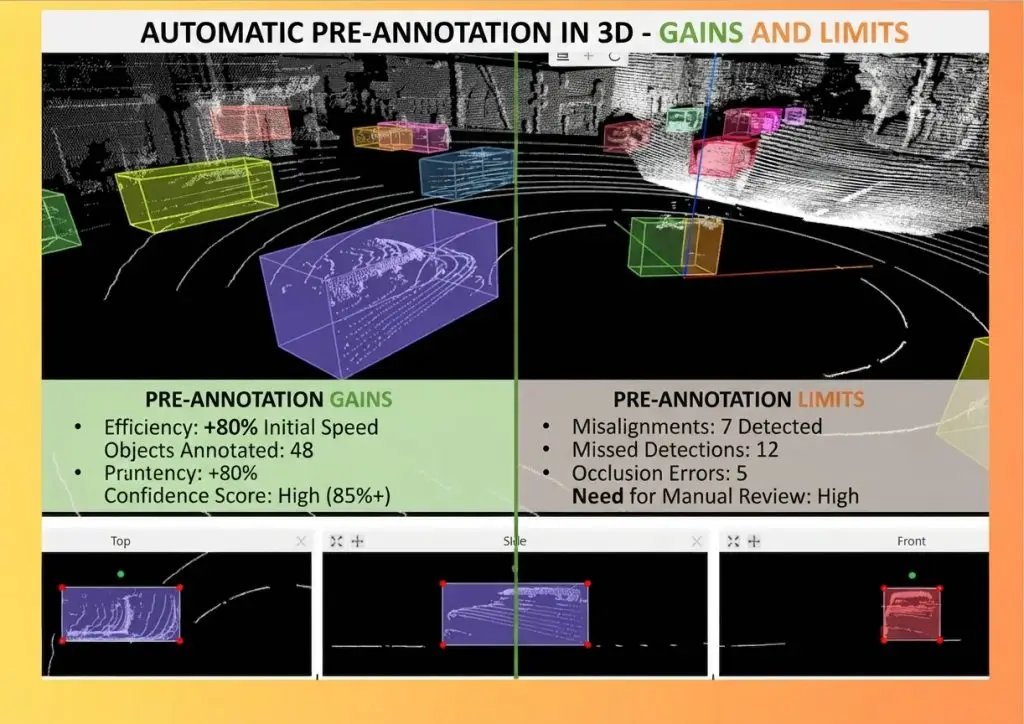
Before assessing the limitations of auto-annotation, it is useful to define its scope precisely. Pre-labeling refers to the use of a pre-trained model to generate candidate annotations on new images. These proposals are then reviewed, corrected, and validated by human annotators. Auto-annotation, in its more radical form, minimizes or eliminates this human validation step entirely.
Where pre-labeling delivers real value
In the right conditions, pre-labeling provides measurable gains in image annotation projects. On large volumes of images with low variability — consistent lighting conditions, visually distinct classes, stable capture context — a pre-trained model can substantially reduce the time annotators spend on each image. Rather than drawing annotations from scratch, annotators validate, adjust, or reject pre-generated proposals. This can represent significant time savings on standardized images and directly lower the per-image cost of an image annotation project.
The most favorable use cases are those where the pre-labeling model was trained on data closely matching the target domain. Generic object detection — vehicles, pedestrians, urban furniture — on images captured under standard conditions often benefits from an acceptable level of pre-annotation. Similarly, semantic segmentation projects targeting scenes well-represented in public benchmarks can achieve faster validation rates that reduce the overall scope of manual review.
The effectiveness of pre-labeling also depends on task granularity. The simpler and more clearly defined the task — classifying an image into one of two categories, verifying the presence or absence of a specific object — the more automation can handle a significant portion of the workflow. The finer and more context-dependent the task — segmenting an anatomical structure at the pixel level, distinguishing visually similar but semantically distinct classes — the more human supervision becomes essential.
What auto-annotation cannot cover
Pre-labeling performance drops sharply as soon as images diverge from the model’s training domain. Outside the categories represented in public datasets, generic models struggle to produce reliable image annotations. This applies to images from domain-specific industrial sensors, agricultural crops under atypical growth conditions, or medical imaging modalities underrepresented in public benchmarks. In these contexts, pre-labeling generates annotations that appear plausible on the surface but are semantically incorrect — a situation that can sometimes be more dangerous than having no annotation at all.
Furthermore, auto-annotation assumes a stable, pre-existing class schema. When it comes to building a new annotation schema — defining boundaries between adjacent categories, drafting rules for edge cases, adjudicating between competing interpretations — the machine has no means to decide. This conceptual work is the exclusive domain of human expertise, and it necessarily precedes any automation pipeline.
The fundamental limitations of automatic image annotation
Automatic image annotation rests on an implicit assumption: the images to be annotated are sufficiently similar to the data on which the pre-labeling model was trained. When this assumption breaks down — which happens frequently in real-world projects — results deteriorate in predictable, and sometimes insidious, ways.
Fragility in the face of rare cases and ambiguous classes
Edge cases are the first stumbling block of automated image annotation. A model trained on clean, well-represented images will systematically struggle with atypical situations: partially occluded objects, degraded lighting conditions, small instances in dense scenes, or classes that are visually similar but semantically distinct.
These edge cases are not rare exceptions. In an agricultural image annotation project, 20 to 30% of images may present difficult configurations: intermediate growth stages, mixed plant species, backlighting, or morning haze. In an industrial quality control project, rare defects — the ones most critical to detect — are precisely those the model has almost never encountered during training.
The consequences are twofold. First, automatic annotations on these cases are wrong or missing. Second — and this is the more serious risk — they may appear visually plausible while being semantically incorrect. An experienced human annotator immediately detects the inconsistency; an automated quality control system may let it pass unnoticed.
Dense scenes, which pack large numbers of small objects into a limited field of view, are a particularly challenging case for automated image annotation. The risk of merging adjacent instances, missing small objects, or confusing neighboring categories is structurally high in these configurations. These are precisely the images where the value added by human annotators is greatest, and where the cost of relying solely on automation is highest.
Silent error amplification
One of the least understood risks of auto-annotation is what might be called silent error amplification. When a pre-labeling model makes a systematic error on a specific image type — for example, consistently confusing two classes in a particular visual context — that error propagates into potentially thousands of generated annotations before being identified.
If the human review process is not sufficiently rigorous, or if annotators place too much trust in model proposals without examining them critically, errors accumulate in the training dataset. The final model will be trained on biased data, and the impact on its production performance will be difficult to trace back to the root cause.
Analyses of reference datasets have revealed non-negligible label error rates, even in corpora considered domain standards. These errors, once embedded in a training pipeline, produce effects on model quality that no architecture — however sophisticated — can fully compensate. The quality of image annotation is not an operational detail: it is a decisive factor in the performance of the final model.
Dependence on initial training data
Automatic image annotation does not create new knowledge: it applies and generalizes what a model has learned from other data. This structural dependence raises several practical problems that practitioners need to anticipate.
First, if the pre-labeling model’s training data is biased — in terms of class representation, capture conditions, or underrepresented subpopulations — that bias will be mechanically reproduced in newly generated annotations. Second, when a project introduces new classes or modifies its annotation schema, the model must be retrained or replaced, which requires additional time and resources. Third, pre-labeling quality degrades progressively in production as real data drifts away from training data — a phenomenon known as data drift that affects even well-maintained models.
For all these reasons, automatic image annotation is never truly autonomous: it requires continuous monitoring, periodic reassessments, and structured human supervision to remain reliable over time.
When manual image annotation remains non-negotiable
There is a defined set of situations where manual image annotation is not merely preferable, but strictly necessary. These situations are characterized by two combined factors: the inherent complexity of the annotation task, and the high cost of error in the final use case.
Contextual judgment: irreplaceable in complex environments
Annotating an image means first understanding what it represents in context. This contextual understanding is at the core of what manual image annotation provides and what automation cannot reliably reproduce in complex scenarios.
Consider a medical imaging project. Annotating a lesion in a dermoscopic image is not merely a matter of drawing a contour: it requires distinguishing, based on subtle visual cues, potentially benign structures from diagnostically significant features. This type of decision requires clinical expertise that no general-purpose model or pre-labeling tool can replicate without structured medical supervision and formalized review protocols.
In less specialized but equally demanding contexts — object detection in cluttered logistics environments, perception under degraded driving conditions — manual image annotation remains essential for handling partial occlusions, image-edge truncations, and perspective-related ambiguities. A human annotator understands that two objects overlap in the image but are distinct in physical reality; the pre-labeling model typically has no robust representation of this distinction.
Autonomous driving datasets illustrate this particularly well: identifying a pedestrian partially hidden behind a post, distinguishing a turned-off traffic light from a dark circular object, or correctly annotating debris on the road all require a level of contextual reasoning that automated systems cannot reliably deliver at the quality thresholds demanded by safety-critical applications.
Domain expertise: a prerequisite for quality
In many sectors, image annotation can only be performed reliably by annotators trained in the domain’s specific requirements. This is not a matter of general rigor or goodwill: it is a structural condition of annotation quality.
An annotator unfamiliar with plant morphology cannot distinguish a main stem from a secondary stem in a greenhouse crop image. An annotator not trained in an aerospace project’s conventions cannot correctly apply a complex taxonomy with dozens of classes and their associated inclusion and exclusion rules. In these contexts, initial and ongoing annotator training — led by project managers in direct contact with the client’s technical teams — is the defining factor of quality, not just a nice-to-have.
This training requires iterative back-and-forth between annotators and domain experts, the development of annotated example sets covering both standard cases and known edge cases, and escalation mechanisms for genuinely ambiguous situations. Every update to the annotation instructions from the client is followed by a group training session with live annotation review. It is this human calibration work that gives a training dataset its value, and makes each image annotation project unique and non-replicable by automation alone.
Daily performance monitoring through competency matrices allows project teams to identify in real time which annotators need additional support, and to pair them with more experienced mentors for collaborative learning. This continuous feedback loop is one of the most reliable guarantees of consistency in a large-scale image annotation project.
Image annotation in critical sectors: medical, industrial and defense
Certain sectors concentrate the highest requirements for image annotation and concretely illustrate why human expertise remains central to the process at every level.
In medical imaging, annotation quality can directly determine the performance of a diagnostic assistance algorithm or a CE-marked medical device. European regulations impose rigorous traceability of training data and explicit documentation of validation processes. In this context, delegating image annotation to an automatic process without structured clinical validation is not a viable option. Annotators must be healthcare professionals or specifically trained operators working under medical supervision, with formalized double-reading and arbitration procedures at each step. Projects requiring accuracy rates above 95% on complex segmentation tasks — follicular measurement, volumetric organ segmentation — simply cannot meet their targets without a structured multi-level human review process.
In industry, defect detection on metal surfaces, printed circuit boards, or precision-machined parts requires knowledge of the manufacturing process that only annotators trained in the product’s specifics can provide. A porosity defect on a weld and a natural texture variation in the material may look visually similar; only an annotator trained in the industrial context makes the distinction correctly. This distinction is decisive for the quality of the detection model and for the effectiveness of quality control in production. Projects with micrometric precision requirements — annotating surface defects on rolled steel, for instance — make this dependency on trained human expertise particularly visible.
In defense-related projects and applications involving sensitive data, complex taxonomies with dozens of classes and precise rules, combined with inter-sensor consistency requirements for objects tracked across multiple simultaneous camera feeds, make manual image annotation performed by dedicated and specifically trained teams non-negotiable. Automated systems lack the conceptual flexibility needed to absorb these constraints without quality degradation.
These sector-specific examples confirm a widely recognized operational reality: speed cannot be the only optimization variable in image annotation. Quality, regulatory compliance, and traceability are non-negotiable requirements that make human supervision indispensable in all high-stakes contexts.
The hybrid model: human-assisted image annotation
Given this reality, the operational response adopted by the most advanced ML teams is not to choose between manual and automatic annotation, but to combine them in a structured, deliberate way. The hybrid model — sometimes referred to as human-in-the-loop or human-assisted image annotation — leverages the strengths of each approach while compensating for their respective weaknesses.
Human-in-the-loop as the reference architecture
In a human-in-the-loop architecture, pre-labeling is used as a productivity accelerator, not as an autonomous decision system. A model generates candidate annotations that human annotators review, correct, and validate. Validated annotations can then be used to further refine the pre-labeling model itself, creating a progressive improvement cycle where both human judgment and automated efficiency compound over time.
This architecture offers several decisive advantages. On one hand, it reduces the repetitive workload for annotators by handling the most standardized tasks. On the other hand, it preserves human supervision for ambiguous cases, difficult classes, and out-of-distribution images — precisely where the automatic model is least reliable. Annotator expertise is concentrated where it adds the most value.
The key to this model is the routing strategy: identifying which images can be quickly validated based on an automatic proposal, and which require fully manual image annotation. This routing can itself be partially automated — using the pre-labeling model’s confidence score as a routing signal — but requires regular calibration to remain accurate and reliable as the project evolves.
Calibrating the degree of automation for each project
The optimal balance between manual and machine-assisted annotation varies significantly from project to project. Several parameters come into play: domain maturity (the more the domain is covered by public reference datasets, the more effective pre-labeling will be), image variability (the higher the variability, the more manual correction will be needed), error tolerance of the final use case, and applicable regulatory constraints.
For a generic object detection project on images captured under standardized conditions, a high rate of automatic validation may be entirely appropriate. For a quality control project on industrial images with rare and critical defects, every image must pass before a trained annotator, regardless of the apparent quality of the automatic proposal. The decision criterion is not confidence in the model but the risk tolerance of the final application.
The tool for this calibration decision is not the AI model itself: it is field feedback, derived from regular quality audits of the annotations produced. For structuring these workflows, the choice of annotation tooling also plays a significant role. The comparison of
image annotation tools in 2026: CVAT, Label Studio, and alternatives provides an operational overview to identify platforms that natively support hybrid workflows and integrated quality control features.
Quality control in image annotation: the human safety net
The question of quality control is inseparable from the debate between manual and automatic image annotation. In both approaches, the final quality of the dataset depends on rigorous verification processes. But when image annotation workflows incorporate automation, quality control becomes even more critical: errors can propagate rapidly and silently before being detected, affecting the entire downstream model training pipeline.
Key metrics to implement
Two families of metrics allow effective monitoring of image annotation project quality. Consistency metrics — IoU (Intersection over Union) for detection and segmentation tasks, Cohen’s kappa for classification tasks — measure annotation convergence on shared reference images. They detect drift between annotators, or between the pre-labeling model and its human reviewers, and serve as early warning signals for quality degradation.
Production metrics track quality evolution across the full project: rejection rate for model-proposed annotations, distribution of correction types made by annotators, frequency of cases escalated for arbitration. These indicators quickly reveal whether a batch is problematic, whether the model is degrading on a specific image subset, or whether an annotator is showing drift in their practice.
Combining these two metric families creates an operational quality dashboard that is essential for managing any image annotation project involving both human expertise and automated tools. Without this measurement infrastructure, it is impossible to know whether the level of automation adopted is appropriate for the required quality level — or whether it is silently compromising it.
Auditing pre-labeled batches: a non-negotiable step
Auditing pre-labeled batches is one of the most underestimated steps in image annotation projects that incorporate automation. It involves submitting a representative sample of each batch to an independent review, performed by controllers who did not participate in the initial validation.
This audit detects two distinct phenomena. First, systematic errors from the pre-labeling model, which often manifest on homogeneous image subsets (same capture angle, same lighting condition, same production phase). Second, validation biases introduced by annotators themselves — including the well-documented tendency to over-validate automatic proposals without examining them with sufficient critical attention.
The most robust audit processes combine random sampling to ensure statistical coverage, targeted sampling on difficult cases identified during production, and the use of control batches containing images pre-annotated with known ground truth. These control images, discreetly integrated into production batches, enable objective measurement of annotator reliability and pre-labeling model quality under real-world conditions.
To explore the fundamentals of image annotation and its role in the computer vision model lifecycle, the
2D and 3D annotation services for computer vision. To discuss the specifics of your project and identify the right balance between automation and human expertise,
contact our team.