Choosing an image annotation tool is a decision that shapes your entire data pipeline for years to come. Depending on the annotation geometries required, the volume of data to process, the sensitivity of your images and the technical resources available internally, the options on the market in 2026 offer very different trade-offs. Two computer vision projects that look similar on paper can call for radically different solutions: a team handling confidential industrial images will gravitate toward a self-hosted open source platform, while a startup with no dedicated infrastructure will prefer a SaaS tool they can have running within hours.This guide offers a structured comparison of the main image annotation tools available in 2026, from the CVAT vs Label Studio debate to commercial SaaS alternatives and lightweight open source options, along with the criteria that should objectively guide your decision. The goal is not to identify the “best tool” in the abstract, but the one that best matches your actual constraints. For a reminder of core concepts before diving into tooling, see our
complete guide to image annotation for computer vision.
A Maturing Market for Image Annotation Tools
The image annotation tooling landscape has changed significantly over the past five years. In the early 2020s, many teams relied on in-house scripts or rudimentary interfaces limited to bounding boxes. By 2026, the space has its own dedicated players, a mature open source ecosystem and commercial offerings that now include AI-assisted pre-annotation, workforce management and MLOps integration.The global data annotation tools market is projected to exceed $8 billion by 2030, according to multiple industry research firms, driven by accelerating model deployments across manufacturing, healthcare, agriculture and autonomous systems. This growth comes with increased specialization: some tools target internal data science teams, others are designed for annotation service providers, and still others focus on specific domains such as medical imaging or geospatial data.For organizations managing image annotation at scale, this abundance is both an opportunity and a risk. Migrating from one tool to another carries a real operational cost: retraining annotators, converting existing datasets, reconfiguring ML pipeline integrations. The initial choice deserves rigorous analysis rather than a default adoption based on familiarity.It is also worth distinguishing between image annotation tools in the strict sense, which produce training-ready labels, and dataset management platforms, which organize, version and serve data to the full ML pipeline. Some solutions cover both scopes, which significantly changes the cost-benefit equation. Evaluating where one scope ends and the other begins is an important part of the selection process.
CVAT: The Open Source Standard for Professional Image Annotation
CVAT (Computer Vision Annotation Tool) originated at Intel before transitioning to the open source community. It is now developed and maintained by CVAT.ai, with an active user base spanning thousands of organizations worldwide. Its production robustness and feature depth have made it the default reference for teams seeking a self-hosted image annotation platform.
Annotation Capabilities
CVAT supports virtually every image annotation geometry: rectangular bounding boxes, free polygons, polylines, keypoints, cuboids for objects with depth in a 2D image, and semantic or instance segmentation masks. The interface is built for intensive use by large teams: fully configurable keyboard shortcuts, automatic interpolation between keyframes for video annotation, and polygon drawing assistance tools. Tasks and jobs can be distributed across multiple annotators, and review passes can be structured with defined roles.One of CVAT’s strongest capabilities for image annotation is its native integration with Nuclio, a serverless framework that allows pre-trained detection or segmentation models to be connected directly to the annotation interface. Annotators can obtain automatic pre-annotations on each image and focus on correction and validation rather than drawing from scratch. This hybrid human-AI workflow significantly reduces production time per image without sacrificing final quality.CVAT exports in a wide range of formats: COCO JSON, YOLO (multiple variants), Pascal VOC, LabelMe, CVAT XML, TFRecord, MOT for video tracking and more. This format coverage is critical for ensuring compatibility with downstream ML frameworks and conversion tools.
Deployment and Architecture
CVAT deploys via Docker Compose, making installation straightforward on any Linux infrastructure. Once deployed, the platform is accessible from a standard web browser, simplifying access for distributed annotator teams without requiring thick clients. A documented REST API and Python SDK enable automation of task creation, data import, annotation export and project progress monitoring.Self-hosting CVAT for image annotation ensures that data never leaves the organization’s controlled environment. This is a decisive criterion for projects operating under strict confidentiality requirements, whether in defense, healthcare, precision manufacturing or any environment governed by ISO 27001 or equivalent data security standards.
Community and Public Cloud Option
CVAT benefits from an active open source community that contributes bug fixes, new features and documentation. The GitHub repository registers thousands of stars and an ongoing stream of pull requests, which is a reliable indicator of ecosystem health. CVAT.ai also offers a managed cloud version for organizations that want the same interface and feature set without managing the underlying infrastructure, bridging the gap between fully self-hosted and pure SaaS deployment models.One particularly useful architectural pattern for teams with mixed data sensitivity is running a self-hosted CVAT instance for confidential projects while routing non-sensitive pilot work through the cloud version. Both environments use the same API and the same export formats, which makes it possible to maintain consistent tooling and annotator training across deployment contexts.
Limitations to Consider
CVAT’s learning curve, both for administrators and for first-time annotators, is steeper than many SaaS alternatives with more streamlined interfaces. Infrastructure updates, backup management, server sizing and Docker service monitoring require DevOps expertise that not all organizations have internally. These operational constraints are the main friction point in CVAT adoption for teams without a dedicated IT department. A realistic deployment estimate for a production-grade self-hosted CVAT environment, including initial setup, annotator onboarding and pipeline integration, is two to four weeks for a team with adequate technical resources.
Label Studio: The Flexible Image Annotation Tool for Multimodal Teams
Label Studio is developed by Heartex and distinguishes itself from CVAT through its multimodal approach. Where CVAT is optimized for computer vision, Label Studio is designed to annotate any data type from a unified interface: images, text, audio, video, time series and PDF documents. This versatility makes it the preferred choice for teams managing multiple project types simultaneously who want to avoid maintaining separate platforms.
Template-Based Configuration
Label Studio’s configuration relies on declarative XML templates. Project administrators define precisely which annotation types are available for each task (bounding box, polygon, full-image classification, audio transcription, named entity recognition on text, etc.) and adapt them to the project’s specific requirements. This flexibility is the primary strength of Label Studio for image annotation in non-standard contexts: it is possible to combine a bounding box, a classification field and a free-text comment field in a single task, which enriches annotation metadata for ambiguous cases.The library of pre-built templates covers most common use cases and enables fast project setup without custom development. For advanced configurations, direct XML editing provides full control over the interface presented to annotators.
ML Backend and Active Learning
Label Studio provides an ML backend system that allows internally developed pre-annotation models to be connected to the platform. The Python SDK facilitates this integration: the model receives an image, returns predictions as annotations, and the annotator validates or corrects them. This workflow is particularly effective in active learning settings, where the images most uncertain for the current model are prioritized for human verification, optimizing the annotation budget available.
Community and Enterprise Editions
Label Studio is available as open source (Community Edition) under the Apache 2.0 license, and as a commercial product (Enterprise) that adds advanced role management, integrated quality control, modification auditing and SSO support. The Community Edition meets the needs of mid-sized teams for standard image annotation projects, provided they are willing to handle workflow and review configuration manually. Both editions can be self-hosted via Docker or run as a managed cloud service by Heartex.One practical advantage of Label Studio over more specialized image annotation platforms is the ability to manage annotation tasks across different data modalities in a single workspace. An NLP team and a computer vision team within the same organization can share the same Label Studio instance, the same user management infrastructure and the same quality review process, which reduces administrative overhead and training time when annotators move between project types.
Image Annotation Tool Alternatives: A Market Overview
The image annotation ecosystem extends well beyond CVAT and Label Studio. Several alternatives are worth examining depending on the project context, team size and specific constraints.
SaaS Platforms for Computer Vision Teams
Roboflow is a SaaS platform that integrates image annotation, dataset management, augmentation and model deployment in a single continuous workflow. Its interface is highly accessible for research teams and startups that need to iterate quickly without managing infrastructure. The trade-off is that images are stored on Roboflow’s servers, which may be incompatible with data security policies for sensitive projects.
Labelbox targets large enterprises with a platform that combines image annotation, external workforce management, consensus-based quality evaluation and MLOps integrations. Its pricing model is oriented toward significant volume commitments, making it a better fit for industrial-scale deployments than for smaller teams.
Encord (formerly Cord) has established itself strongly in medical and computer vision use cases with a quality-first approach. The platform natively integrates metrics such as average IoU per annotator, consensus rates and honeypot detection directly into the image annotation workflow, making it a serious candidate for projects where annotation precision is mission-critical.
V7 Darwin is particularly prevalent in the life sciences and medical research sectors, with versioned dataset management and a quality review interface designed for interdisciplinary teams that include domain experts alongside annotators.
Complementary Open Source Options
COCO Annotator is a lightweight alternative natively oriented toward the COCO JSON format. It suits teams with limited image annotation needs focused on detection and instance segmentation, at moderate data volumes. Its installation is simple, but its workflow management capabilities are limited compared to CVAT or Label Studio.
Supervisely occupies a hybrid position: a commercial platform available both as SaaS and on-premise installation, with a limited free tier. Its interface is feature-rich, with strong native support for 2D and 3D computer vision tasks and an active plugin community.For complex or high-volume image annotation projects that require both the tooling and trained annotator expertise, partnering with a specialized service provider that combines infrastructure and human teams often represents the most efficient approach. Infoscribe AI offers this kind of integrated solution through its
2D and 3D annotation service for computer vision.
Self-Hosted vs SaaS: Choosing the Right Deployment Model for Image Annotation
The deployment question is often as structurally important as the tool selection itself. It determines data security posture, total cost of ownership and the ability to integrate the platform into the existing technical and organizational environment.
The Case for Self-Hosting
Running your image annotation platform in-house first delivers complete data control. Images never leave the organization’s environment, which simplifies compliance with GDPR, ISO 27001, HIPAA, and sector-specific confidentiality policies. In domains where images contain sensitive information, whether in defense applications, medical imaging, industrial R&D or proprietary product design, this requirement is often non-negotiable and eliminates all SaaS options from the start.Self-hosting also enables deep customization. Interface modifications, domain-specific plugin development, integration with internal systems (ticketing, reference databases, project management tools) and workflow automation via API: all of these adaptations are feasible with CVAT and Label Studio thanks to their open architectures, and are generally not possible with closed SaaS platforms.At scale, self-hosting becomes economically advantageous. The marginal cost of each additional image annotation decreases as infrastructure is amortized, unlike SaaS pricing, which typically grows linearly with data volume. For projects processing millions of images annually, the total cost difference over three to five years can be substantial.
The Case for SaaS
SaaS image annotation platforms reduce infrastructure administration overhead to zero. No updates to schedule, no server sizing to monitor, no backup management. For a team without dedicated DevOps resources, this is a decisive advantage, particularly in the early stages of a project where speed of deployment matters more than long-term cost optimization.SaaS also simplifies access for geographically distributed teams or external freelance annotators. Most SaaS platforms include workforce management, quality review and reporting features that would require custom development in a self-hosted environment.
Making the Decision
The right answer depends on five factors to be weighted according to context: data sensitivity, monthly image volume, internal infrastructure and system administration resources, regulatory compliance requirements and integration needs with the ML pipeline. A hybrid model is also viable: SaaS for non-sensitive or pilot projects, and self-hosted infrastructure for high-constraint projects. This approach requires careful documentation discipline to prevent dataset fragmentation across multiple environments.A practical way to structure the decision is to start with a hard filter on data sensitivity. If images cannot leave a controlled perimeter under any circumstances, the entire SaaS category is eliminated before any feature comparison begins. If data sensitivity is not a blocker, the next filter is internal DevOps capacity: teams that cannot dedicate engineering resources to platform maintenance will find SaaS more sustainable regardless of cost projections. For teams that pass both filters, total cost of ownership over a three-year horizon becomes the deciding factor, factoring in infrastructure costs, licensing, internal administration time and the cost of any customizations required to integrate the platform with existing ML pipelines.
Key Criteria for Selecting the Right Image Annotation Tool for Your Use Case
Beyond the deployment debate, selecting an image annotation tool requires a methodical evaluation of several technical and organizational criteria before making any long-term commitment.
Required Annotation Geometries
Start by precisely listing the annotation types your models actually need: bounding boxes, polygons, semantic segmentation masks, instance segmentation, keypoints, polylines or free-form shapes. Not all tools support all geometries. CVAT covers a very wide spectrum, including 3D shapes (cuboids) in 2D images. Some SaaS platforms limit available geometry types based on subscription tier. Defining geometric requirements precisely before tool selection avoids unpleasant surprises mid-project.
AI-Assisted Pre-Annotation
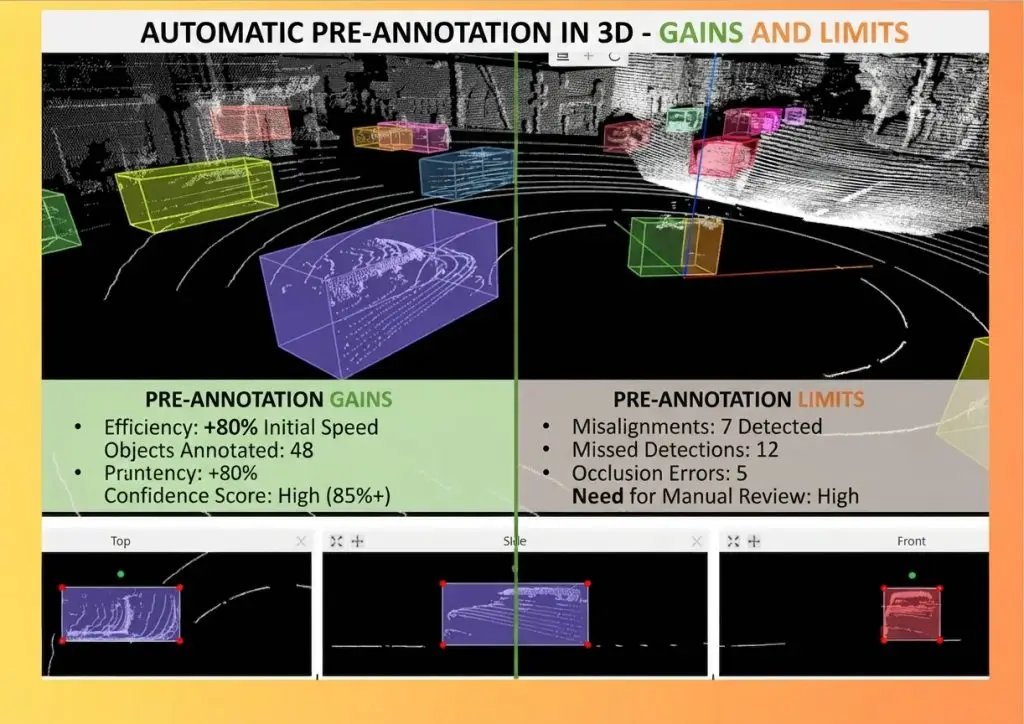
Automatic pre-annotation has become a key differentiating criterion among image annotation tools. The best platforms allow pre-trained detection or segmentation models to generate initial annotations that human annotators validate and correct. This human-AI workflow can reduce production time per image by 30 to 70 percent depending on model maturity and scene complexity. Verify whether the tool offers native integration (as CVAT does with Nuclio) or an open API to connect your own models.
Export Format Coverage
Interoperability with your ML pipeline is non-negotiable. Confirm that the tool natively exports in the formats your framework expects: COCO for PyTorch-based detection architectures, YOLO in its various versions, Pascal VOC for legacy tools, TFRecord for TensorFlow. The breadth of available export formats is a reliable indicator of the platform’s technical maturity and attention to real-world pipeline integration.
Quality Control Features
A good image annotation tool goes well beyond the drawing interface. It must enable clearly defined roles (annotator, reviewer, validator), multi-pass review workflows, inter-annotator agreement metrics and detection of annotators whose output deviates from established standards. Honeypot images, where previously annotated reference images are inserted into production batches to assess each annotator’s accuracy without their knowledge, are particularly valuable for high-volume projects. Rigorous annotation guidelines are the prerequisite for making quality control effective. For a detailed methodology, see our article on
writing effective image annotation guidelines.
Scalability and Workflow Management
In production, an image annotation tool must handle dozens of simultaneous annotators, distribute work batches efficiently, track progress by project and task, and support multi-level review processes. Evaluate workflow management capabilities from the start, even if you are beginning with a small team. Migrating tools at scale typically takes several weeks of reconfiguration and retraining, a cost that usually exceeds any initial savings that prompted the switch.
Integration with the ML Ecosystem
An image annotation tool that cannot integrate cleanly with your existing ML infrastructure creates friction at every iteration cycle. Beyond export formats, evaluate the depth of available SDK support (Python being the lingua franca of ML engineering), the quality of documentation and versioning of the API, and whether the platform supports webhooks or other event-driven mechanisms to trigger downstream steps automatically when a batch of annotations is completed and validated. Teams that have invested in MLOps platforms like MLflow, Weights and Biases, or custom data versioning systems should verify compatibility before committing to a tool.
Longevity and Support
For open source solutions, community health is the best longevity indicator: active GitHub issues, regular release cadence, diverse contributors and up-to-date documentation. For commercial solutions, examine the SLAs offered, technical support availability, roadmap transparency and the publisher’s financial stability. An abandoned or acquired tool forces an unplanned migration at the worst possible time. Several annotation platforms that were popular in the early 2020s have since been discontinued, acquired and pivoted, or reduced to maintenance mode, leaving their users to absorb migration costs that could have been avoided with more careful due diligence at the outset.
Evaluate on Real Data
No general benchmark replaces a test on your actual data. Before committing to any platform, run each shortlisted tool on a representative batch of your images, using your actual annotation types, under realistic production conditions with multiple simultaneous annotators, review passes, and downstream ML pipeline integration. The time invested in this pilot is returned many times over in the certainty that the selected tool matches your real constraints rather than a vendor’s marketing narrative.Choosing the right image annotation tool is a necessary condition for a successful computer vision project, but not a sufficient one. Team organization, annotator training and annotation guideline quality remain equally decisive factors in the final quality of the data produced. A technically excellent platform paired with poorly written guidelines or inconsistently trained annotators will still yield datasets that underperform at training time. Conversely, a rigorous quality process built on top of even a simple tool can produce highly reliable annotations. The tool choice sets the ceiling; the human process determines how close you get to it.To discuss which image annotation setup best matches your data types and project constraints,
reach out to the Infoscribe AI team.