
Wide-spaced row crops are the most favourable ground for weed detection. The sowing geometry supplies information the plants’ appearance does not, and that information changes the nature of the problem.This article sets out what the row brings, what it does not resolve and how it structures an annotation chain. It extends the article on annotating problem species.
What the row brings
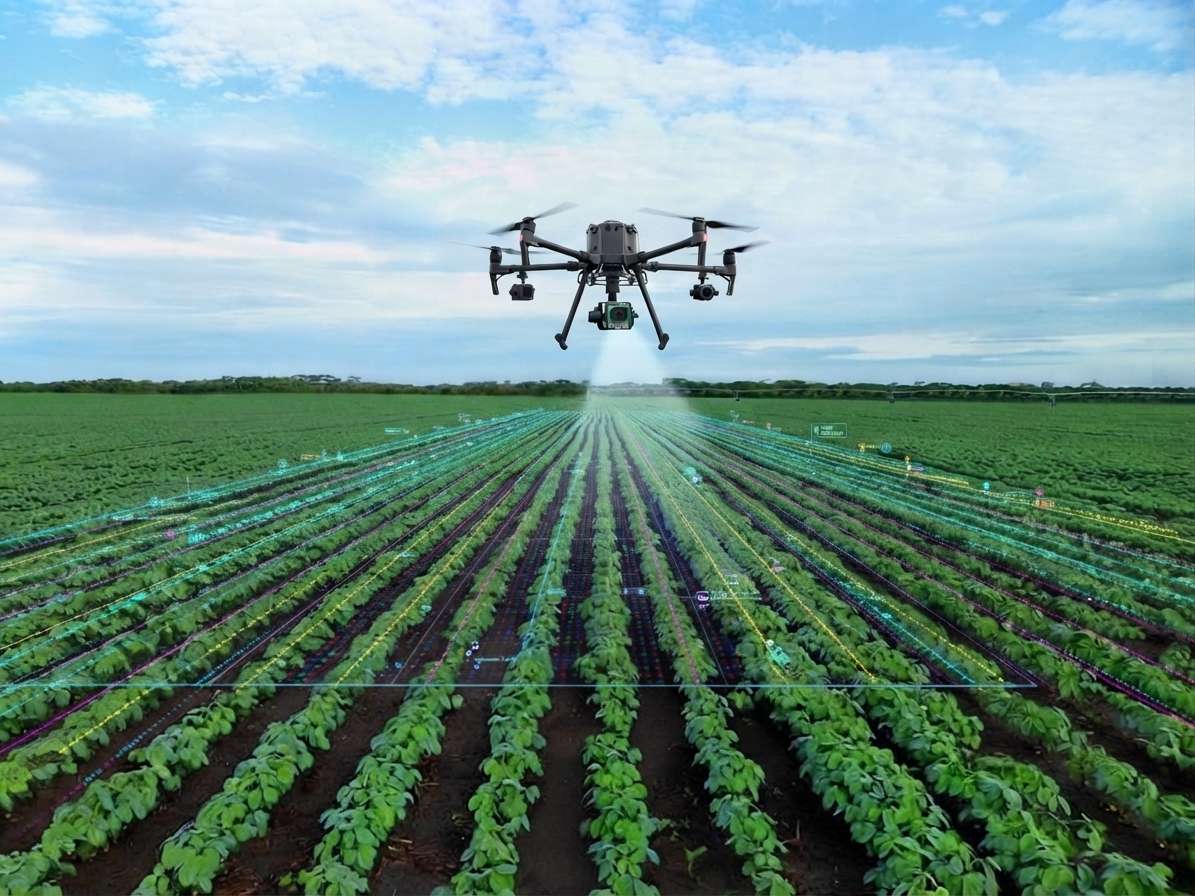
A geometric regularity distinguishes these crops in weed detection.No other context offers its equivalent.Line sowing places crop plants at regular intervals along a straight trajectory, which a weed’s spontaneous emergence does not reproduce.Four distinct exploitations follow.Separating space into a row zone and an inter-row zone, all vegetation in the second being undesirable by construction.Reinforcing the decision on the row, a plant aligned and spaced according to the sowing having a high probability of belonging to the crop.Detecting gaps, an abnormal interval between two plants signalling incomplete emergence, agronomic information distinct from weeding.And geometric correction of the trajectory, the sowing line serving as a reference to register a machine’s successive passes.One important practical consequence follows. The first exploitation permits treating a substantial share of the area with no botanical recognition at all, which shifts the annotation need onto the row zone alone and appreciably reduces the cost of a weed detection project.The three reference crops
Maize, beet and soya concentrate most weed detection projects.Their difficulties differ markedly.Maize presents a tall, vertical crop plant morphologically distant from most broadleaf weeds, which makes it the most favourable case. Its own difficulty comes from grass weeds, which share its architecture.Beet presents a plant with wide spreading leaves, morphologically closer to several broadleaf weeds, which makes the distinction more delicate at the young stage. Its intervention window is narrow.And soya presents a canopy that closes rapidly, which strongly bounds the period during which the inter-row stays observable and imposes early acquisition.One observation runs across those three crops. The difficulty follows not from the cultivated species in itself but from the combination of its morphology, the associated weed flora and the speed of canopy closure, which precludes transposing a corpus from one crop to another even at identical sowing geometry.Detecting the row itself
This preliminary operation conditions everything else.It constitutes a problem in its own right.Exploiting the sowing geometry presupposes first locating the crop lines in the image, which is not trivial.Four difficulties complicate it in practice.Gaps create interruptions that disturb line detection.Contour farming produces non-straight rows, an assumption many simple methods make implicitly.Dense infestations mask the line beneath the weed vegetation, precisely in the zones where the information would be most useful.And headlands present turning configurations where rows converge or break off.One practical consequence follows. Those four difficulties concentrate in the most infested and most irregular zones, which means row information degrades exactly where it would be most valuable, a property projects often discover after building their approach on it.What the row does not resolve
Four limits deserve stating.This information is sometimes presented as sufficient for complete weed detection.Weeds on the row escape this logic entirely, and they are the most damaging since they compete directly with the crop.Canopy closure progressively removes the observable inter-row, which bounds the window of exploitation.Volunteers from the previous crop are aligned or not by chance, and one falling on the row will be classified as crop.And the information disappears in broadcast-sown crops or direct drilling under cover, configurations whose share is growing.That first limit is the most consequential. It means the geometric approach handles the volume and leaves the issue intact, recognition on the row remaining necessary and requiring the finest annotation.What annotation requires in this context
Five requirements characterise weed detection in a row crop.The position convention must be written, a plant straddling the row and inter-row boundary having to receive a determined attribution.The width of the row zone must be defined, it belongs to a decision and not to an observation.The handling of gaps must be stated, a zone without crop on the row potentially being annotated as such or ignored.Crop plants must sometimes be annotated themselves, an additional requirement relative to annotating weeds alone and one that doubles the object volume.And headlands require a rule, these zones presenting configurations the rest of the field does not contain.One important observation follows for a weed detection project. The fourth requirement weighs most on the budget, a row crop image often containing more crop plants than weeds, and the decision to annotate them is taken at scoping according to the strategy adopted.Annotating the crop rather than the weed
This strategy finds its most natural application here in weed detection.It strongly reduces cost and deserves developing.It consists of recognising the crop and treating everything else as undesirable.Three reasons reinforce it particularly in this context.The target class is highly homogeneous, a sowing producing plants of the same variety, the same stage and the same spacing.The geometry supplies an independent verification, a crop plant detected out of alignment probably signalling an error.And the class count reduces to two, which removes most of the nomenclature difficulties the preceding articles set out.One practical consequence follows. This strategy produces a corpus faster to build, more consistent between annotators and more robust to the appearance of an unknown weed, and it stays underused in favour of species approaches the use did not require.The question of stage and window
This temporal constraint bounds exploitation.It is specific to these crops.The useful window opens when the crop has emerged and is identifiable, and closes when the canopy masks the inter-row.Three consequences follow.The corpus must cover that window and no further, annotating images outside it producing data the system will never use.The window’s duration varies strongly with the crop and the year, which makes acquisition planning delicate.And the acquisition campaign is confined to a few weeks a year, which considerably lengthens a project’s calendar and sometimes imposes waiting a whole season to complete a corpus.That third consequence is regularly underestimated at scoping. A project launched after the window waits a year for its images, a calendar constraint no technical means lifts and which must appear in a schedule from the first meeting.Acquisition conditions
Three configurations dominate weed detection in a row crop.They impose distinct constraints.The camera mounted on the implement observes the row at close range and at high rate, which gives the best resolution and produces motion blur as forward speed increases.The low-altitude drone covers the field quickly and loses the resolution needed at early stages.And the hand-held camera at chest height serves the building of reference corpora rather than operation, its quality being superior and its throughput incompatible with operational use.One important observation follows. The third configuration produces the best images for establishing a reference and the least representative of real conditions, which makes it a good annotator training tool and a poor training corpus.Reasoning by expected density
A complementary approach deserves setting out because it bypasses botanical recognition.A sowing produces a known number of plants per unit length of row, information the grower holds.Three exploitations follow in weed detection.Departure from the expected count signals an infestation on the row with no plant being individually identified, which permits a treatment decision at section level.Spacing regularity distinguishes a sown population from a spontaneous one, the first presenting a distribution the second does not reproduce.And comparison between neighbouring sections locates abnormal zones with no absolute reference, a section twice as populated as its neighbours signalling an infestation whatever the sowing rate.One practical consequence follows. This approach works precisely where morphology fails, on grass weeds in particular, and it requires a counting corpus rather than a recognition corpus, which considerably reduces its annotation cost.Evaluating a system in a row crop
Four principles govern that evaluation.They take the sowing geometry into account.Performance must be measured separately on the row and on the inter-row, the second being markedly easier and pulling the global indicator up.Errors on crop plants must be counted apart, their cost bearing no relation to that of a missed weed.Evaluation must cover the whole window, a system excellent at the mid stage and failing at the opening not being usable in practice.And headlands must feature in the evaluation set, these zones concentrating atypical configurations and representing a non-negligible share of the area treated.One practical consequence follows. The first principle is the one most often omitted, and its omission produces a flattering indicator that masks exactly the performance that matters, which restates the finding every preceding series established on global metrics.What geometry brings to quality control
Four automatic verifications become possible in a row crop and they have no equivalent elsewhere.Detecting crop plants out of alignment, which signals a classification error more probably than a stray plant.Counting per row section, a large gap with neighbouring sections signalling an atypical batch or an annotation drift.Continuity of the detected line between successive images, an interruption revealing a badly handled image.And consistency of the annotated row width, a value varying between annotators betraying a badly applied convention.One observation follows for a weed detection project. Those four checks are programmed once and run across a whole batch without intervention, which makes them the best ratio between setup cost and defects detected, and they exploit structural information contexts without rows do not supply.Narrow-spaced row crops
An intermediate category deserves flagging because it occupies an ambiguous position.Some crops are sown in lines with reduced spacing, oilseed rape and cereals notably, which produces a visible geometry with no exploitable inter-row.Three consequences follow.The line stays detectable, which permits consistency checking and counting per section.The inter-row no longer constitutes a zone treatable as a block, its width being below the precision of a treatment implement.And canopy closure occurs very early, which further reduces the useful window.One practical consequence follows for a weed detection project. These crops benefit from only part of the geometric advantage, they often compound the morphological difficulty of grasses, and they constitute the context where the gap between a demonstration’s promise and the field result is greatest.The comparative cost against other contexts
Four factors make a row crop project cheaper than its equivalent in a dense crop.The share treatable with no recognition, the inter-row representing a substantial fraction of the area depending on spacing.The homogeneity of the crop class, which reduces the volume of examples needed to cover it.The possibility of a binary nomenclature, which removes the difficulties of distinguishing between species.And the geometric verification available, which permits an automatic consistency check with no external reference.Two factors work the other way.The possible annotation of crop plants, which can double the object volume per image.And the window constraint, which limits acquisition to a few weeks a year and lengthens the calendar.One observation follows for a weed detection project. The balance stays clearly favourable, which explains why the first industrial deployments of this technology concerned these crops and not small-grain cereals, despite a smaller area involved.The transition towards cover cropping
A shift in cultural practice modifies this context and it deserves following.Direct drilling, permanent covers and intercropping are advancing, driven by soil conservation objectives.Three consequences follow for weed detection.The inter-row ceases to be a zone with no legitimate vegetation, the cover being deliberately present there, which invalidates this context’s most economical rule.The plant to protect class becomes central rather than marginal, since it occupies most of the surface between rows.And the distinction no longer concerns crop against non-crop but three categories, crop, desired cover and weed, which moves the problem towards full botanical recognition.One practical consequence follows. A corpus built under conventional sowing does not transpose to these systems, and a provider having invested in row logic should anticipate that the share of fields where it applies is falling rather than rising.The first batch to annotate
Four criteria compose a representative first batch in a row crop.Several stages of the target window, the opening and the closing posing difficulties different from the mid stage.Clean zones and heavily infested ones, the latter concentrating the row detection difficulties.Headlands, whose configurations appear nowhere else in the field.And several lighting conditions, a batch acquired in a single outing telling nothing about the real variability.One observation follows. That batch represents a modest fraction of the final corpus and it determines most of the conventions, which justifies devoting to it a care out of proportion to its size.Approaching a row crop project
Five questions scope this type of project and they are asked in one meeting.Which crop and what spacing. That answer determines the exploitable inter-row share and the morphological difficulty.Does treatment concern the inter-row alone or the row as well. An answer limited to the inter-row considerably simplifies the project.Must crop plants be annotated. That answer can double the object volume and is decided by the strategy adopted.What intervention window is targeted. That answer bounds the corpus and constrains the acquisition calendar.And are the fields on contour lines. That configuration invalidates the simplest row detection methods and must be known before choosing an approach.Those five answers determine the strategy, the volume, the budget and the calendar. Asking them before acquiring images avoids the situation where a corpus proves unusable because it covers a window the use does not concern.What this use case teaches
One cross-cutting observation deserves closing this examination because it contrasts with the other contexts in this cluster.The row crop illustrates a general principle: where structural information independent of appearance exists, it is worth more than a refinement of the visual model.Three findings compose it.The sowing geometry handles most of the volume with no botanical recognition, a result no architectural improvement would have produced.That information is free, it follows from the cultural practice and requires no additional acquisition.And it degrades exactly where the problem is hardest, on the row and in dense zones, which leaves the hard core intact.That last finding matches the one the series on satellite image segmentation and aerial LiDAR established about assistance tools: they accelerate the easy work and leave the hard work intact, which makes their contribution real and their effect on total cost more modest than announced.Why the demonstration always looks good
One pattern deserves naming because it shapes buyer expectations across this whole market.Row crop weed detection demonstrates extremely well. A video of a machine spraying individual weeds between maize rows is legible, convincing and technically honest.Three properties of the demonstration setting explain the gap with routine field performance.The demonstration is filmed at the favourable stage, where the crop is unmistakable and the inter-row is fully open, which is a fraction of the season.It is filmed on a clean field, where infestation is light enough that individual plants separate, which is the configuration where detection is easiest and treatment least needed.And it is filmed in good light on straight rows, which removes two of the four difficulties row detection actually faces.One practical consequence follows for anyone evaluating a weed detection system. The useful question is not what the demonstration shows but what the system does at the window’s edges, in a heavily infested patch, and on a headland. Asking to see those three is neither hostile nor unusual, and a supplier who has them ready is signalling something a supplier who does not cannot.Common mistakes
These failures recur often enough that naming them is usually enough to avoid them.- Assuming straight rows in fields on contour lines.
- Building the approach on row detection without checking its behaviour in dense zones.
- Neglecting weeds on the row in favour of the inter-row alone.
- Annotating images outside the target intervention window.
- Omitting the convention for a plant straddling the row boundary.
- Not defining the width of the row zone.
- Deciding to annotate crop plants without costing the additional volume.
- Excluding headlands from the corpus and the evaluation set.
- Measuring global performance without separating row and inter-row.
- Building a corpus from hand-held chest-height images.
- Launching a project after the window closes without allowing for a season’s wait.