
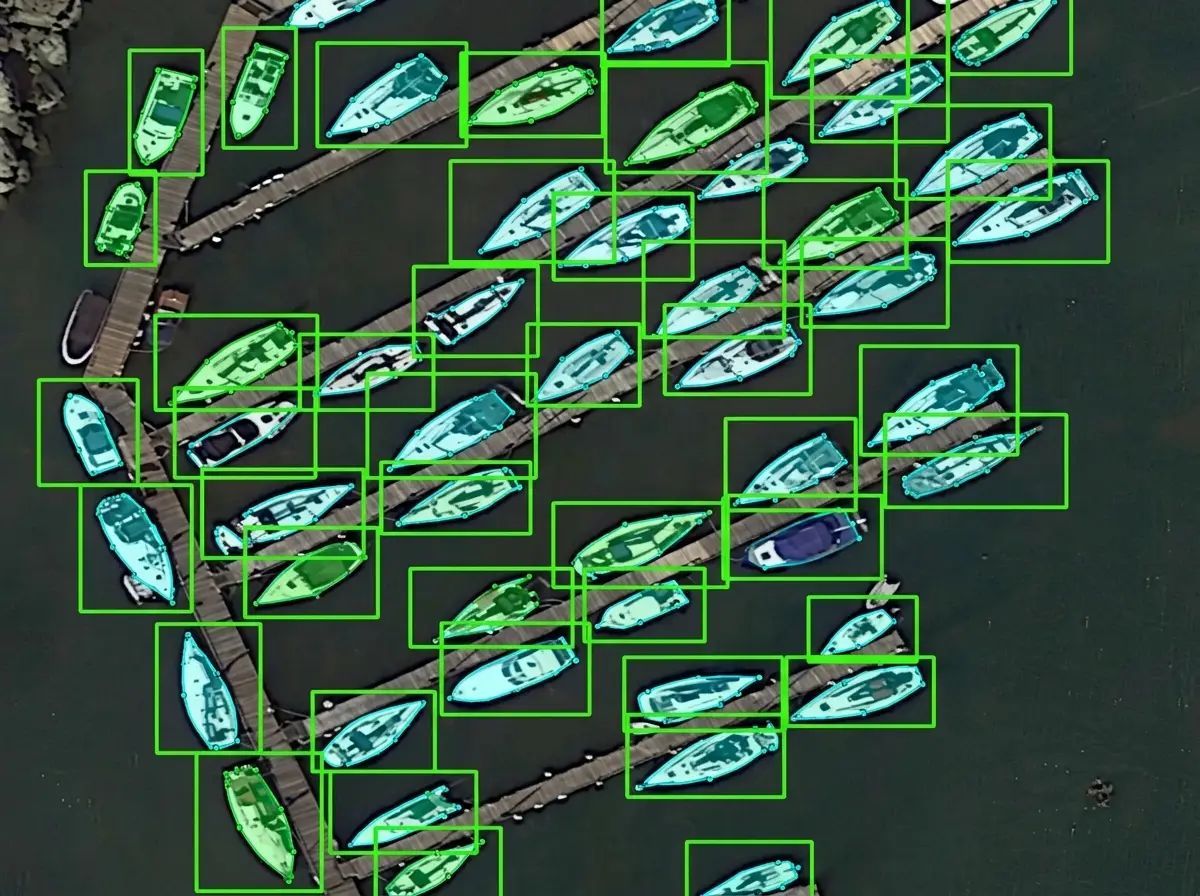
A scene holding three hundred objects a few pixels across is not handled like a scene holding ten. The difficulty comes not from the hand movement, which stays identical, but from the fact that nothing signals what the operator has missed.
This article sets out those conditions. It extends the article on occlusion and truncation.
What smallness changes
Five effects accompany an object of a few pixels in bounding box work. The object’s presence is guessed far more than it is observed. A gap of two pixels represents a large share of the drawing. The class becomes uncertain for want of any visible detail. The zoom required sharply reduces the field covered. And visual fatigue then sets in far faster. One important practical consequence follows. The second effect distorts every agreement measurement, two correct boxes diverging strongly in proportion, which produces poor rates without any operator having made a mistake.What density changes
Five effects accompany a heavily populated scene in bounding box work. Time per image is then counted in tens of minutes. The objects mask each other in a permanent way. Losing one’s place becomes very likely during the sweep. Overall visual control becomes quite simply impracticable. And the omission of an object is quite simply no longer noticed. One important observation follows for a bounding box project. The last effect defines the difficulty proper to these scenes, an image holding two hundred and ninety-seven boxes instead of three hundred looking perfectly complete, which makes omission undetectable by plain examination.What the size threshold decides
Five consequences follow the choice of this threshold in bounding box work. The number of objects that must be annotated per image. The total time that will have to be devoted to the corpus. The presence or else the absence of the most distant objects. The system’s capacity to detect small objects afterwards. And comparability with another corpus from the same field. One practical consequence follows. The threshold is fixed from the use rather than from convenience, an object too small to be annotated staying too small to be detected, which makes it coherent to exclude what the system will not manage to recognise in any case.What splitting the image permits
Four benefits follow from handling by successive portions. The zoom stays constant rather than variable. The sweep becomes at last systematic rather than free. Progress is then followed portion by portion. And fatigue is spread across shorter sequences. One observation follows. Those four benefits are paid for at the edges, an object straddling two portions appearing twice or disappearing between the two, which calls for a joining rule as precise as a tiling one.What the sweep method brings
Five method instructions act directly on omission. An entirely systematic sweep rather than a free path. A rigorously constant reading direction from one image to the next. A marking of the portions already examined. A zoom level fixed once and for all rather than variable. And a full restart of the sweep after any interruption. One important observation follows for a bounding box project. The third instruction acts on the cause rather than on the symptom, an operator unable to know what they have already covered returning to some zones and forgetting others, which produces an omission of purely organisational origin.What the control must become here
Five bounding box arrangements suit these scenes. A double annotation bearing on a fraction of the images. An automatic count then compared between operators. A rereading conducted portion by portion rather than globally. A cross-check against an external source where one exists. And a tracking of the pace observed through the session. One important practical consequence follows for a bounding box project. The second arrangement is the only one revealing omissions at low cost, a count gap between two operators immediately flagging an image to rework, which avoids fully rereading scenes nothing distinguishes.What the measurement must break down here
Four indicators are read separately by size. The omission rate, always far higher on the smallest objects. The overlap between two annotations, mechanically lower here. The correctness of the class assigned from few pixels. And the movement of those three values through one same session. One important practical consequence follows. The last indicator is produced effortlessly and rarely asked for, a comparison between a session’s first and last images at once revealing whether the organisation of the work takes fatigue into account.What pre-annotation changes here
Four effects follow from using an automatic proposal. The drawing volume falls very sharply on well contrasted objects. The proposed count supplies an immediate point of comparison. Objects the tool omitted almost always stay omitted. And the operator slides from exhaustive sweeping towards mere checking. One important observation follows for a bounding box project. The second effect partly offsets the third, a gap between the proposed count and the final count directing attention towards the doubtful images, which restores a signal where the scene supplied none.What throughput becomes here
Four factors determine the time spent per dense image. The number of objects to draw, which dominates all the others by far. The zoom required by the objects’ reduced size. The number of portions that must be covered in succession. And the restart made necessary after an interruption of the sweep. One important observation follows for a bounding box project. The last factor costs more than one imagines, an operator interrupted midway through a dense scene having to resume their sweep without knowing exactly where they had reached, which makes interruptions more costly here than on any other kind of image.What the corpus must cover here
Five situations deserve an explicit place in the corpus. Scenes of rising density running up to the maximum expected. Objects spread across the whole range of sizes adopted. Objects close to the threshold, where the rule is genuinely tested. Zones where several objects touch without overlapping. And entirely empty scenes, serving as a counter-example. One important practical consequence follows for a bounding box project. The last situation is almost always neglected, a corpus made solely of populated scenes producing a system inclined to find objects everywhere, which is corrected by deliberately including images holding none.Three errors proper to these scenes
Three bounding box defects belong to density and to smallness. A control founded on the sole visual examination of a whole image. A purely global agreement measurement, with no breakdown by size. And a rate purely aligned on that of an ordinary scene. Those three defects produce deliverables that look compliant, they reveal themselves only by counting rather than by looking, and their common point is to treat these scenes like the others when nothing here works the same way.What the annotator must know here
Five kinds of knowledge condition correct work on these scenes. The size threshold, expressed in a directly verifiable way on screen. The sweep method adopted for covering each image. The conduct to adopt before objects that touch without overlapping. The moment to take a break rather than to carry on. And the value there is in flagging an abnormally populated scene. One important observation follows for a bounding box project. The fourth kind serves quality as much as the operator, a break taken before the drop in pace costing a few minutes whereas a prolonged session produces omissions no control will entirely recover.What the delivery format requires here
Four choices condition the use of a dense corpus. The size threshold effectively applied, stated with the corpus. The object count per image, supplied as a data item in its own right. The joining rule used when the images have been split. And the marking of images having been checked by a second operator. One important practical consequence follows for a bounding box project. The second choice turns the deliverable into a verifiable object, a supplied count letting whoever takes up the corpus spot abnormally sparse images, which gives the client a means of control no visual inspection would replace.What the client must specify here
Four pieces of information come from the client rather than from the provider. The minimum size of the objects that genuinely interest them. The maximum density they expect within their own scenes. The relative importance they attach to omission and to false positives. And the possible existence of a reference count on some images. One important observation follows for a bounding box project. The last piece is worth a great deal and is rarely asked for, a count known independently on a few dozen images supplying an external reference against which to measure the work, which replaces agreement between operators with an independent truth.What the first batch must establish
Four results justify a trial batch before production. The average as well as maximum number of objects met per image. The count gap observed between two operators on the same images. The real time spent on a scene judged representative. And the movement in pace observed between a session’s start and end. One important observation follows for a bounding box project. The second result gives the approximate omission rate at once, two operators counting two hundred and eighty and three hundred objects respectively on the same image indicating a gap the whole production will reproduce, which permits sizing the control before having to endure it.What these scenes change about the project’s economics
Four effects distinguish the budget of a high density project. The cost is then calculated per object rather than per image. Control here represents an unusually high share of the total. Shorter sessions reduce the apparent hourly output. And the variability of density makes the initial estimate very fragile. One important practical consequence follows for a bounding box project. The last effect justifies an explicit clause, a corpus whose average density doubles mid-project doubling the cost without any rule having changed, which makes a per-object rate more honest for both parties than a per-image one.What the working tool changes here
Five functions make this work practicable. An automatic split of the image into perfectly regular portions. A visible marking of the portions already handled. An object counter kept visible at all times on screen. A zoom level remembered from one image to the next. And an automatic flagging of objects drawn twice. One important observation follows for a bounding box project. The third tool transforms the operator’s relation to their work, a visible counter making perceptible a progress the scene does not show, which replaces an impression of advancement with information and reduces the temptation to conclude too early.What this subject has that is particular
Four traits distinguish these scenes from the course’s others. The dominant defect leaves absolutely no trace in the deliverable. Fatigue weighs far more here than competence does. The usual control by rereading loses practically all effectiveness. And counting becomes markedly more informative than looking. One important practical consequence follows for a bounding box project. Those four traits combine into a unique difficulty, correct work and lacunary work having exactly the same appearance, which makes the measurement arrangement the only observable difference between the two.What the provider brings here
Four contributions distinguish a serious engagement on these scenes. A count-based control planned into the arrangement rather than added afterwards. A systematic sweep instruction given to all the operators. Sessions strictly limited in length on this kind of work. And quality measurements broken down by size in the report handed over. One important practical consequence follows. The first contribution shows on the quotation and is justified in one sentence, a count-based control costing a fraction of a full rereading while revealing what no rereading shows, which makes it the best ratio between expenditure and information on this kind of scene.Approaching a high density project
Five questions scope such a bounding box project. What size threshold applies. It decides the volume. Will the image be split. The edges demand a rule. Is the count compared. It is the only affordable control. Is the measurement broken down by size. Otherwise it misleads. And are sessions limited. Fatigue arrives quickly. Those five answers determine the corpus’s reliability. Asking them before production avoids work whose gaps will stay invisible.The question that frames the project
One question determines the arrangement to put in place in bounding box work. Will the result be judged on the count or on the localisation. The count, an inventory or a crowd estimate, makes every omission directly visible in the final figure and requires an exhaustive control. Localisation, a detection or an alert trigger, tolerates a few gaps provided the objects found are correctly placed. That question belongs to the use of the result and not to the difficulty of the scene, it is asked before the first image, and it separates two control arrangements whose costs are nothing alike.Three decisions before producing
Three decisions commit a high density bounding box project. Fixing the size threshold from the use rather than from convenience alone. Putting in place a control by counting rather than by plain rereading. And explicitly limiting the length of sessions on this kind of scene. Those three decisions cost one meeting, they precede the first image, and their absence produces a corpus whose gaps will never be seen.Three checks on a dense corpus
Three checks qualify a set of bounding boxes in dense scenes. The size threshold, written and then expressed in pixels rather than as an impression. The effective existence of a count-based control between two operators. And the breakdown of every quality measurement by object size. Those three checks are each asked in one question, they require no particular tool, and their absence indicates a corpus whose omission rate nobody knows.Three questions before quoting
Three questions precede any estimate on these scenes. How many objects does an image judged representative hold on average. What is the maximum density met across the whole corpus. And will the rate finally bear on the image or else on the object. Those three questions are asked before the quotation, they require only a random sample, and their absence produces a costing reality will contradict within the first weeks.What this chapter teaches
One cross-cutting observation deserves closing this examination. On these scenes, nothing signals what the operator has missed. Three findings compose it. An image holding two hundred and ninety-seven boxes instead of three hundred looks complete. Two correct boxes on a small object diverge strongly in proportion. And an object too small to be annotated stays too small to be detected. That finding extends the preceding chapter, the invisible bearing here on absence rather than on extent.What this chapter shares with the previous ones
Three findings recur from the start of this course. A global measurement masks a failure on one particular population. The dominant defect stays invisible in the deliverable itself. And the organisation of the work weighs as much as the annotation rule. One important practical consequence follows for a bounding box project. The third finding takes its clearest form here, a sweep instruction and a session limit acting more on the omission rate than any precision added to the reference, which shifts quality from the wording of the instruction towards the conduct of the work.What this chapter leaves to the next
All those boxes end up in a file whose format matters. Three questions stay open in bounding box work. What each common format describes and what it ignores. Why a conversion sometimes produces an invisible offset. And how to choose without tying oneself to one particular tool. Those three questions belong to file formats, which constitute the subject of the following chapter.Why the count belongs in the deliverable, not just the process
One point about what gets handed over belongs at the close of this chapter. Providers usually treat the object count as an internal quality figure. Three reasons follow in bounding box work. It was produced for the provider’s own control, not for the client. Publishing it invites scrutiny of images that look sparse. And no client has ever asked for it in a specification. One important practical consequence follows for a bounding box provider. Handing the count over anyway is what distinguishes a corpus a client can verify from one they must simply trust, and a provider confident in their sweep loses nothing by supplying the one number that would expose a weak one.Common mistakes
These failures recur often enough that naming them is usually enough to avoid them.- Controlling these scenes by an overall visual examination.
- Measuring agreement without breaking it down by object size.
- Fixing the size threshold from annotation convenience.
- Splitting the image without defining the joining rule.
- Assigning dense scenes across sessions that run too long.
- Neglecting counting as a control arrangement.
- Comparing two corpora whose size thresholds differ.
- Handling a dense scene at the rate of an ordinary one.
- Assuming a visually complete image genuinely is one.
- Ignoring the effect of fatigue on the last portions.