
The preceding articles concerned the question of where an object is. This one concerns a different question: when an action begins. The deliverable is no longer a position but an interval, and that shift changes the conventions, the metrics and the difficulties.
This article sets out what temporal segmentation demands. It extends the article on surveillance and smart city.
What the task covers
Four formulations coexist in temporal video annotation. Their confusion produces incompatible corpora. Sequence classification, which assigns a single label to a whole clip without locating the action in time. Temporal detection, which locates the start and end of each occurrence in a continuous stream. Dense segmentation, which assigns a label to every instant, the whole duration being covered with no empty interval. And instant detection, which reduces an event to a point rather than to an interval. One important practical consequence follows. Those four formulations demand work whose cost varies by a substantial ratio, and the gap between a sequence classification and a dense segmentation exceeds that between two nomenclatures of different sizes in video annotation.The central difficulty
This property distinguishes the task from all the preceding ones. An action has no sharp temporal boundary, unlike an object which has a spatial outline. Three manifestations follow. The start of a gesture can be placed at the preparation, at the movement itself or at its effect. The transition between two actions happens by overlap rather than by break, one movement ending while the next begins. And intent precedes observable action, which leaves an interval where something is being prepared without yet being done. One important observation follows. That imprecision is intrinsic and not correctable by a more attentive annotator, which requires measuring disagreement on the boundaries rather than attributing it to a lapse in rigour.Defining a temporal boundary
Five elements compose an action’s definition in video annotation. The second is the one that gets forgotten. The action’s name, expressed unambiguously and distinct from its neighbours. The start criterion, framed as an observation rather than as an intent. The end criterion, distinct from the start and rarely symmetrical. The handling of interruptions, an action resumed after a pause constituting one occurrence or two. And the tolerance permitted on the boundaries, a figure bounding acceptable disagreement. One practical consequence follows for a video annotation project. The last element turns disagreement into declared tolerance, which permits measuring conformity rather than observing divergence, and it costs one line in a convention.Three convention rules
Three formulations resolve most disagreements and they fit in three lines. Express each start criterion by what becomes visible, and not by what begins to be prepared. Treat a resumption after a short interruption as a single occurrence, by fixing the interruption duration that justifies counting two. And assign to the residual class anything satisfying no criterion, rather than attaching it to the nearest. Those three rules do not remove the imprecision and they make it uniform, which is enough to make a corpus consistent.What granularity changes
This decision structures everything else. It is taken with the end user. One sequence can be described at several levels of detail. Three levels occur. The activity, which covers several minutes and groups many gestures. The action, which lasts a few seconds and constitutes a functional unit. And the elementary gesture, which lasts a fraction of a second and composes an action. One observation follows. Moving from one level to the next multiplies the number of occurrences to annotate, which makes granularity this task’s principal cost lever, and requires fixing it by what the downstream decision demands rather than by what is describable.Building the action vocabulary
This operation determines the ceiling of everything that follows and it is conducted on real sequences. Four principles govern that operation. Start from decisions rather than from movements, two different gestures calling for the same reaction potentially belonging to one class. Verify each class on real examples, a distinction obvious on paper often proving inapplicable on images. Count occurrences per class on a sample, a class met twice in an hour not being learnable. And provide a class for what belongs to no other, failing which annotators arbitrarily attach the edge cases. One practical consequence follows for a video annotation project. The third principle regularly leads to merging classes the client distinguished, an operation that improves the result and presents better before production than after a disappointing performance.Simultaneous actions
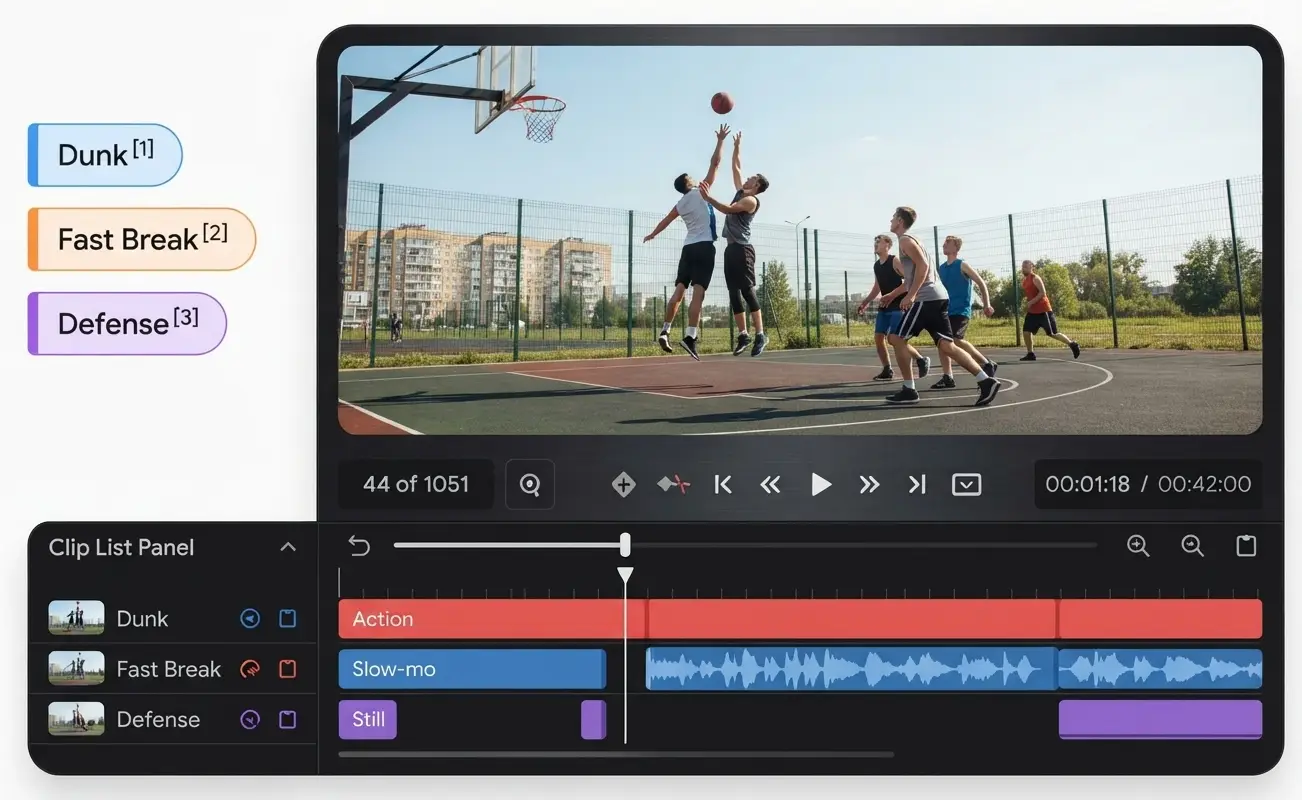
This configuration complicates the nomenclature. It is frequent in video annotation. Several actions can coexist at the same instant. Three distinct cases occur. One actor performing two compatible actions, walking and talking for instance. Several actors performing different actions in the same scene. And a collective action coexisting with the individual actions composing it. One important practical consequence follows. Those three cases preclude a segmentation with a single label per instant, which requires either parallel annotation tracks or a combination nomenclature, a structuring decision to be taken before production.What measurement must report
Four indicators account for a temporal segmentation. They differ from those of detection. Temporal overlap between the predicted interval and the reference interval, the temporal equivalent of spatial overlap. The detection rate at occurrence level, an action found with imprecise boundaries remaining an action found. The boundary error reported separately, distinct from whether or not it was detected. And fragmentation, a single action detected as several occurrences constituting a failure mode of its own. One observation follows for a video annotation project. The third indicator must be compared with the disagreement between annotators on the same boundaries, a comparison that distinguishes a system’s imprecision from one intrinsic to the task.Measuring disagreement on boundaries
One operation quantifies this task’s intrinsic imprecision and it is conducted on a short sample. The principle is to have the same sequence annotated by two trained people and to compare the boundaries placed. Four pieces of information follow. The mean error on starts, which bounds the precision a system can reach. The mean error on ends, generally higher than on starts since an action finishes more gradually than it begins. Agreement on the very existence of the occurrence, an action detected by one and not the other signalling an insufficient definition. And the variation of those errors by class, which identifies the definitions to rework. One important practical consequence follows for a video annotation project. The second result regularly surprises and it justifies adopting an asymmetric tolerance, tighter on starts than on ends, rather than a single value that would be too loose on one side and untenable on the other.How the annotator works
Five functions condition the quality of this video annotation work. They differ from those of tracking. Fine temporal navigation, permitting frame-by-frame movement around a boundary. Track visualisation, showing the intervals already placed on a timeline. Looped playback of a segment, which permits judging a transition by seeing it several times. Variable speed, a rapid scan locating zones of interest before a precise examination. And deferring a decision, the annotator having to be able to mark an uncertain boundary rather than settle at random. One practical consequence follows. The third function is the most decisive and the most often absent, a boundary not being judged on a single viewing but on a comparison across several passes.Quality control on a temporal segmentation
Four checks detect the defects specific to this video annotation task. The distribution of durations per class, an abnormally brief or long occurrence signalling a boundary error. Detection of forbidden overlaps, two exclusive actions overlapping constituting a formal contradiction. Checking uncovered intervals in dense segmentation, a gap signalling an omission rather than an absence of action. And comparing boundaries between annotators on a sample, which measures the real tolerance rather than the hoped-for one. One important observation follows. The first check is the most economical and the most revealing, an action’s duration being strongly constrained by its nature, which makes an aberrant value immediately suspect.What this task costs
Five factors determine the video annotation load. They do not reduce to duration. The granularity adopted, the dominant factor determining the number of occurrences. The density of actions, a continuous sequence costing more than one where nothing happens. The number of classes, whose proximity matters more than their count. The number of parallel tracks, each actor or each dimension multiplying the work. And the precision required on boundaries, a tight tolerance demanding frame-by-frame examination. One practical consequence follows. Those five factors multiply, and the ratio between a sequence classification and a multi-track dense segmentation exceeds what clients anticipate, which makes scoping the granularity decisive.The relation to tracking
These two tasks frequently combine. Their relation deserves stating. An action is performed by an actor, which presupposes knowing which one. Three arrangements exist. Segmentation alone, which describes what happens without saying who acts, sufficient for a single-actor scene. Segmentation attached to a track, which presupposes prior tracking and permits individual analysis. And independent segmentation per actor, which produces one temporal track per person without requiring continuous tracking. One important observation follows for a video annotation project. The second arrangement inherits tracking’s failures, an identity switch reattributing every subsequent action to the wrong actor, which makes tracking quality decisive for a task that seemed independent of it.Assistance and its limits
Two forms of help reduce the load and they do not act on the same difficulty. Automatic shot change detection, which cuts an edited video into units and supplies reliable boundaries where they coincide with the events. Interval proposals from a model, which locates candidates the annotator confirms or corrects. Three observations accompany them. The first form serves only on edited content, a continuous fixed-camera stream having no shot changes. The second accelerates detection and not boundary adjustment, which remains the most expensive line. And validation bias operates here as elsewhere, an annotator accepting an approximate boundary more readily than placing one. One practical consequence follows for a video annotation project. Those three observations lead to a clear division, assistance handling the question of where to look and the human handling that of where exactly to cut.The delivery formats
Four format decisions commit the exploitation and they are taken before production. The time unit, an absolute timestamp and a frame number not converting without knowing the exact rate. The boundary inclusion convention, the last frame of an interval belonging to it or not. The representation of parallel tracks, a per-actor structure and a per-instant structure carrying the same information and not reading the same way. And the treatment of uncovered intervals, an absence of label meaning either that no action occurs or that the period was not handled. One important observation follows. The last decision produces the commonest misunderstanding, a user reading silence as an absence of action where it reflects an unannotated portion, an ambiguity lifted by an explicit declaration of the periods covered.The domains where this task dominates
Five contexts require temporal segmentation rather than object detection. Sports analysis, where game events constitute the expected deliverable. Security, where a fall or a gathering is described by an interval rather than by a position. Industrial gesture, where an operation’s conformity is measured on its sequence and its duration. Medicine, where an examination divides into phases whose order and duration inform on practice. And content indexing, where locating segments serves search and editing. One observation follows for a video annotation provider. The third context is the least explored and the most accessible, a production line offering a stable environment, an action vocabulary bounded by the operating sheet and a conformity need that justifies the spend.What this task does not permit
Four limits bound temporal video annotation. Intent is not observable, which makes a class founded on it methodologically fragile. Exact boundaries do not exist, which bounds the achievable precision independently of any effort. A hidden action is not annotatable, occlusion having the same effect here as in detection. And missing context sometimes prevents deciding, one gestural sequence receiving two interpretations according to what precedes it. That second limit deserves emphasis. It means a contractual requirement on boundary precision must be compared with expert disagreement before being accepted, failing which it commits to a result the task does not permit.The first batch to handle
Four criteria compose a representative pilot batch in temporal segmentation. One sequence containing the most frequent actions, which verifies that the vocabulary holds on ordinary cases. One rapid transition between two actions, a configuration testing the start and end criteria more reliably than ten minutes of continuous sequence. One action interrupted and resumed, which tests the convention on multiple occurrences. And one period with no identifiable action, which verifies that the residual class is usable. One observation follows. That batch represents a few minutes, it supplies the real throughput and the boundary disagreement, and it reveals the classes whose definition does not hold, which makes it the only serious basis for a costing in video annotation.Approaching a temporal segmentation project
Five questions scope this type of video annotation project. Which formulation, classification, detection, dense segmentation or instant. That answer changes the cost by a substantial ratio. What granularity. That answer determines the number of occurrences and must come from the downstream decision. Are simultaneous actions possible. A positive answer requires parallel tracks. What tolerance on the boundaries. That answer must be a figure and compared with the measured disagreement. And must the action be attached to an identified actor. That answer adds a dependency on tracking. Those five answers determine the load and the feasibility. Asking them before starting avoids a corpus whose granularity does not match the use.The question that frames the project
One question determines the formulation and it concerns the use rather than the content. What will the user do with the result, find or measure. A search-oriented answer, finding the moments where an action occurs, tolerates imprecision on the boundaries since an operator will adjust while viewing. A measurement-oriented answer, computing a duration or a frequency, depends entirely on boundary precision and imposes the tightest tolerance. That distinction is stated in one sentence and it changes the tolerance required, hence the throughput, hence the cost, which makes it the most profitable question at scoping.What this chapter teaches
One cross-cutting observation deserves closing this examination. Temporal segmentation moves the imprecision from space to time without removing it. Three findings compose it. A temporal boundary is intrinsically fuzzy, as a badly defined object outline was, and disagreement between annotators measures that imprecision rather than a lapse in method. Granularity plays here the role nomenclature plays in detection, an extra level of detail multiplying the work without always serving the decision. And declared tolerance turns disagreement into a specification, which makes measurable what would otherwise remain grounds for dispute. That finding matches the one the preceding series established about spatial boundaries: where the data carries no sharp limit, the convention creates one, and a corpus’s quality lies in the stability of that convention rather than in its correctness.Why this task gets underestimated
One estimation pattern recurs and it deserves naming, since it produces most of the overruns in this area. Temporal segmentation sounds cheaper than object annotation, and it frequently is not. Three reasons explain the gap. The unit of work is invisible in the source material. A video contains a visible number of objects and an unknown number of actions, so the volume cannot be estimated by looking at it. The expensive part is boundary adjustment, not detection, and a client watching an annotator work sees the detection and not the minutes spent settling one edge. And a request phrased as a short list of classes hides the granularity question entirely, five class names being compatible with a corpus of hundreds of occurrences or of tens of thousands. One practical consequence follows for a video annotation provider. Those three reasons make a pilot batch more necessary here than in object annotation, since nothing about the source material reveals the volume, and an estimate made without one is not conservative or optimistic but simply uninformed.Common mistakes
These failures recur often enough that naming them is usually enough to avoid them.- Confusing sequence classification with temporal detection at scoping.
- Fixing granularity by what is describable rather than by the downstream decision.
- Not writing the start criterion in observable terms.
- Omitting the end criterion, rarely symmetrical with the start.
- Not putting a figure on the tolerance permitted for boundaries.
- Assuming a single label per instant where actions coexist.
- Reporting a global performance without isolating the boundary error.
- Attributing disagreement between annotators to a lapse in rigour.
- Neglecting the dependency on tracking where the action is attached to an actor.
- Defining a class founded on intent rather than on the observable.