Foundation models are reshaping the artificial intelligence landscape faster than most practitioners expected. Meta’s Segment Anything Model family, large vision-language models, multimodal architectures trained on billions of images: these tools promise unprecedented visual understanding capabilities, and with them, the prospect of dramatically reducing, or even eliminating, the effort involved in image annotation. For data science teams, technical directors, and AI project managers, this evolution raises a legitimate question: does image annotation as we know it still have a future?
The answer is nuanced, and that is precisely what makes this question strategically important. Yes, foundation models are transforming certain segments of the image annotation pipeline, accelerating pre-annotation, reducing costs on generalist tasks, and opening new possibilities for large-scale production. No, they do not replace high-quality annotated data, nor the human expertise required to produce it in the specialized domains where model performance is critical. Understanding this distinction is what separates organizations that build robust image annotation strategies for the coming years from those that navigate blindly through a rapidly shifting technology landscape.
This article examines the concrete changes brought by SAM, SAM 2, SAM 3, and large vision-language models, identifies the persistent limitations of these tools in real operational contexts, and outlines a durable hybrid image annotation architecture suited to the age of foundation models. Understanding this landscape is increasingly a prerequisite for any organization that wants to build AI systems that actually perform in production, not just in benchmarks.
Foundation Models and Image Annotation: Understanding the Ongoing Shift
A foundation model is a model pre-trained on massive quantities of heterogeneous data, capable of adapting to a wide range of downstream tasks through fine-tuning or prompting, without full retraining. In computer vision, this definition covers architectures with very different implications for image annotation workflows.
The first family is that of universal segmentation models, of which Meta’s SAM family is the best-known representative. These models were designed to segment any object in any image, without having been explicitly trained on the specific class in question. Their impact on image annotation is immediate and direct: they can generate segmentation masks in response to a visual prompt, a click, a bounding box, without the annotator needing to trace each contour manually.
The second family is that of vision-language models (VLMs), which connect visual perception and language understanding. These models can answer questions about an image, generate descriptions, identify visual attributes, and, critically for image annotation, classify or tag images from instructions written in plain language. GPT-4V, LLaVA, PaliGemma, Gemini Vision, and InternVL2 are all representatives of this family, and their capabilities continue to improve with each new generation.
The third family is that of generative models, diffusion models and image generation architectures, whose impact on image annotation is more indirect but growing. These tools can produce synthetic annotated data that complements real datasets insufficient in volume or in diversity of represented situations.
All three families share a fundamental characteristic: they were built on training data of a scale that exceeds anything the field had previously produced. SAM 1 required 1.1 billion segmentation masks generated through a semi-automated pipeline coupled with human validators. CLIP, the OpenAI vision-language model that paved the way for modern VLMs, was trained on 400 million image-text pairs. These figures illustrate a founding paradox: the models that promise to reduce the need for image annotation were themselves built on unprecedented volumes of image annotation. This is not an anecdote, it is the central thread of any serious analysis of the future of the field.
SAM, SAM 2, SAM 3: What Universal Segmentation Brings to Image Annotation
The Segment Anything Model family represents the most immediately relevant evolution for image annotation practitioners, because it acts at the core of the production workflow: segmentation mask generation. Each successive version has extended the boundaries of what is possible, with concrete implications for operational pipelines.
SAM, released in 2023, introduced zero-shot segmentation driven by visual prompts. An annotator clicks a point in an image, or roughly delimits an area with a bounding box, and the model generates a precise segmentation mask with no domain-specific training required. For image annotation teams working on common objects in standard visual contexts, the impact is immediate: mask production time falls from several minutes to a few seconds, with the operator’s role shifting from drawing to reviewing and correcting the proposed output.
SAM 2, released in 2024, extended these capabilities to video through a memory mechanism that propagates masks from frame to frame while handling partial occlusions, lighting changes, and viewpoint variations. For image annotation projects involving video sequences, a growing share of computer vision requirements, particularly in autonomous driving, intelligent surveillance, and sports analytics, the reduction in manual workload is substantial.
SAM 3, presented at ICLR 2026, introduced an additional layer: conceptual understanding. Where SAM 2 segmented visually distinct objects, SAM 3 can interpret high-level instructions and segment regions corresponding to abstract concepts, “areas of dense vegetation,” “damaged surfaces,” “user interface elements in this screenshot.” This evolution is particularly significant for image annotation in contexts where classes are not discrete objects but states, textures, or functional properties.
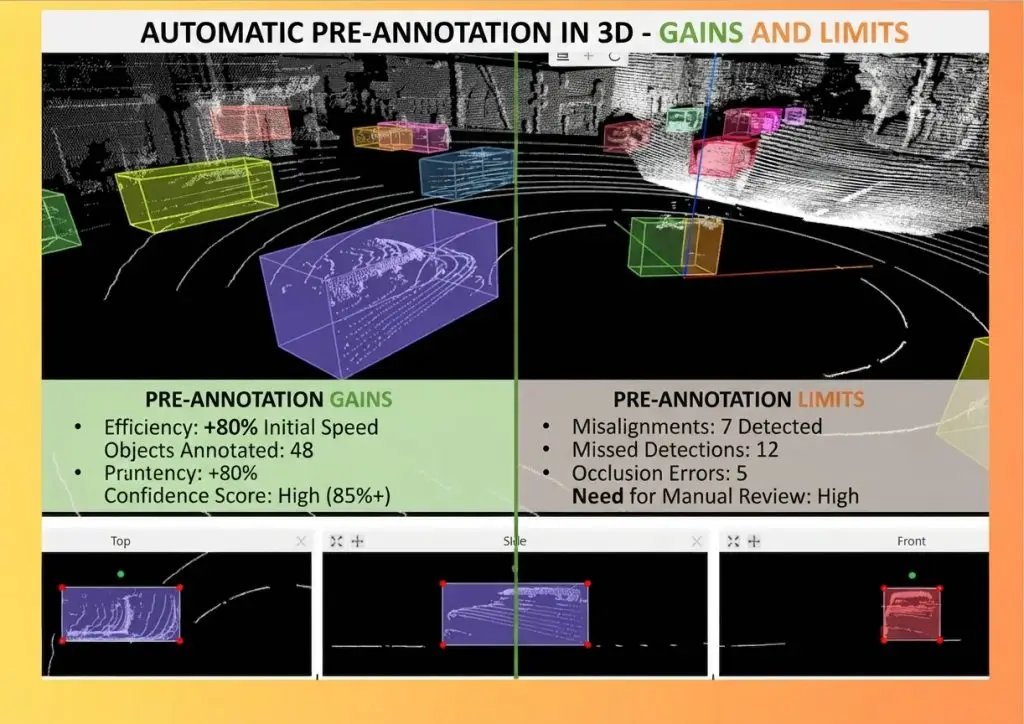
That said, three persistent limitations define the boundaries of automation in image annotation. First, SAM 3’s performance degrades in domains where the concepts to be segmented differ structurally from the general visual distributions in its training data. A cyst in an ultrasound image, a sub-surface inclusion in a die-cast part, a leaf vein in plant phenotyping: these objects require systematic expert review because the model lacks the visual references needed to process them reliably. Second, geometric precision at the boundaries of fine structures, vascular networks, surface cracks, electrical wires, does not yet meet the standards required for high-demand medical or industrial applications. Third, the model has no knowledge of project-specific annotation guidelines: it does not know that a partial occlusion must be annotated to the image edge according to a particular rule, or that a defect below a certain threshold should be ignored per the client’s acceptance criteria. Semi-automatic image annotation remains distinct from automatic image annotation in these real operational contexts.
Vision-Language Models and Image Annotation: Scale Through Natural Language
VLMs open a complementary dimension of AI-assisted image annotation. These multimodal architectures enable annotation through text-based instructions: “classify this image among these five crop categories,” “indicate whether this document contains a handwritten signature,” “identify dangerous objects present in this industrial scene.” For classification, tagging, and attribute detection tasks on images well represented in generalist training data, current VLMs achieve performance levels that rival those of non-specialized human annotators, at a fraction of the production time.
This capability makes possible image annotation pipelines in which VLMs process clear-cut cases in large volumes and at high speed, while humans concentrate on ambiguous cases, quality control sampling reviews, and class-boundary arbitration decisions. For content moderation, document sorting, product classification, or large-scale image categorization projects, this hybrid model significantly changes the economic equation, provided that human quality control over a representative sample remains part of the process design.
However, structural limitations constrain the applicability of VLMs in professional and industrial image annotation contexts. First, VLMs inherit the biases of their training data: they perform less well on atypical visual categories, cultural contexts under-represented in public corpora, or technical domains without publicly available datasets. Second, they struggle with fine-grained and evolving taxonomies, those where a class distinction is defined by a precise business guideline rather than by an intuitive visual description. This is exactly the type of classification that serious industrial image annotation projects require. Third, VLM behavior on edge cases is difficult to anticipate and audit systematically: they can produce a plausible but incorrect answer with the same apparent confidence as a correct one, which complicates the design of reliable quality control protocols.
For image annotation in domains with strong regulatory constraints, CE-marked medical devices, high-risk AI systems under the EU AI Act, aerospace or defense applications, these uncertainties are incompatible with the requirements of a rigorous industrial quality chain. A VLM model cannot sign a contractual quality commitment, nor account for its decisions in a traceable manner within a regulatory technical file.
What Foundation Models Cannot Replace in Image Annotation
The question is not whether foundation models are transforming image annotation, they are, demonstrably and substantially. The question is to map precisely what they cannot do in real operational contexts, so that human resources can be allocated where they generate irreplaceable value.
The first domain resistant to full automation is that of business classes with low visual representation in public data. Specialized concepts, a specific pathological state in medical imaging, a particular defect type in industrial inspection, a plant species at an exact growth stage, an electrical grid configuration specific to a given geographic context, have no equivalent representation in the corpora on which foundation models were trained. Image annotation in these domains requires operators trained in the vocabulary and criteria of the target field, capable of distinguishing actual anomalies from acceptable variations according to sector-specific standards.
The second domain is that of fine geometric precision. SAM 3 masks on common objects with clear boundaries are impressive. On fine structures, gradual transitions, or partially occluded objects in noisy images, precision reaches measurable limits. Segmenting the vascular network in fundus imaging, a hairline crack on a carbonated concrete surface, or individual seeds in a densely occluded agricultural shot cannot be satisfied by a generalist model’s output without expert review. This review requires an image annotation competency built through specialized training and domain experience that general automation tools do not possess.
The third domain is that of quality control and annotation guideline governance. Producing high-quality image annotation is not just about generating masks or labels: it means maintaining the consistency of an annotation schema across tens of thousands of images, arbitrating ambiguous cases according to documented and regularly updated rules, identifying progressive drifts introduced by annotator fatigue or bias, and guaranteeing the traceability of each decision for regulatory audits. These functions require human judgment organized into controlled processes, and cannot be delegated to a model whose behavior on unseen cases cannot be fully anticipated.
Quality-Annotated Data Remains the Backbone of Every Image Annotation Pipeline
There is a deeper argument beyond the technical limitations inventory: foundation models are themselves massive consumers of high-quality annotated data, and their operational usefulness in real industrial applications depends on fine-tuning on specialized data that only expert image annotation can produce.
Meta declared that 1.1 billion segmentation masks were produced to train SAM 1, combining manual annotation, semi-automatic annotation, and human validation in a sophisticated iterative pipeline. This figure illustrates a fundamental reality: even the most advanced image annotation systems in the world need high-quality annotated data to exist and function at scale. At the industrial and sector level, this need translates differently but remains structurally present in every serious AI project.
Domain-specific fine-tuning is the step that determines the operational usefulness of foundation models in real projects. A VLM pre-trained on generalist data will perform poorly at detecting weld defects on galvanized steel, or at segmenting anatomical structures in abdominal MRI slices. To adapt it, a few hundred to a few thousand image annotation examples representative of the domain are needed, produced by operators who understand the business nuances and the quality criteria specific to the intended application.
This need for domain-specific data does not decrease as foundation models become more powerful: it evolves in nature. The raw volume required may decrease thanks to few-shot learning and efficient adaptation techniques such as LoRA or PEFT adapters, but the quality and relevance of each image annotation example become more critical, not less. A small poorly annotated dataset fine-tunes a model in the wrong direction with remarkable efficiency, and these errors propagate through all subsequent inference in production. The rigor of image annotation does not become less important as foundation models improve, it becomes more decisive.
The “data wall” concept, widely discussed in the research community since 2024, adds another dimension to this analysis. Generalist foundation models have consumed nearly all high-quality public text and visual data available on the internet. The next performance leaps in vision models will come from private, specialized, rigorously annotated data that only organizations capable of producing expert, confidential image annotation can supply. Companies that build a proprietary image annotation dataset today, annotated according to rigorous, versioned guidelines, are creating a durable strategic asset that no generalist model will be able to replicate, regardless of its computational scale.
For a practical overview of how these dynamics translate into project design, visit our page on
2D and 3D annotation for computer vision.
The Evolving Role of Human Expertise in Image Annotation
It is not the overall volume of image annotation work that decreases with foundation models, it is its structure. The shift is profound and demands adaptation from organizations that produce or commission professional annotation, whether in-house or through specialized partners.
Tomorrow’s annotator is less a systematic polygon drawer and more an expert reviewer and decision-maker on difficult cases. Their added value lies in their ability to detect model errors on atypical images, to arbitrate ambiguous boundaries according to business guidelines, and to maintain the consistency of an annotation schema across a large dataset. This evolution requires significant sector-specific upskilling: an operator performing medical image annotation must understand enough anatomy and pathology to evaluate whether a SAM 3 automatic mask is clinically acceptable or requires revision. Similarly, an operator specializing in industrial inspection must be able to distinguish genuine defects from surface artifacts according to the standards applicable to the component and production process in question.
Image annotation service providers adapting to this reality are restructuring their teams accordingly: domain-trained lead annotators whose primary role is reviewing and correcting automatic pre-annotations; independent quality controllers tasked with auditing global consistency and maintaining contractual precision levels through defined sampling protocols. This model focuses human attention on high-stakes decisions, where errors have measurable costs on final model performance, and delegates to automatic tools the repetitive tasks where their precision is documented and verifiable on a reference corpus.
This shift does not eliminate the need for human image annotation in specialized domains. It moves it away from systematic labeling toward the supervisory, quality control, and expertise functions that foundation models cannot assume. Organizations that achieve the best outcomes in quality and efficiency are those that find this balance, neither blind automation that sacrifices precision on difficult cases, nor resistance to change that results in unjustified costs on generalist tasks, and invest in training their image annotation teams to operate at higher value-added levels.
This repositioning also implies an evolution in training and supervision processes. Teaching an operator to review an automatic pre-annotation requires different skills than teaching them to annotate from scratch: they must be able to rapidly identify the model’s characteristic error patterns, understand their probable causes, and correct them consistently with the project’s overall guidelines. These competencies are built through experience and supervised practice, reinforcing the importance of qualified human supervision in any professional image annotation pipeline.
Image Annotation and Foundation Models: Building a Durable Hybrid Strategy
Looking toward 2026 and beyond, the most effective image annotation strategy is neither purely manual nor purely automatic: it is a hybrid architecture calibrated to the specific characteristics of each project, leveraging foundation models where they are reliable and maintaining human expertise where it is irreplaceable.
For generalist segmentation tasks in domains well-represented in public training data, common objects, urban or natural scenes, standard RGB imagery, digital documents, SAM 3 and its successors deliver pre-annotation rates that substantially change cost and timeline equations. An operator reviews and corrects in a few seconds what would have taken several minutes to produce entirely from scratch. This productivity gain is real, measurable, and applicable today in projects that match this data profile.
For broad-grained classification tasks on images covered by generalist training data, VLMs enable image annotation at a scale that was not feasible three years ago. For content moderation, document sorting, product classification, or large-volume image categorization projects, this capability changes the economic equation significantly, provided that human quality control over a defined representative sample remains embedded in the process.
In specialized domains, medical imaging, industrial inspection, defense, precision agriculture, high-resolution geospatial analysis, expert image annotation remains irreplaceable, not out of conservatism but because foundation models lack the specialized training data that would make them reliable on these segments. The stakes involved, regulatory compliance, human safety, critical decision-making, do not tolerate the uncertainties inherent in generalist models, however impressive their generalist performance may be.
Quality-annotated data is also a proprietary strategic asset whose value grows over time. An organization that builds over several years a domain-specific image annotation dataset, annotated according to rigorous, versioned, documented guidelines, holds a durable competitive advantage that neither SAM 4 nor the next generation VLM can take away. This asset contains the accumulated business knowledge of thousands of expert image annotation decisions, made by operators trained to the specific criteria of the domain in question. No amount of computation can replicate this depth of domain-specific knowledge.
The strategic question is therefore not “do I still need image annotation in the age of foundation models?” but “how do I integrate pre-annotation tools into my pipeline to produce better-quality data, faster, at controlled cost, without sacrificing the rigor that determines my models’ performance?” This question deserves an answer built with partners capable of combining operational mastery of the latest pre-annotation tools and deep sector-specific human expertise, two complementary competencies that together define next-generation image annotation.
The organizations that will lead in AI performance over the next decade are not necessarily those with the most computing power, but those that built the most reliable, domain-specific image annotation assets. This is the durable competitive advantage that no model release can neutralize overnight.
To deepen your understanding of the fundamentals and build your project step by step, read our
complete guide to image annotation for computer vision and our article on
choosing the right type of image annotation for your use case. To assess the feasibility of your project and define the hybrid architecture suited to your technical and sector context,
contact our teams.