It is the first question asked in almost every request for proposal, and often the least well answered: how much does an image annotation project cost? The honest answer is that there is no single price, because cost depends on a cluster of factors that can move the rate per annotated object by a factor of one hundred. Simple classification runs in fractions of a cent; medical segmentation reviewed by a clinician can run tens of dollars per image. Between the two, everything depends on the annotation type, object density, the level of expertise required, and the quality bar set for the project. Buyers who anchor on a single headline number, without asking which of these factors it assumes, routinely end up comparing quotes that are not actually comparable.
This guide breaks down the pricing models used across the market, the factors that move the price, and the trade-offs that determine the real cost of an image annotation project, beyond the unit price a provider quotes upfront. It complements our
complete guide to image annotation, which covers the full lifecycle of a project, from scoping to delivery.
Image annotation pricing models
Three billing logics coexist on the market, each suited to a different type of project.
Per-unit pricing (per image or per object)
The provider charges a fixed amount per image or per annotated object. This is the most legible model: it allows a project to be costed in advance and quotes to be compared easily. It suits well-defined, stable tasks where processing time per unit varies little from one image to the next.
Its limit is structural: per-unit pricing creates an incentive for speed over quality, since a provider or annotator paid by volume gains from processing more units per hour. A per-unit contract should therefore always come with a measurable contractual quality rate and rework clauses for non-conformance, otherwise the low price is paid for in relabeling.
Hourly pricing
The provider bills the working time of annotators and reviewers. This model suits complex tasks where time per image varies significantly: medical segmentation, annotation requiring domain expertise, or projects whose guidelines evolve along the way. It is harder to forecast upfront, which requires rigorous time tracking and regular reporting to avoid budget overruns.
Retainer or ongoing commitment
For image annotation needs that continue over time (monthly flows, recurring production), some providers offer a flat commitment covering a defined volume and service level. This model stabilizes both budget and production capacity, at the cost of less flexibility when volumes swing sharply from one month to the next; volume-variation clauses deserve to be negotiated explicitly at signature.
The factors that move the price
The annotation type
This is the single most determining factor. From cheapest to most expensive: image classification, bounding boxes, polygons, semantic segmentation, then instance segmentation. Each step up adds drawing time, review time, and finer precision requirements. We break down these gaps and their technical implications in our article on
choosing the right type of image annotation.
Object density and complexity
An image containing a single clean object is processed in seconds; an image containing dozens of overlapping, partially occluded objects visually close to other classes can take several minutes. Object density per image is often underestimated at initial costing time, even though it directly drives real production time.
The level of expertise required
Generic annotation (vehicles, pedestrians, everyday objects) mobilizes quickly trained annotators. Specialized image annotation (medical imaging, industrial defects, plant species, satellite imagery) demands domain expertise, longer training, and often supervision by subject-matter experts, which feeds straight into the hourly or per-unit rate.
The required quality level
A 90 percent quality rate does not cost the same as a 99 percent rate. Every additional point of quality, past a certain threshold, demands tighter control: systematic review, golden samples, validation by a second expert. Medical or safety-critical projects, which demand rates close to 99 percent, necessarily build this control overhead into their budget.
Volume and scale effects
Total volume cuts both ways. On the upside, it unlocks tiered discounts: providers commonly apply degressive pricing beyond certain volume thresholds, with reductions that can reach several tens of percent on very large batches. It also enables a learning effect: annotators gain speed and consistency as they grow familiar with the guidelines and the corpus. On the downside, a very small volume cannot amortize the fixed cost of scoping, piloting, and training annotators, which is why some providers apply a minimum order.
Region and production model
Labor cost varies significantly by production geography, which explains part of the price gap observed between providers. This factor should never be the sole selection criterion, however: location says nothing about process quality, team training, or information security guarantees, which weigh just as heavily on the real cost of a project as the hourly rate.
Market benchmarks worth knowing
Without claiming a universal price grid, given how wide the gaps between providers and projects run, several patterns recur across published analyses. Simple classification commonly sits between a fraction of a cent and around ten cents per image. Standard bounding box annotation most often falls between 0.02 and 0.10 US dollars per object. Segmentation, semantic or instance-level, ranges from a few tens of cents to several dollars per image depending on scene complexity. Medical annotation reviewed by a clinician can reach several tens of dollars per image, driven by the expert time involved and compliance requirements. These figures should be read as rough orders of magnitude rather than a contractual grid, and they keep shifting as quality requirements and use cases grow more demanding.
These benchmarks never replace a costing exercise on your actual corpus. Object density, image quality, class count, and the required quality rate move the final price in ways no generic grid can anticipate. A pilot on a representative sample remains the only reliable way to obtain a price that holds up in production.
Is automated assistance really changing the price?
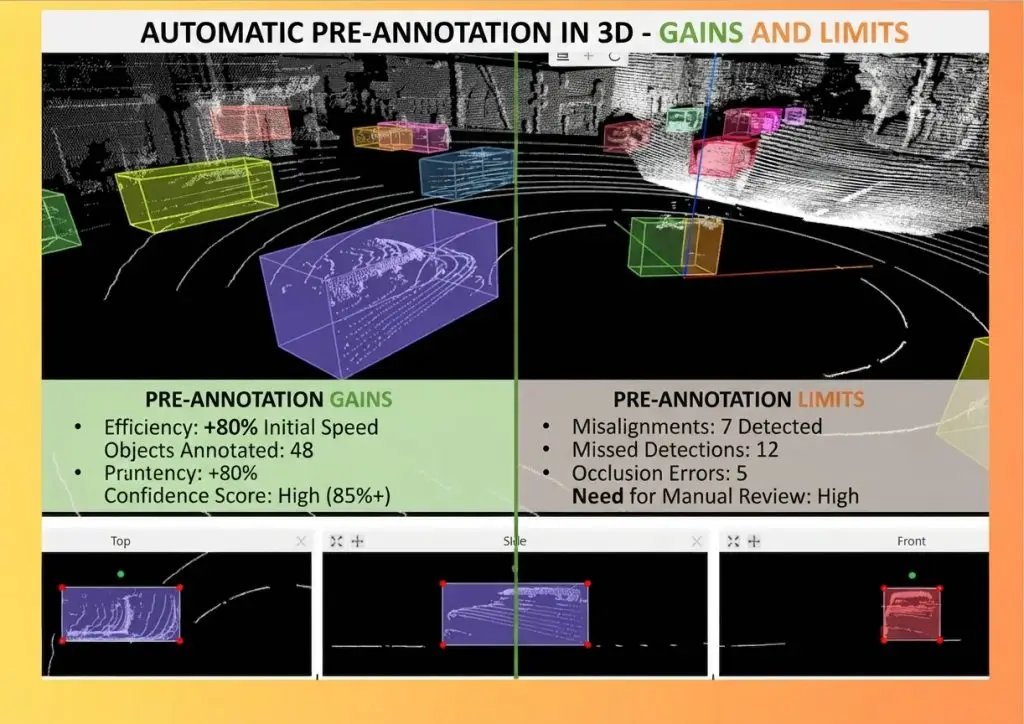
Foundation models and assisted pre-annotation tools are routinely presented as levers for drastically cutting image annotation costs. Reality is more nuanced. On generic classes well represented in public data (vehicles, pedestrians, everyday objects), assistance genuinely cuts production time, and that gain logically flows through to price. On domain-specific classes absent from generic models’ training data, automated assistance offers imprecise suggestions that annotators must correct, sometimes with more effort than drawing directly by hand.
The consequence for buyers: a provider announcing a generic AI-driven price cut should be questioned on the exact nature of the corpus concerned. A 40 percent discount on urban vehicle detection does not automatically transfer to a corpus of rare industrial defects or specialized medical imaging. The only reliable check remains, once again, a priced pilot on the project’s actual images, which reveals the real gain of assistance on that specific corpus rather than on a market average.
A deeper trend is also worth noting, documented across several recent sector analyses: while prices for generic tasks tend to fall under partial automation, prices for specialized, high-quality-bar annotation keep rising year over year, driven by growing demand for reliable training data in regulated or safety-critical uses. The price gap between generic and specialized image annotation, already substantial today, therefore tends to widen rather than close.
Three priced examples of image annotation
To make these mechanisms concrete, three scenarios illustrate how the factors combine in a real image annotation costing exercise, each drawn from a distinct combination of volume, precision, and criticality that a generic price list cannot capture on its own. None of the three is meant as a universal template; each simply shows one plausible way the same underlying factors can add up.
First scenario: a 20,000-image corpus for an industrial defect detector, in bounding boxes, averaging two to three defects per image, with a target quality rate of 97 percent. The unit price sits in the market’s mid-range for bounding boxes, but reinforced quality control (systematic review, continuously inserted golden samples) adds a clearly identifiable budget line. Volume, above the usual provider discount threshold, allows negotiating a degressive rate on the second half of the batch.
Second scenario: a 5,000-image medical corpus to segment, with validation by a radiologist on a sample. The price per image climbs sharply due to segmentation, the expert time mobilized for clinical validation, and the near-99-percent quality rate the domain demands. The smaller volume does not allow a significant tier discount, but the per-image cost remains justified by the criticality of the final use.
Third scenario: a recurring monthly flow of 3,000 quality-control images in food processing, in simple classification. The unit price is low, but a monthly retainer with a capacity commitment stabilizes the budget and avoids the cost of remobilizing a team for every new batch, something a one-off per-image quote would not anticipate.
These three cases illustrate the same rule: the price of an image annotation project never reads off a single line of a pricing grid; it is built from the actual combination of the project’s own factors.
Questions to ask before signing an image annotation quote
Beyond the headline price, a checklist of questions helps secure an image annotation quote before signature. What is the contractual quality rate, and how is it measured on an audited sample? What exactly does the unit price cover: the first pass, review, golden samples, guideline iterations? What are the rework terms in case of non-conformance, and are they billed separately? What is a realistic timeline given the volume and expertise required, and does that timeline include the pilot? What information security guarantees apply to the corpus, particularly for sensitive images or those under confidentiality constraints?
A provider able to answer these five questions precisely, rather than pointing back to a generic price grid, gives a reliable signal about the seriousness of its process, often more telling than the unit price itself.
Reading a rate card without being misled by geography
Region is often the first variable buyers reach for when comparing image annotation quotes, and it does explain part of the observed spread. But treating it as the main lever leads to two common mistakes. The first is assuming that a lower hourly rate automatically means a lower total cost: if lower supervision or thinner quality control comes with the lower rate, the saving disappears the moment relabeling starts. The second is assuming that a higher rate automatically means better quality: process discipline, guideline rigor, and management structure explain far more of the quality outcome than geography alone.
A more useful question than “where is this produced” is “what does this rate actually buy”: how many review passes, what sampling rate for golden samples, what escalation path for ambiguous cases, what reporting cadence. Providers who answer these questions in concrete, auditable terms, rather than in general reassurances, tend to be the ones whose pricing holds up once volume production starts. Certifications such as ISO 27001 add a verifiable layer on top of this: they do not set the price, but they narrow the field to providers whose information security practices have been externally audited, which matters as soon as the corpus carries any sensitivity at all.
Comparing image annotation quotes without getting it wrong
Comparing quotes on unit price alone is like comparing cars on purchase price alone, without looking at fuel consumption or maintenance. A rigorous comparison covers a coherent set of factors: the unit price, of course, but also the contractual quality rate and how it is measured, what the price includes (review, golden samples, guideline iterations) versus what is billed as an extra, realistic timelines given volume and required expertise, and information security guarantees for sensitive corpora, with a certification such as ISO 27001 serving as a verifiable benchmark rather than a mere marketing claim.
A serious comparison requires having the same pilot batch priced by several providers, under identical conditions, rather than comparing generic rate cards that never reflect the reality of a specific corpus.
In-house versus outsourced: a different cost calculation
The cost question also arises against the option of building an in-house team. The full cost of an internal team includes recruiting, training, supervision, tooling, turnover management, and management time, line items often missing from an internal project’s initial costing even though they weigh heavily over time. Keeping annotation in-house retains its appeal for small volumes, highly sensitive corpora that cannot leave the organization, or exploratory phases where guidelines change too fast to hand off to a third party. Past a certain volume or recurrence, outsourcing to a structured provider generally becomes more economical, on top of freeing data science teams from a task that is not their core job.
Negotiating without degrading quality
The temptation to negotiate the unit price down is natural, but it carries a well-documented risk: below a certain threshold, the provider can no longer maintain its quality control level without losing money, and the price cut mechanically translates into a quality cut, rarely announced as such. The negotiation levers that preserve quality are different: a volume commitment over time in exchange for a degressive rate, simplifying guidelines where possible without losing useful information, or accepting a longer timeline in exchange for a lower price, rather than direct pressure on unit price at constant volume and quality.
Costing an image annotation project is therefore always built from two directions at once: from the model’s actual need, and from a priced pilot on a representative sample of the corpus. This is the approach we systematically recommend to teams who consult
Infoscribe AI, a specialist in 2D and 3D annotation for computer vision: before any firm quote, a priced and delivered pilot batch lets everyone validate price, quality, and timeline against real data rather than a theoretical estimate. This step, a marginal investment at the scale of the full project, avoids most of the budget surprises that typically surface once a project scales up.
Turning a price into a service commitment
A quote only becomes a reliable budgeting tool once it is backed by a service commitment that can actually be enforced. In practice, this means the contract should state the quality rate as a number, the sampling method used to audit it, the rework terms that apply when a batch falls short, and the reporting cadence that lets the client catch a drift early rather than discover it at model evaluation time. Image annotation agreements that leave these terms implicit tend to look identical to more rigorous ones on the cover page, and only diverge once something goes wrong.
This is also where the choice between billing models interacts with governance. Per-unit pricing needs the tightest enforcement, since it is precisely where the incentive to cut corners is strongest. Hourly pricing needs the clearest reporting, since it is precisely where costs can drift unnoticed. Retainer pricing needs the clearest capacity clauses, since it is precisely where volume swings create friction. None of these models is inherently safer than the others; each becomes safe only when paired with the governance that offsets its specific weak point, and a buyer who understands this trade-off can negotiate the right safeguard instead of simply picking the model that sounds cheapest on paper.
Budgeting a multi-month image annotation program
Beyond a one-off project, many AI teams need to budget an image annotation program that spans several months or years, as the model evolves and new classes or use cases appear. This context changes the costing logic: rather than optimizing the price of a single isolated batch, it becomes relevant to think in terms of total cost of ownership over the life of the program, a shift in framing that changes which negotiation levers actually matter.
Three levers structure this type of budget. First, the cumulative learning effect: a provider already familiar with a project’s guidelines, corpus, and edge cases processes subsequent batches faster and with fewer iterations than a new entrant, which often justifies favoring continuity with a partner over chasing the lowest price on every new batch. Second, budget predictability: an annual volume commitment, even an approximate one, allows negotiating degressive rates and capacity reservation that protects against delays during periods of high demand. Third, a margin for responsiveness: a multi-year program must retain fast-turnaround capacity for the targeted annotation campaigns that follow error analysis on a model in production, corrective campaigns that are often more urgent and smaller than the initial batches, but just as decisive for system performance.
A well-built multi-year image annotation budget therefore plans for both a predictable, negotiated share of volume and a reserved share of flexibility for the adjustments that running a model in production inevitably reveals. This budgeting discipline, closer to managing a recurring operational line item than a one-off purchase, reflects the place image annotation now holds in the sustainable lifecycle of a computer vision system. Teams that reach this stage tend to stop asking “what does annotation cost” and start asking “what does it cost to keep our models accurate,” a reframing that usually leads to better decisions on both sides of the contract.
Cost it before you commit
There is no universal price for an image annotation project, only factors that, combined, determine a cost specific to each corpus: annotation type, object density, required expertise, quality level, volume. Comparing quotes only makes sense if it covers a coherent set of these factors, and the only reliable way to obtain a workable estimate remains building it on a real sample of the project, not on a generic pricing grid. The lowest price on paper is almost never the lowest cost once the model reaches production: it is the full cost, relabeling and retraining included, that actually separates the options. Treating image annotation as a budget line to be minimized in isolation, rather than as one input among several that determines whether a model works at all, is the single costliest misreading a buyer can make.
If you are preparing a project and want a costing exercise built on your actual corpus rather than a theoretical estimate, you can
get in touch with the team to discuss a pilot batch.