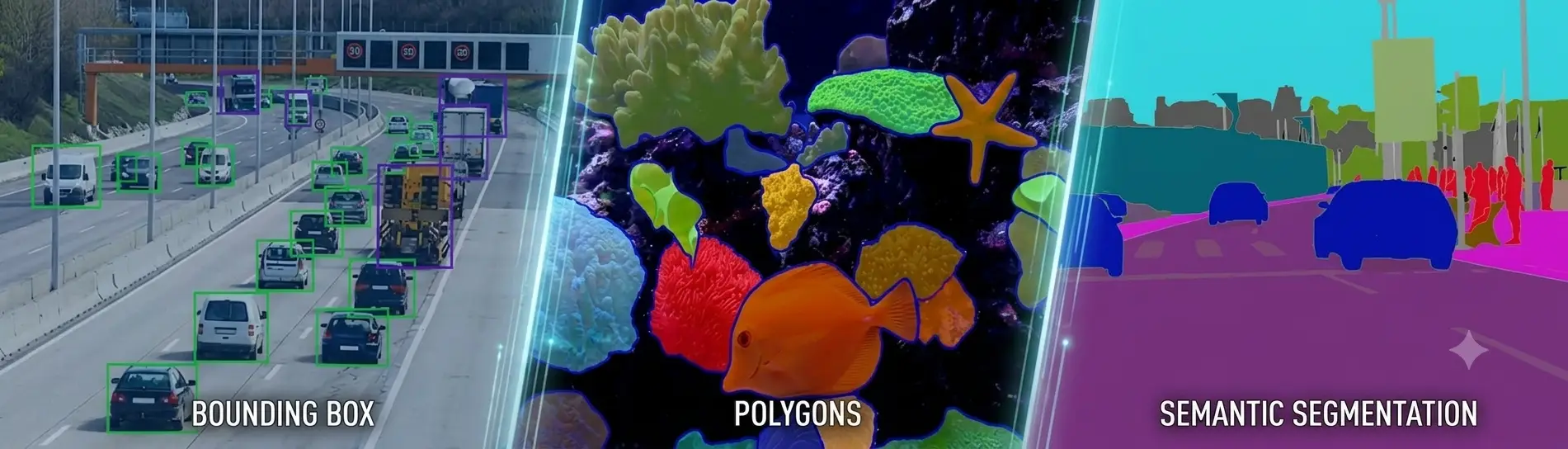
Rectangle, polygonal outline, or pixel-level mask: choosing the geometry is the first technical decision of any image annotation project, and one of the most consequential. It commits the budget, the timeline, the model architecture, and the ceiling of achievable performance. Yet it is often settled by habit or by whatever the default tool offers, before the question has been asked seriously. Every image annotation campaign should instead open with this trade-off made explicit, documented in the guidelines, and validated by the team that will train the model.
The gaps at stake are not marginal. According to analyses published across the industry, a precise polygon takes three to ten times longer to produce than a bounding box, and the authors of the COCO dataset documented roughly 60,000 worker hours for its annotation, with an average close to 80 seconds per polygon mask. At the scale of a corpus of several hundred thousand images, choosing a richer geometry than the real need can multiply the budget by four; choosing a poorer one condemns the model to a performance ceiling that no amount of retraining will lift. This guide compares the formats one by one, then proposes a five-question decision method.
The image annotation type: an architecture decision, not an execution detail
The annotation geometry determines what the model can learn. A detector trained on bounding boxes predicts rectangles: it will localize objects but never know their shape. A segmentation model requires pixel-level masks: it cannot be trained on rectangles without a major loss of information. The link is mechanical: the expected output of the model dictates the format of the ground truth, and therefore the type of image annotation to produce.
The decision is also hard to reverse. Moving from a corpus annotated with bounding boxes to a segmented corpus means relabeling, because a precise shape cannot be derived from a rectangle. The reverse is possible (a bounding box derives automatically from a mask), which creates a useful asymmetry: when hesitating between two levels of precision, and if the budget allows, the higher level preserves future options. In most cases, however, discipline consists of choosing the minimum level that satisfies the need, because every additional notch of precision is paid for across the entire corpus.
One last factor weighs on the decision: skills availability. An image annotation campaign in bounding boxes can start with quickly trained annotators; a medical segmentation campaign or fine polygon work requires practiced profiles, calibrated on reference samples, with reinforced supervision. The chosen format therefore also sizes the team, its training, and its ramp-up speed, parameters that matter as much as the unit price when the project timeline is tight.
Classification: image annotation without localization
Classification assigns one or more labels to the whole image, without pointing at any region. It is the fastest and cheapest format to produce, and it is sufficient for more use cases than commonly assumed: pass/fail sorting at the end of a production line, product categorization, corpus filtering, presence detection (does the image contain a defect, an animal, a document?).
Its limits are obvious: no position, no counting, no shape. It also fails as soon as an image contains several objects of different classes whose joint presence must be distinguished. Classification nevertheless remains an excellent first-pass format: classifying a corpus before localizing anything routes images to the right annotation queues and discards useless images before any drawing time is invested in them. In multi-stage pipelines, a lightweight classifier trained on such labels often serves as the gatekeeper that decides which images deserve the expensive downstream treatment at all.
Bounding boxes: speed and scale
The enclosing rectangle is the reference format for object detection. Two clicks draw it, annotator training is fast, tools are universal, and the export formats (COCO, YOLO, Pascal VOC) are supported by every framework. When the need is to localize and count objects, the bounding box offers the best information-to-cost ratio on the market.
Its weaknesses are the flip side of its simplicity. On an irregularly shaped object, the rectangle includes a large proportion of background pixels: for a diagonal, elongated, or concave object, the box may contain more background than object. In dense, overlapping scenes, boxes overlap massively and the training signal blurs. Two variants partially address these limits: the oriented bounding box, which rotates to follow the object’s axis and proves invaluable in aerial imagery and document analysis, and amodal annotation, which encloses the occluded part of an object to teach the model to reason about occlusions.
The drawing rule matters as much as the format: a box must fit the object as tightly as possible, consistently across the whole corpus. Boxes that are sometimes tight and sometimes loose produce an imprecise detector, regardless of the quality of everything else.
Polygons: fidelity to shape
The polygon traces the real outline of the object through a sequence of vertices. It captures shape, orientation, and area, information a rectangle cannot carry, while remaining cheaper than exhaustive dense segmentation. It is the natural format for agricultural parcels seen from above, building footprints, complex industrial parts, and lighter medical imaging tasks.
Cost varies strongly with outline complexity: an experienced annotator draws a simple five-to-ten-vertex polygon almost as fast as a box, while a fine thirty-to-fifty-vertex outline takes several times longer. It is on these complex outlines that model assistance (generating an initial outline that a human corrects) delivers its clearest gains, with tooling vendors reporting time reductions in the range of 40 to 70 percent on common object classes. Quality vigilance then concentrates on the boundaries: assistance models round off corners, smooth fine details, and fail on occlusions, exactly where the polygon’s precision justified its extra cost.
Segmentation: the pixel as the unit of image annotation
Segmentation assigns a class to every pixel. It is the maximum level of information, and the only admissible format when the exact area, the precise boundary, or the topology of the object carries the business value.
Semantic segmentation
Every pixel receives a class, with no distinction between instances: all “vegetation” pixels form a single region. It suits coverage and proportion analyses: land use in satellite imagery, material surfaces, free versus occupied zones in a scene.
Instance segmentation
Each object is segmented individually: two neighboring tomato plants are two distinct masks. It enables counting, measuring, and tracking every object, and becomes mandatory in medical imaging (every lesion counts), precision agriculture (every plant, every fruit), and defect detection (every defect is a distinct quality event).
Panoptic segmentation
It unifies the previous two: countable objects are segmented per instance, background regions (sky, road, ground) per class. It is the format of complete scenes, notably in autonomous driving, and the most demanding to produce and control.
Segmentation remains the most expensive of all formats, even with foundation model assistance, because boundary verification and correction stay manual. The question to ask is always the same: is the business value in the pixel? If the answer is yes (dosimetry, surgical planning, area computation, precise cropping), segmentation is an investment. If the answer is no, it is an expense.
Keypoints, polylines, cuboids: the specialized geometries
Three formats complete the palette. Keypoints mark positions without area: joints for human or animal pose estimation, anatomical landmarks, object corners and centers. They are fast to place but demand rigorous definitions: each point must correspond to an unambiguously defined anatomical or geometric position, otherwise the learned skeletons are inconsistent.
Polylines annotate linear structures without a closed area: lane markings, crop rows, cables, cracks, fiber outlines. They carry trajectory and continuity information that neither boxes nor masks represent efficiently.
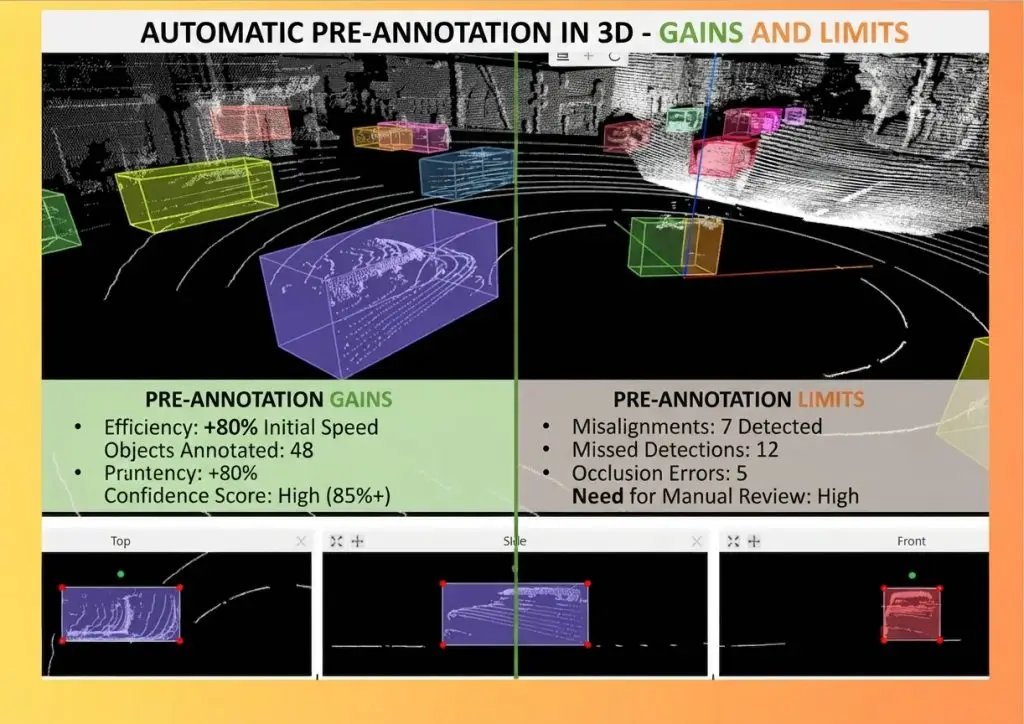
The 2D-projected cuboid, finally, approximates an object’s volume in a flat image, pending or complementing true 3D annotation on point clouds. It serves mainly perception for vehicles and robots, where object orientation and footprint matter as much as position.
Time and cost: what geometry changes in practice
Published orders of magnitude converge. The bounding box is the reference unit. The polygon takes three to ten times longer depending on outline complexity, and academic work on scene text corpora measured polygon annotations roughly four times more expensive than equivalent boxes. Exhaustive instance segmentation sits beyond that, as the COCO precedent and its tens of thousands of worker hours illustrate. These ratios pass straight through to the budget, but also to the schedule and to the quality control effort, which grows with the required precision: verifying a pixel-level boundary takes longer than verifying a rectangle.
Two second-order effects deserve a place in the calculation. First, richer geometry sometimes reduces the required volume: a segmentation model learns more information per image, and some projects reach their target with fewer finely annotated images than with a large volume of boxes. Second, the cost of the wrong decision dominates all others: relabeling a corpus into a richer geometry costs the entirety of the initial work, plus the new one. We break down pricing mechanisms, ranges, and optimization levers in our article on
how much an image annotation project costs.
Foundation model assistance shifts these ratios without canceling them. The gains reported by tool vendors, around 40 to 70 percent on polygons for common classes, concentrate on generic objects well represented in public data. On domain-specific classes, fine boundaries, and degraded imaging conditions, human correction takes back most of the time, and the cost gap between geometries persists. The practical rule: price assisted image annotation on a real sample of your corpus, never on the tool’s generic promises.
Start from the model: what the target architecture requires
The safest reasoning starts from the end. What output is the production system expected to deliver? A presence alert calls for classification. Localization and counting call for detection, hence bounding boxes. An area measurement, a shape, or a boundary calls for segmentation, hence masks or polygons. A posture or a trajectory calls for keypoints or polylines.
Architectures follow the same logic: standard detectors consume boxes; segmentation models require pixel-level masks; pose estimators require point skeletons. Trying to train a segmentation architecture on rectangles, or the reverse, means paying for information the model will not use, or depriving the model of information it requires. Evaluation metrics follow suit: mean average precision on boxes for detection, mask IoU and the Dice coefficient for segmentation. The annotation format, the architecture, and the metric form a coherent triplet that should be chosen as one block.
Five questions to choose the right type of image annotation
The method fits into five questions, asked in order.
One: what decision must the system enable in production? This is the master question: presence, position, counting, shape, area, and trajectory do not call for the same geometry. Two: does object shape carry business value? If the exact boundary changes nothing in the final decision, shape precision is a luxury. Three: how overlapping and irregular are the objects? Dense, nested, or concave objects sharply degrade the information carried by rectangles and push toward polygons or instances. Four: what budget and timeline can the project sustain, cost ratios in mind? Five: how is the need likely to evolve within twelve months? If segmentation is probable down the line, the conversion asymmetry (a mask degrades into a box, never the reverse) can justify annotating part of the corpus directly at the higher level.
In every case, the decision is validated on a pilot: a few hundred images annotated in the intended geometry, a first training run, a measurement. The pilot costs a few days and protects against the two symmetric errors, over-annotation that burns the budget and under-annotation that caps the model. A well-designed pilot also doubles as a calibration exercise: it produces the reference samples against which annotator accuracy will be measured during volume production, and it surfaces the edge cases that the guidelines must settle before they multiply across thousands of images. Teams that treat the pilot as an inconvenient formality tend to rediscover its purpose later, at relabeling time and at full price.
Geometry and quality control: requirements that change with the format
Each geometry calls for its own control system, a point regularly underestimated at decision time. In classification, control bears on class correctness and lends itself well to inter-annotator agreement measures. For bounding boxes, it covers three dimensions: completeness (no object missed), class correctness, and geometric precision measured by IoU, with a contractual threshold per object type. For polygons and segmentation, boundary verification becomes the dominant cost item: a mask can be right on 98 percent of its pixels and wrong exactly where it matters, on the thin edge separating two structures.
The budget consequence is direct: quality control cost grows with the richness of the geometry, and this surcharge belongs in the initial format comparison. An image annotation project in medical segmentation devotes a share of its budget to control and validation that bears no comparison with a box-based detection project. Conversely, undersized control on a rich geometry is the worst arrangement of all: you pay for precision at drawing time without guaranteeing it at delivery. The quality bar, the format, and the control system should be sized together, at scoping stage.
Four typical situations, four image annotation choices
A few concrete cases illustrate the decision mechanics.
Defect detection on a production line: the need is to spot and localize each defect to reject the part. Bounding boxes suffice in most cases; polygons or instance segmentation take over when the defect’s area or shape conditions the decision (a scratch acceptable below a certain length, a porosity tolerated below a certain diameter). Industrial image annotation then shifts from a presence logic to a measurement logic.
Plant counting in agriculture: each individual must be distinguished from its neighbors in dense, overlapping scenes. Bounding boxes hit their limits quickly on intertwined foliage; instance segmentation, despite its cost, is often the only format that preserves reliable counting. On well-separated row crops, the box remains perfectly adequate.
Land cover in satellite imagery: the need is a proportion of surfaces per class, with no counting. Semantic segmentation is the natural format, and precision at the boundaries between neighboring classes (cropland and fallow, buildings and bare soil) concentrates the quality effort.
Diagnostic support in medical imaging: the structure’s boundary is the clinical data itself. Segmentation, validated by experts, has no alternative, and the project budget is built around that requirement rather than against it.
In all four cases the reasoning is identical: start from the business decision, deduce the necessary information, choose the minimal format that carries it.
Export formats and interoperability: locking the choice into the pipeline
Once the geometry is chosen, it must travel cleanly from the annotation tool to the training pipeline, and format details deserve attention before production starts rather than after delivery. Bounding boxes are the least problematic: COCO JSON, YOLO text files, and Pascal VOC XML cover virtually every framework, and conversions between them are lossless as long as coordinate conventions (absolute versus normalized, corner versus center) are validated on a sample. Oriented boxes are less standardized, and the angle convention should be pinned down explicitly in the guidelines and in the export specification.
Polygons and masks raise more interoperability questions. COCO JSON stores polygons as vertex lists and masks as run-length encodings, while many segmentation pipelines expect PNG masks with one gray level or color per class; converting between the two is straightforward but must preserve class mappings and handle holes and multi-part objects correctly. Keypoints add a skeleton definition (which points exist, in what order, connected how) that must match between the annotation schema and the model configuration. In every case, the same inexpensive safeguard applies: run one fully annotated file from the pilot batch through the actual training code, end to end, before authorizing volume production.
Interoperability also has a contractual face. When several providers, tools, or internal teams contribute to the same dataset over time, the format specification becomes the shared contract that keeps the corpus coherent. Versioning that specification, and recording which batches follow which version, costs little and prevents the slow drift that otherwise turns a multi-year dataset into an archaeology project.
Hybrid strategies: combining formats within one corpus
Mature projects frequently mix geometries. A common strategy annotates the whole corpus with bounding boxes and reserves segmentation for critical classes or difficult images: the detection model routes cases to the fine-grained model. Another segments a reference subset used for evaluation and calibration, while the training volume stays in boxes. A third exploits weakly supervised approaches, which train segmentation models from boxes complemented by a small batch of exact masks, with intermediate results documented in the literature.
These strategies demand disciplined corpus management: every image must carry a record of its annotation level, and guidelines must define without ambiguity which classes fall under which geometry. This is precisely the kind of trade-off an experienced provider helps structure upstream; the teams at
Infoscribe AI, a specialist in 2D and 3D annotation for computer vision, build these mixed schemas with the client at scoping stage, because the right split is decided by looking at the real corpus, not by picking from a catalog.
Decide, test, iterate
The right type of image annotation is neither the most precise nor the cheapest: it is the minimum level of information that lets the model deliver the expected decision, validated by a measured pilot. Classification sorts, the bounding box localizes and counts, the polygon restores shape, segmentation delivers the pixel, points and lines capture postures and trajectories. The rest is context: scene density, domain criticality, budget, product trajectory. And because contexts evolve, the choice deserves re-examination at every corpus extension: an image annotation approach that fits a prototype phase does not always fit the move to scale.
To place this decision within the full process, from guidelines to quality control, our
complete guide to image annotation covers the entire lifecycle of a project. And if you are hesitating between two geometries on a concrete corpus, the most effective route is to discuss it on real material: you can
get in touch with the team to test your case against comparable project experience.