


Methodology
Through a well-established annotation methodology, continuous upskilling of our teams, and enhanced cybersecurity, we protect your data while maximizing its value for training your AI models.
Home > Methodology
EXpertise
6 Steps to Power Your AI Model Training
At Infoscribe.ai, we apply a strict process to turn your raw data into high-quality, consistent, and immediately usable AI training datasets.
This phase most often takes place during discussion meetings, during which we aim to gain a precise understanding of your project and your expectations.
The objective is to establish a clear and shared framework before any operational launch.
These discussions allow us in particular to clarify:
- the project and the objectives being pursued, what you wish to annotate and the types of annotations expected;
- the types of data to be processed, the volumes involved, and the proposed timeline.

We structure the project team and set up the appropriate tools and workflows for file sharing, communication, and data annotation.
This step aims to ensure a smooth project kickoff and clear management throughout the project.
It notably includes:
- the appointment of a dedicated project manager, acting as the single point of contact on the Infoscribe side;
- the definition of communication and exchange channels;
- the selection and configuration of the annotation platform.

We begin by verifying the received data, then by reviewing the annotation guidelines in order to eliminate any ambiguity before the operational start. At this stage, the project manager is the sole contributor.
This step includes:
- the receipt, inventory, and verification of the data to ensure they are complete, usable, and not corrupted;
- a thorough review of the guidelines, with questions raised when certain cases or scenarios are not explicitly defined;
- the implementation of a customized annotation and quality control process tailored to the project.

We carry out a pilot project based on a representative sample provided to us, in order to measure annotation and quality control throughput, identify any ambiguities in the guidelines, and validate with you the expected level of quality.
This phase allows us to obtain your prior validation of the quality of our work, develop our commercial proposal, and confidently prepare for the production launch.
It notably includes:
- the production of an annotated test batch;
- the measurement of actual annotation and quality control throughput;
- validation by your teams of the understanding of the guidelines and the quality of the annotations;
- the development of a tailored commercial proposal adapted to the project’s volumes and requirements.

Après validation de la phase pilote, nous lançons la production en appliquant des procédures de contrôle qualité continues, afin de garantir la fiabilité et la cohérence des annotations.
Tout au long du projet, vous bénéficiez d’un suivi d’avancement clair, avec des reportings réguliers vous permettant de suivre précisément les volumes produits et l’état d’avancement.
En fonction de l’évolution de vos besoins, nous pouvons adapter la taille des équipes mobilisées afin d’ajuster les volumes produits au quotidien.
Cette organisation repose sur :
- un contrôle qualité permanent,
- des reportings réguliers,
- une visibilité complète côté client sur l’avancement du projet

Après validation de la phase pilote, nous lançons la production en appliquant des procédures de contrôle qualité continues, afin de garantir la fiabilité et la cohérence des annotations.
Tout au long du projet, vous bénéficiez d’un suivi d’avancement clair, avec des reportings réguliers vous permettant de suivre précisément les volumes produits et l’état d’avancement.
En fonction de l’évolution de vos besoins, nous pouvons adapter la taille des équipes mobilisées afin d’ajuster les volumes produits au quotidien.
Cette organisation repose sur :
- un contrôle qualité permanent
- des reportings réguliers,
- une visibilité complète côté client sur l’avancement du projet.

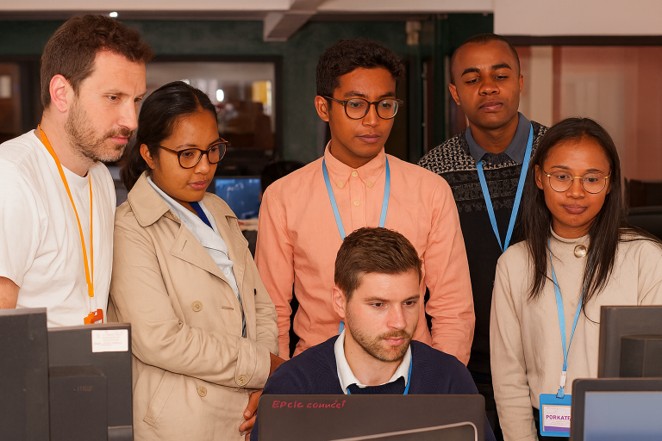
Human in the Loop
We place humans at the heart of our approach: our annotators validate, correct, or reject your AI’s predictions to enhance its accuracy, robustness, and operational reliability.
We design custom workflows and APIs, integrated with your tools, to provide real-time access to controlled, documented, and traceable data streams—perfectly tailored to the requirements of your use cases and your product or data teams.
This oversight is performed within very short timeframes; depending on the tasks, we can commit to reviewing a batch in as little as 5 minutes.
Our Quality Approach : 3 Levels of Engagement
We tailor our quality framework to your priorities, with three clear levels of commitment to balance accuracy, budget, and project timelines.
Quality target
95%
1. launch
- Annotation of 2% of the Project’s Images
- Quality control is carried out by our independent QC department to identify the best annotators to assign as “controller-annotators.”
2. Production
- Training for Each New Guideline
3. Continuous Quality Control:
- 100% Quality Verification by Controller-Annotators
- 25% Sample Quality Check: conducted by the independent QC department.
Quality target
97%
1. launch
- Annotation of 2% of the Project’s Images
- Quality control is carried out by our independent QC department to identify the best annotators to assign as “controller-annotators.”
2. Production
- Continuous Training for Each New Batch, Including Guideline Refreshers and Updates on Best Practices
3. Continuous Quality Control:
- 100% Quality Verification by Controller-Annotators
- 50% Sample Quality Check: conducted by the independent QC department.
- 10% Sample Check: carried out by the project managers before final delivery.
Quality target
99%
1. launch
- Annotation of 2% of the Project’s Images
- Quality control is carried out by our independent QC department to identify the best annotators to assign as “controller-annotators.”
2. Production
- Continuous Training: 30 Minutes per Day, Conducted by a Trainer and Project Manager, Supported by the Production Lead, Including Group Annotation, Identification of Challenging Cases, and Adjustment of Practices
3. Continuous Quality Control:
- 100% Quality Verification by Controller-Annotators
- 100% Quality Check: conducted by the independent QC department.
- 10% Sample Check: carried out by the project managers before final delivery.
Annotator Training and Upskilling
We support our annotators with regular, targeted training to maintain a high level of quality on every project.
Initial Onboarding and Training for Image Annotators
From the very start of the project, our operators are trained in sessions led by our project managers, based on the guidelines and examples you provide.
If needed, your experts can also participate directly to train our project managers via video conference, ensuring full alignment on business requirements.
At the end of these workshops, we conduct a live annotation session: annotators work on real cases, ask questions in real time, and immediately correct errors with the support of the project manager.
Continuous Training
Once production is underway, we monitor the quality of each annotator daily using a skills matrix that allows us to quickly identify operators with weaknesses in accuracy or speed.
Identified profiles are supported by more experienced annotators through a mentorship and collaborative learning approach. Project managers remain available to answer questions.
Any client feedback or guideline updates trigger a new training session, followed by a group annotation session to ensure that the updated rules are fully understood and correctly applied by all