
Image annotation and data
processing for retail
Reliable datasets for in-store and e-commerce AI: cameras, in-store video, warehouse flows, product catalogs, and UGC content.
Home > Image annotation and data processing for retail

What we do
A team of data and computer vision experts dedicated to retail and e-commerce.
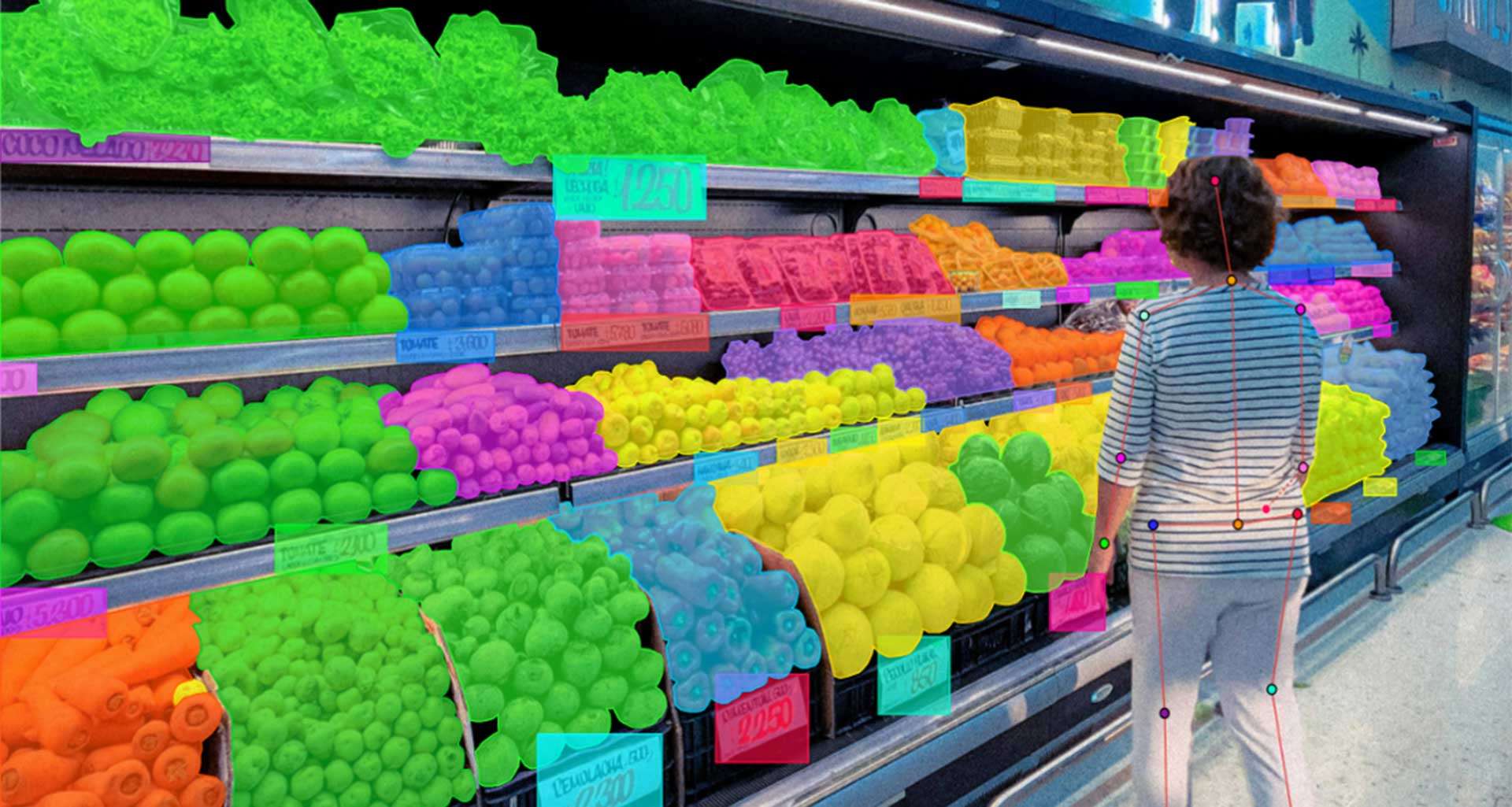
We support data, operations, and merchandising teams in building robust datasets: product (SKU) recognition, shelf segmentation, planogram compliance, object tracking, and document indexing. A multi-layer quality control process ensures consistency, traceability, and usability.
Rigorous and controlled process
Objective scoping (detection, counting, compliance), annotation guidelines and class schema, pilot on a representative sample, iterative cycles with inter-annotator QA, regular audits, and dashboards (IoU, F1, mAP, class coverage, drift).
Security & compliance (ISO 27001 / GDPR)
Secure pipelines: encryption, role-based access control, logging, environment isolation, and face/body anonymization in line with GDPR. Controlled data retention policies and full compliance documentation.
Multi-channel annotation
Covering in-store cameras (mono, stereo, 360°), ToF/Depth, e-commerce images, receipt OCR, and IoT & POS data: 2D/3D segmentation, tracking, sensor fusion, and temporal analysis. Normalization through harmonized schemas and retail ontologies (categories, facings, promotions). QA via dedicated metrics and cross-validation.
EXpertise
Retail data annotation and segmentation optimize in-store vision, merchandising, inventory, and customer experience.
At Infoscribe, we combine industry expertise, human precision, and advanced annotation tools to produce reliable, consistent, and training-ready datasets for AI models in-store and online.
Trust Infoscribe to transform your images, videos, receipts, and sensor data into high-quality, secure, annotated information, ready to use, and designed to accelerate your retail AI projects.
Retail & E-Commerce Image Annotation
Product Recognition (SKU) & Planogram Compliance
Detection and segmentation of products, verification of placements, facings, and price labels, monitoring of POS materials, planogram compliance, and tracking of promotional displays.
Out-of-Stock & Shelf Availability (OOS/OSA)
Visual shelf analysis to detect stock gaps, estimate product availability, trigger real-time alerts, and correlate visual observations with POS data and forecasts.
Store Counting, Traffic & Heatmaps
Anonymous tracking of customer movements and zone densities, analysis of queues and dwell times, and optimization of product layout and staff allocation.
Loss Prevention & Self-Checkout Anomalies
Visual detection of risky actions: missed scans, product substitutions, item/weight inconsistencies, and suspicious movements. Video logs are correlated with POS records for auditing and prevention.
Self-Checkout & Checkout Vision
Visual assistance at checkout to recognize barcode-less items, differentiate fresh products, and accelerate the checkout process.
E-Commerce Analytics & Visual Search
Product image annotation to improve visual search, UGC moderation, image-to-product matching, catalog visual compliance, and defect detection (occlusion, blur).
In-Store Merchandising & A/B Testing
Visual comparison of product placements, measurement of product visibility, tracking of customer interactions, and correlation between exposure, sales, and promotion effectiveness.
Store Supply Chain & Logistics
Visual reading of delivery notes and pallet labels, detection of package anomalies, automated inventory via cameras, validation of shipment integrity, and automated receiving.
Temporal – Video & Sequences
Multi-object tracking (products, baskets, carts), object re-identification across cameras, long-term tracking, and event labeling (missed scan, item recovery, cart abandonment).
Derived & Specialized Annotations
OCR/NER (prices, SKUs, VAT), image quality (blur/exposure), planogram mapping (shelf-SKU graphs), checkout anomaly detection, multi-camera calibration, and panoptic sensor fusion.
Product Quality & Catalog Visual Control
Annotation of defects (damaged packaging, wrong color, missing logo), inconsistencies between images and product sheets, and detection of outdated visuals to ensure a consistent presentation across all channels.
Personalized Shopping Experience
Fine-grained annotation of styles, uses, colors, materials, and contexts in product images to feed visual recommendation engines and improve cross-selling relevance.
Omnichannel Visual Merchandising
Harmonization of in-store and e-commerce visuals through annotation of brand universes, seasonal themes, collections, and atmospheres, ensuring a seamless physical-to-digital experience.
Shelf Competition Analysis
Annotation of competitor shelf images (displayed prices, shelf share, promotional presence, brand visibility) to feed dashboards for competitive intelligence and price/assortment optimization.
Virtual Try-On & Product Configuration
Annotation of visual attributes needed for virtual try-on experiences (sizes, cuts, body shapes) and 3D configurators (colors, options, finishes) to enhance engagement and reduce returns.
Text Annotation for Retail and E-Commerce
OCR for Retail Tickets & Documents
OCR annotation and automatic data extraction from receipts, invoices, or delivery notes: prices, VAT, quantities, SKUs, and pricing compliance.
POS & E-Commerce Text Analysis
Annotation and classification of text from receipts, product descriptions, and customer feedback to identify anomalies, pricing inconsistencies, or return reasons.
Out-of-Stock Detection via Logs & Messages
Textual analysis of POS logs, internal emails, or supplier messages to detect reported stock-outs, delivery delays, or supply errors.
Competitive Intelligence & Catalogs
Semantic annotation of product descriptions and competitor listings to compare prices, features, and positioning, supporting purchasing strategies and dynamic pricing.
Customer Satisfaction & Reviews
Sentiment annotation and classification of customer feedback to identify sources of dissatisfaction, product perception trends, and improvement opportunities.
Customer Support & Service
Annotation of chat/email conversations to detect intents, classify requests, and automate prioritization of support tickets for in-store and online service.
Product Description Optimization
Annotation of titles, attributes, and product benefits to detect missing information, harmonize wording, and improve SEO, conversion, and cross-channel consistency.
Marketing Segmentation & Targeted Campaigns
Annotation of customer profiles, preferences, and expressed intentions in forms, newsletters, and interactions to enrich marketing segments and personalize promotional campaigns.
Other Industries
FAQ
Frequently Asked Questions
Infoscribe can annotate a wide range of media used in the retail sector, addressing needs related to product management, in-store analytics, operations automation, and computer vision model training.
The company first processes all product images, whether e-commerce packshots, in-store photos, or images used for visual product recognition. These assets can be annotated to identify categories, variants, labels, barcodes, or specific attributes such as color, size, or packaging.
Infoscribe can also handle shelf and aisle images, used for out-of-stock detection, facing analysis, brand recognition, zone segmentation, or identifying misplaced products. These images may come from still photos, mobile cameras, or inventory robots.
In-store videos are also annotatable: surveillance camera feeds, customer tracking sequences, and videos for behavioral analysis, footfall counting, or automated event detection. Infoscribe can anonymize faces and annotate the movements of people, carts, or customer-product interactions.
Additionally, the company can process 360° images, in-store sensor data, and 3D scans of stores or products for advanced applications such as space reconstruction or 3D modeling.
Finally, Infoscribe can manage large catalogs, various multimedia assets, and hybrid datasets combining images, videos, product metadata, or ERP data.
With this versatility, Infoscribe covers all the essential visual media needed for modern retail operations.
Yes. Infoscribe can manage retail- and e-commerce-specific metadata during annotation, and this capability is a core part of its expertise in preparing complex datasets for AI models, visual search systems, recommendation engines, or catalog management platforms. The company understands that retail environments require much more than simple bounding boxes or segmentations: they demand precise structuring of product information, compliant with industry standards and synchronized with internal catalogs and databases.
When a project involves product categories, Infoscribe can incorporate hierarchical trees and follow client-specific taxonomies, whether for simple classification or multi-level categorization. This structuring also applies to multi-variant products, complex assortments, and sector-specific product families (food, fashion, beauty, home appliances, DIY, etc.).
The company can also manage SKU, EAN, UPC, or internal codes. When images include a visible barcode, it can be annotated and automatically linked to the corresponding product. When no barcode is present, annotators work with client-provided metadata to ensure accurate matching between the image and the cataloged reference. This level of precision is essential for visual search, shelf detection, and automated inventory systems.
Infoscribe can also annotate more detailed product attributes such as brand, color, size, material, packaging, or type of packaging, whether units, multi-packs, promotional packaging, or industrial formats. These metadata can be integrated as labels, multi-attribute tags, or JSON/XML structures tailored to client pipelines.
For e-commerce, where catalogs evolve rapidly, Infoscribe can maintain metadata consistency despite collection changes, product rotation, or seasonal variations. The company is capable of managing large catalogs, synchronizing annotations with existing data, and adapting guidelines when new attributes need to be added.
Finally, Infoscribe implements rigorous quality management: every annotated metadata is verified, checked, and validated to avoid product identification errors that could directly impact recommendation systems, search, computer vision, or inventory management. This approach ensures perfectly structured data, ready for advanced retail and e-commerce applications
Infoscribe manages in-store video data using a methodology tailored to the specific constraints of retail, where continuous streams, surveillance, behavioral analysis, and privacy protection demand high processing standards. The company can handle videos from fixed cameras, mobile cameras, 360° cameras, inventory robots, or security systems, transforming them into actionable data for computer vision and AI.
1. Continuous Video and Surveillance Management
Infoscribe processes long, segmented, or multi-camera videos using an optimized workflow to:
- Segment and structure video streams
- Extract relevant frames
- Synchronize views across cameras
- Annotate objects, behaviors, or interactions of interest
This enables handling complex scenarios such as congestion, lighting variations, or areas with constant movement.
2. Face and Individual Anonymization
To comply with legal requirements (GDPR) and protect customers, Infoscribe can automatically anonymize faces and body shapes before annotation. This can include blurring, masking, pixelation, or removal of sensitive regions while preserving the context needed for behavioral analysis or event detection.
3. Tracking People, Baskets, and Interactions
Videos can be annotated to track:
- Customer pathways
- Movements of baskets, carts, or products
- Interactions between customers and shelves
- Hot zones, cold zones, or specific behaviors
Infoscribe uses tracking-specific annotation techniques: persistent IDs, temporal bounding boxes, moving object segmentation, and trajectory extraction.
4. Video-Specific Quality Control
A reinforced QA process ensures tracking IDs remain consistent, objects are not lost between frames, and anonymized zones are correctly applied.
5. Compliance and Security
All videos are processed in secure environments in accordance with retail privacy regulations.
With this approach, Infoscribe delivers precise, compliant video annotations tailored to in-store analytics projects.
Yes. Infoscribe is fully capable of annotating very large and rapidly evolving product catalogs, including cases where new SKUs are frequently added or seasonal collections change. The company has developed a flexible organization that can handle high volumes while maintaining perfect consistency in metadata, attributes, and product labels. This capability is especially critical in e-commerce, where product rotation, new ranges, packaging variations, or assortment updates require an agile and responsive annotation workflow.
To manage dynamic catalogs effectively, Infoscribe begins by setting up an evolving guidelines system designed to track changes in the client’s catalog. These guidelines can include categorization rules, product nomenclature, variations in size, color, or style, as well as instructions specific to each product family. When new items appear, the guidelines are updated seamlessly so the team can immediately integrate the new parameters.
Infoscribe also implements a scalable organization of annotators trained in the e-commerce sector, capable of processing large volumes of visual data quickly: packshots, in-context photos, multiple views of the same product, or images from international catalogs. Annotators are trained to recognize subtle variations between similar products (sizes, colors, formats, materials), which is essential in sectors such as fashion, beauty, food, or DIY.
A multi-level quality control process ensures that new catalog entries maintain the same annotation consistency as previously annotated items. This includes verification of SKU metadata, EANs, brands, and product attributes, as well as compliance with client-defined categories. Regular audits ensure that no drift occurs over time, even as volume increases.
When catalogs evolve rapidly, Infoscribe also manages synchronization between visual and textual data provided by the client, ensuring alignment between internal databases and delivered visual annotations. The company can integrate automated or semi-automated pipelines to import new SKUs and accelerate deployment.
Finally, Infoscribe adapts to e-commerce teams’ needs by providing fast turnaround, high scalability, and delivery in formats compatible with internal systems (JSON, CSV, XML, databases, APIs).
In this way, Infoscribe offers a reliable, scalable, and structured solution for annotating large, dynamic, and constantly evolving product catalogs.