
The cost of a 3D project follows neither from the number of scenes nor from the point volume. It depends on scope decisions taken in one meeting, and the gap between two formulations of the same need exceeds what any production optimisation would produce.This article breaks down that cost. It extends the article on 3D annotation tools.
Why the scene is not a unit
Four reasons make this unit misleading in 3D annotation.The number of objects varies strongly from one scene to another.The geometry required changes the cost per object by a substantial ratio.The cloud’s density modifies the difficulty without modifying the number of objects.And the maximum distance adopted determines the share of the scene actually handled.One important practical consequence follows. Those four reasons mean two projects with the same number of scenes can differ by an order of magnitude, which makes costing by the scene defensible only after those parameters have been measured.The units that work
Two units make 3D annotation projects comparable.They differ by task.The annotated object for cuboids, the product of objects per scene and number of scenes.Boundary length between classes for segmentation, that task’s true unit of work.One observation follows. The second unit surprises and is verified on a pilot batch, a fragmented scene costing more than one of the same volume with large homogeneous surfaces, which makes a costing by point count systematically wrong in 3D annotation.The seven lines of a budget
Separating them conditions any realistic estimate in 3D annotation.Preprocessing, subsampling, filtering, division and ground removal.Building the conventions, reference, dimensional range table and pilot batch.Annotation itself, the dominant line by volume.Quality control, distinct from annotation and regularly absorbed into it.The evaluation corpus, whose requirement exceeds that of the training corpus.Documentation, written conventions and quality report.And infrastructure, storage and graphics workstations, a significant line in 3D and negligible for images.What geometry changes
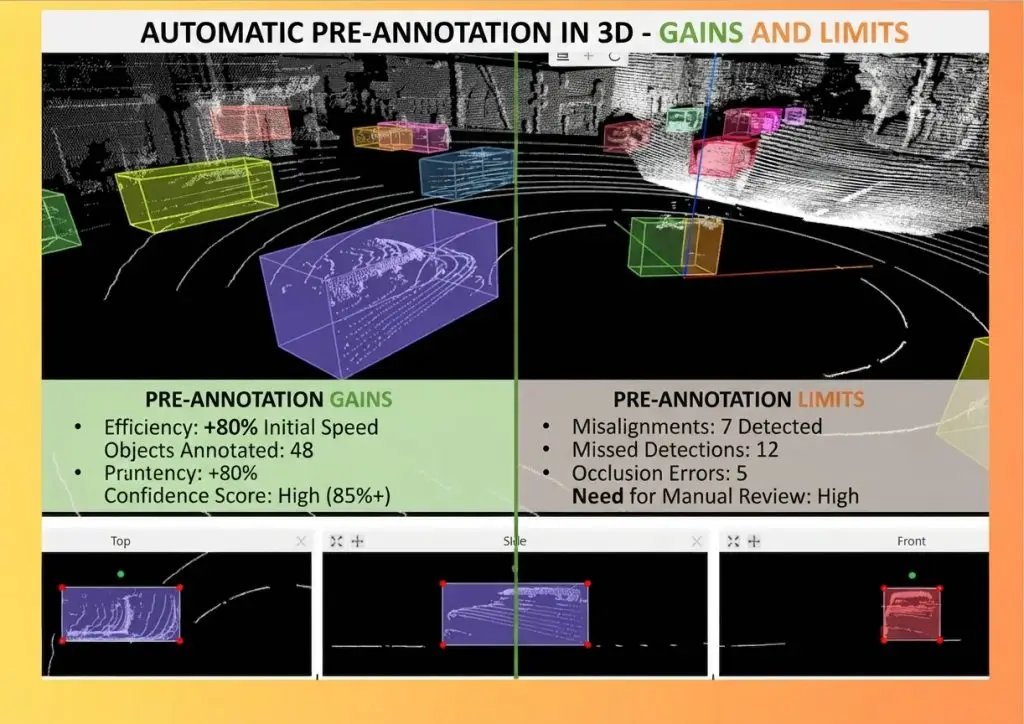
This decision dominates every other lever in a 3D annotation project.It is taken at scoping.Four geometry levels occur in 3D annotation, in order of increasing cost.The point or the count, which requires a coarse localisation.The cuboid, the standard for most perception projects.Semantic segmentation, which assigns a class to every point.And instance segmentation, which adds the separation of objects in contact.One important practical consequence follows for a 3D annotation project. Moving from the second to the third level produces the largest cost variation, and it is justified only where the downstream use exploits shape rather than footprint.What distance changes
This second factor bounds the volume.It is often left open.The number of objects grows with the square of the distance covered.Three consequences follow.A generous distance inflates the object volume considerably.The most distant objects are the most expensive per unit, sparsity slowing the decision.And their training value falls, the class becoming uncertain and the dimension extrapolated.One important observation follows. Those three consequences combine unfavourably, the objects added by a generous distance costing the most and contributing the least, which makes the distance threshold the second saving lever in a 3D annotation project.What attributes change
This third factor is regularly omitted from a 3D annotation costing.Three attribute categories differ in cost.Constant attributes, class and reference, of negligible cost.Observable attributes, occlusion and state, which require an additional examination.And interpretive attributes, intent or fine category, which require judgement and slow the work considerably.One practical consequence follows for a 3D annotation project. Orientation deserves separate treatment, it is not an attribute but a component of the geometry, and its precision requirement changes the time per object more than any attribute does.What density changes
This factor acts in two opposite directions according to the task.Three effects are distinguishable in 3D annotation.On cuboids, a sparse cloud slows the decision, the object becoming hard to qualify and to delimit.On segmentation, a dense cloud lengthens the handling without easing the decision.And on both, uneven density within one scene makes throughput unpredictable.One observation follows. The first and second effects oppose one another, which forbids transposing experience gained on one task to the other and makes a pilot batch necessary for each formulation.The pilot batch as the only estimate
This method turns those factors into a defensible figure.A few real scenes annotated supply what no estimate produces.Four usable pieces of information follow.The throughput observed per scene type, which replaces any assumption.The number of objects per scene and per class, the real basis of sizing.Disagreement between annotators, which bounds what can be promised.And the feasibility of the conventions, including the edge cases revealed.One important practical consequence follows. The throughput gap between a sparsely populated scene and a dense one reaches a factor nobody anticipates correctly, which makes a costing without a pilot arbitrary rather than imprecise in 3D annotation.Relative orders of magnitude
Four ratios help at scoping without quoting a rate and they are verified on a pilot batch.A semantic segmentation costs a multiple of a set of cuboids on the same scene.An instance segmentation adds a surcharge only in the zones where objects of the same class touch.Doubling the maximum distance multiplies the object count far beyond what common sense suggests.And a tight requirement on orientation lengthens the time per object by more than an additional attribute would.One observation follows for a 3D annotation project. Those four ratios are measured on a single pilot batch and they supply the client with a grid they apply themselves to their trade-offs, which shifts the discussion from price to scope.What quality control costs
This line is the most frequently absorbed into annotation and it deserves one of its own.Four elements compose it in 3D annotation.Setting up the automatic checks, dimensional plausibility, intersection and ground consistency, a one-off cost of a few hours.Running them, near nil and repeatable across every batch.Human verification of the alerts produced, proportional to the number of real defects.And double annotation of a sample, whose rate determines the surcharge.One observation follows for a 3D annotation project. The first element is the best returning line in the whole budget, metric quantities supplying verifiable constraints image annotation does not, which makes automatic control more powerful here and its setup cost faster to recover.What infrastructure costs
This 3D annotation line deserves isolating.Four elements compose it in 3D annotation.The workstations, whose graphics memory conditions fluidity.Storage, a corpus of clouds far exceeding an image corpus of equivalent coverage.Transfer, whose duration becomes a scheduling constraint on large volumes.And the platform itself, operation included in a self-hosted configuration.One observation follows for a 3D annotation project. The first element distinguishes this field, an ordinary workstation sufficing for images and becoming limiting for clouds, which constitutes an entry cost few providers anticipate.What genuinely reduces cost
Five levers work in 3D annotation.They act before production.Simplifying the geometry where the use does not demand better.Fixing a maximum distance, which removes the most expensive and least useful objects.Removing the attributes the downstream decision does not exploit.Automating ground removal, which frees most of the volume of an outdoor scene.And subsampling an overly dense cloud where the task does not require it.One practical consequence follows. Those five levers act on the scope and degrade nothing, whereas attention naturally goes to accelerating production, which produces a smaller gain and a greater risk.What assistance changes in the budget
One lever modifies a project’s economics and its effect varies strongly by task.Three levels differ in worth.Automatic ground removal, immediately worthwhile and applicable from the first batch.Automatic fitting of a cuboid to a selected cluster, which speeds placement and leaves the orientation to the human.And full pre-annotation by a model, whose gain grows with the corpus’s maturity.Three caveats accompany them.Verification stays necessary and it bears on the whole.Orientation stays the weak point, a model reproducing the ambiguities rather than resolving them.And validation bias requires targeted checks that consume part of the saving.One practical consequence follows for a 3D annotation project. The first level stands clearly apart from the other two, it requires no prior corpus and it frees the majority of points in an outdoor scene, which makes it the only gain available from the start.The false economies
Four apparent reductions cost more than they save in 3D annotation.Skipping the pilot batch, which saves a day and produces a costing whose gap is paid in production.Omitting the dimensional range table, which deprives the project of its most effective check.Absorbing quality control into annotation, which hides a line rather than removing it.And undersizing the workstations, which saves a purchase and slows all the production.Those four reductions share a common structure. Each removes a cost visible now and creates an invisible one later, a configuration the preceding series identified as the most deceptive.The line nobody budgets
One cost appears after the first delivery and it rarely features in a proposal.Three elements compose it in 3D annotation.Enrichment on the failures observed, which presupposes a recording arrangement decided upfront.Extension to new conditions, a different site or a replaced sensor producing data the initial corpus does not cover.And convention rework, an evolution of the downstream use invalidating a rule applied across a whole corpus.One commercial consequence follows. A proposal presenting only the build understates the client’s real spend, and separating build from operation prevents a competitor appearing cheaper with an incomplete figure.The spending calendar
A cash-flow observation completes the estimate in 3D annotation.Preprocessing and transfer precede any production and tie up time without producing a deliverable.Conventions and the pilot batch occupy the first days and determine everything after.The infrastructure, graphics workstations included, is paid for before the first scene.Annotation spreads out and is a regular charge.And control and documentation arrive at the end of production, when the budget is already committed.One practical consequence follows. The two lines determining whether a corpus will be defensible and reusable fall at the moment a budget has least flexibility, which explains why they are precisely the ones compressed.The billing models
Four modes coexist and their choice redistributes risk.Billing per object, the most faithful to the real work on a cuboid project.Billing per scene, legible and strongly exposing the provider to density variability.Billing by time, suited to work whose difficulty is poorly known.And a fixed price, which gives the client full visibility and transfers the whole risk to the provider.One recommendation follows for a 3D annotation project. A billed pilot batch followed by a fixed price combines the advantages, the pilot removing the uncertainty about objects per scene that made the fixed price risky.Comparing two proposals
Six questions make two 3D annotation offers comparable.What geometry per class.What maximum annotation distance.Is orientation part of the scope and with what tolerance.Are unobserved faces extrapolated and marked.Does the plausibility check feature as a distinct line.And is the evaluation corpus included in the quoted scope.One observation follows. The second question is the one where answers diverge most, a generous distance inflating the volume without improving a system that will not exploit it.Signals of a fragile costing
Five signs indicate a 3D annotation estimate will not hold.The scope is expressed in number of scenes with no mention of object counts.No maximum distance is fixed.The geometry is not specified class by class.Quality control does not appear as a distinct line.And no pilot batch has been run on the client’s real scenes.One observation follows. Those five signs are verified by reading a proposal, they require no technical competence, and their presence predicts an overrun better than any analysis of the headline price.Presenting a budget to a client
Four framings allow a budget dominated by human work to be accepted.Show the calculation in objects, whose result explains a volume the scene count was masking.Set out what the pilot batch revealed on their own scenes, which convinces better than a rate card.Separate build from operation, which avoids the distorted comparison with an incomplete offering.And propose a costed reduction in scope, geometry or distance, which demonstrates that the objective is a usable result rather than a billed volume.One observation follows for a 3D annotation provider. The first framing is the most effective, a client frequently discovering that their scenes contain several times more objects than they imagined as soon as one counts beyond the near zone.Three questions that halve the budget
Three questions asked in one meeting frequently reduce the cost by half.Does the downstream use exploit shape or footprint. A footprint-oriented answer rules out segmentation and halves the budget.Out to what distance does the system actually act. An answer below the sensor’s field removes a large share of the objects.Which attributes does the decision really exploit. An attribute filled and never read is pure load.Those three questions concern the use and not the technique, they are asked before any price discussion, and a client answers them readily once they understand what each answer costs.What the corpus is worth afterwards
Four properties determine whether a 3D corpus behaves as an asset.Retention of the source clouds, an annotation separated from its data losing all value.Declaration of the frame and orientation conventions, without which it is combinable with none.The presence of the occlusion and confidence attributes, which permit filtering rather than reworking everything.And documentation of the source and the sensor, which bounds the corpus’s use on data of another origin.One observation follows. Those four properties cost little at the time of building and cannot be added afterwards, which places them in the same category as the scoping decisions set out above.Approaching the costing of a 3D project
Five questions produce a defensible estimate in 3D annotation.What geometry does the downstream use actually require. That answer is the principal lever.What maximum distance must be covered. That answer bounds the volume.How many objects per scene on average. That answer replaces counting scenes.What tolerance on orientation. That answer changes the time per object.And is a pilot batch accepted. Its refusal makes any fixed price imprudent.Those five answers determine the volume and the structure of the offering. Asking them before costing avoids committing to a scope whose extent surfaces in production.What this chapter teaches
One cross-cutting observation deserves closing this examination.The cost of a 3D project is determined by scope decisions rather than by the quantity of material.Three findings compose it.Geometry and maximum distance multiply against one another and determine the budget more than the number of scenes.Those two decisions are taken in one meeting and commit the whole spend.And they belong to the downstream use rather than to annotation technique, which places a provider’s value at scoping as much as in production.That finding matches the one the video cluster established: an interlocutor able to bring a scope back to what the use requires spares their client a spend out of all proportion to the price of their engagement.The count to do in the first meeting
One arithmetic exercise settles more than any discussion of rates, and it takes minutes.Open one representative scene, count the objects inside the distance the system actually uses, multiply by the number of scenes.Three things happen in a 3D annotation discussion when that number appears.The client sees why a few hundred scenes is not a small job, since the figure is usually far above the mental model they arrived with.The distance threshold stops being a technical detail and becomes the visible lever it is, since counting twice with two thresholds shows the difference immediately.And the conversation moves from what the provider charges to what the project contains.One practical consequence follows for a 3D annotation provider. This count can be done on the client’s own scenes in front of them, it requires no tooling beyond a viewer, and it converts a price objection into a scope discussion more reliably than any explanation of methodology.Common mistakes
These failures recur often enough that naming them is usually enough to avoid them.- Costing by the scene without having counted the objects.
- Costing a segmentation by point count rather than by boundary length.
- Leaving the maximum distance open.
- Requesting segmentation where a cuboid would have sufficed.
- Accepting interpretive attributes without costing their load.
- Omitting the dimensional range table.
- Absorbing quality control into the annotation line.
- Neglecting the cost of graphics workstations and storage.
- Comparing two proposals on the per-scene price.
- Committing to a fixed price with no prior pilot batch.