
Point-wise segmentation is the most demanding formulation in 3D annotation. It assigns a class to every measurement rather than a box to every object, and that change of unit multiplies the load by a ratio few clients anticipate.This article sets out what it demands. It extends the article on 3D cuboids.
The three formulations
Three 3D annotation tasks carry the same name.Their cost differs strongly.Semantic segmentation, which assigns a class to every point without distinguishing objects of the same class.Instance segmentation, which additionally separates two neighbouring objects of the same kind.And panoptic segmentation, which combines the two by treating countable objects and continuous surfaces differently.One important practical consequence follows. Those three formulations demand work whose cost ratio is substantial, separating instances on objects in contact constituting most of the surcharge in 3D annotation.What changes from the cuboid
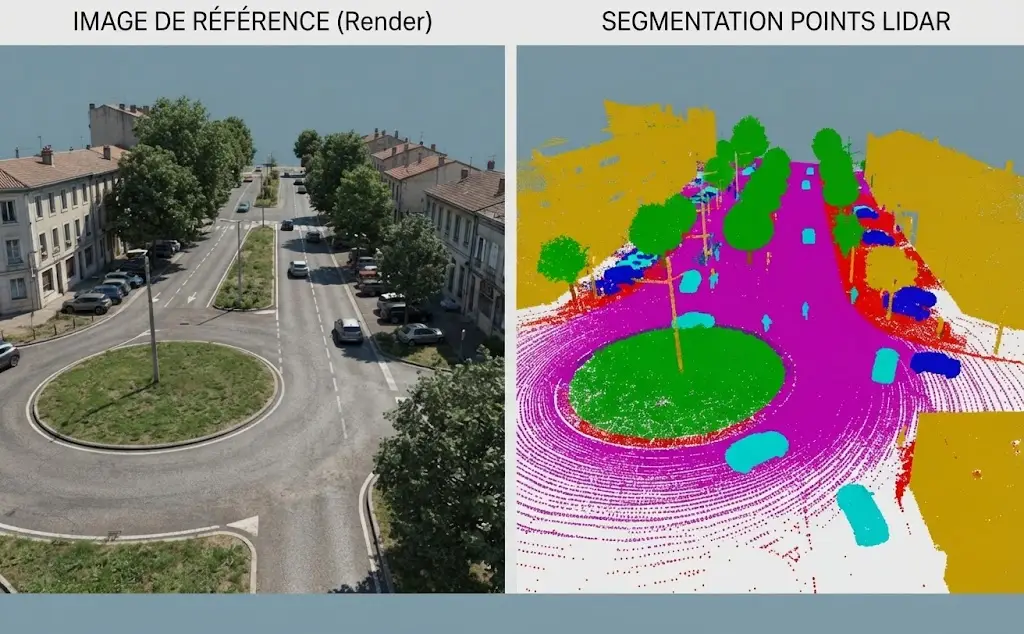
Four differences separate these two 3D annotation formulations.The unit of work becomes the point rather than the object, which makes the load depend on the cloud’s density.Continuous surfaces become annotatable, ground, vegetation and built structures having no box-like footprint.The real shape is described, which serves manipulation and volume measurement tasks.And boundaries between classes become the principal source of disagreement, where the cuboid concentrated the difficulty on orientation.One observation follows. The second difference explains most of the demand, a mapping or planning project needing to classify surfaces no box describes.The boundary between classes
This difficulty dominates the task and it is structural.The passage from one class to another does not always correspond to a sharp limit in the data.Four configurations illustrate it in 3D annotation.Contact between an object and the ground, where the last points under a vehicle belong to one or the other.Low vegetation, whose separation from the ground depends on a height threshold to be fixed.Adjoining surfaces, a wall and a pavement meeting with no measurable discontinuity.And composite objects, a post carrying a sign belonging to one class or two.One practical consequence follows for a 3D annotation project. Those four configurations concentrate most of the disagreement between annotators, which justifies devoting most of the case library to them rather than documenting the obvious situations.What density imposes
This property governs the task’s feasibility.The number of points on a surface falls with the square of the distance.Three consequences follow.A distant surface becomes unclassifiable, a few scattered points carrying no usable signature.The cost per point does not vary but the cost per square metre annotated rises strongly near the sensor.And the boundary between two classes becomes more arbitrary the sparser the points are.One important observation follows. The second consequence inverts the cuboid’s logic, a near dense zone costing more to segment than a distant one while it cost less to enclose.How an annotator works
Five tooling capabilities condition throughput on this 3D annotation task.Volume selection, which assigns a class to every point inside a drawn shape.Selection by propagation, which extends a selection to neighbouring points according to a continuity criterion.Height filtering, which quickly isolates the ground and low objects.Projection onto an image, which permits verifying an ambiguous class.And fine undo, an unfortunate gesture affecting thousands of points at once.One important practical consequence follows. The second capability is the principal throughput lever, a well-tuned propagation handling in one gesture what a manual selection would require delimiting point by point.The role of propagation
This mechanism carries most of the productivity in 3D annotation.It deserves separate treatment.Propagation extends a selection according to a criterion of proximity or surface continuity.Three settings govern its behaviour in 3D annotation.The neighbourhood radius, a value too large causing the selection to spill onto a neighbouring class.The continuity criterion, distance alone or surface orientation, the latter respecting edges better.And the extension limit, which bounds a propagation before it traverses the whole scene.One practical consequence follows. Those three settings differ by class treated, a propagation suited to built structures systematically spilling onto vegetation, which justifies per-class settings rather than one setting.The classes of an outdoor cloud
Six categories compose a common 3D annotation nomenclature.Their difficulty differs markedly.The ground, the largest class by volume and the fastest to handle by filtering.Built structures, whose planar faces propagate easily.Vegetation, whose sparse structure resists propagation.Moving objects, whose separation from the ground demands particular care.Furniture and infrastructure, posts, barriers and signage.And noise, aberrant points whose existence must be provided for by a dedicated class.One observation follows for a 3D annotation project. The last class is the most often omitted, the absence of an outlet for aberrant points leading annotators to attach them arbitrarily and pollute the neighbouring classes.What intensity contributes
One piece of information often accompanies the coordinates and it is regularly ignored.A range sensor also measures the strength of the returned signal.Three exploitations follow in 3D annotation.Distinguishing materials, a reflective road marking separating clearly from asphalt of identical geometry.Detecting problematic surfaces, an abnormally weak return signalling glazing or a dark surface.And aiding segmentation, propagation being able to incorporate that criterion alongside proximity.One important observation follows. The first exploitation resolves a share of the cases geometry alone leaves undecidable, which makes the availability of that information decisive for any nomenclature distinguishing materials rather than shapes.Separating instances
One additional requirement deserves separate treatment since it carries most of the surcharge.Two objects of the same class in contact must receive distinct identifiers.Four configurations make that difficult.Direct contact, two vehicles bumper to bumper presenting no geometric discontinuity.Partial overlap, one object hiding another and removing the visible boundary.Continuous structures, a row of trees or a hedge not dividing into obvious individuals.And composite objects, a tractor and trailer combination belonging to one instance or two.One important practical consequence follows for a 3D annotation project. The third configuration calls for an explicit counting rule rather than a judgement, a hedge potentially constituting a single instance or as many instances as there are plants according to what the downstream use exploits.Quality control on a segmentation
Five verifications detect the defects specific to this 3D annotation task.The distribution of classes per scene, an unusual proportion signalling an omission or a spillover.Unclassified points, whose rate must stay bounded and declared.Vertical consistency, ground points located above a building signalling an error.Isolated islands, a small group of points of one class surrounded by another signalling a propagation spillover.And comparison between annotators on the boundary zones rather than on the whole scene.One important observation follows. The fourth verification is the most revealing and the most economical, a propagation spillover producing a characteristic geometric signature nothing else produces in 3D annotation.Measuring disagreement on a segmentation
One operation bounds what can be promised and it differs from the cuboid version.Two annotators handle the same scene and their classes are compared point by point.Four usable pieces of information follow.Global agreement, generally high and uninformative since dominated by the large easy surfaces.Agreement per class, which identifies the categories whose definition does not hold.Agreement restricted to the boundary zones, the only measure representative of the real difficulty.And the list of contested configurations, the raw material of the case library.One practical consequence follows for a 3D annotation project. The first indicator is the one that gets reported and the third is the one that informs, a flattering global agreement being able to coexist with massive disagreement on the boundaries that constitute the corpus’s whole point.What this task costs
Five factors determine the load in 3D annotation.They do not reduce to the number of points.The number of classes, whose proximity matters more than their count.The length of the boundaries between classes, this task’s true unit of work.The instance requirement, which adds separating objects in contact.The cloud’s density, which lengthens verification time without changing the difficulty of the decision.And the presence of a projected image, which reduces the time spent on ambiguous classes.One practical consequence follows for a 3D annotation project. The second factor is the most predictive and the least used, a scene whose objects are numerous and fragmented costing more than a scene of the same volume with large homogeneous surfaces.The uses that require this formulation
Five contexts require a segmentation rather than a cuboid.Mapping and the digital twin, where the deliverable is a classification of space and not a list of objects.Robotic manipulation, where grasping an object presupposes knowing its shape and not its footprint.Volume measurement, in quarrying, in storage or in forest biomass.Traversable ground detection, where the question concerns a continuous surface.And structural analysis, where the geometry of a structure or a plant constitutes the information sought rather than a means to locate it.One observation follows for a 3D annotation provider. Those five contexts have in common that they concern surfaces rather than countable objects, which supplies a simple criterion for steering a client towards one or the other formulation from the first exchange.What pre-annotation contributes here
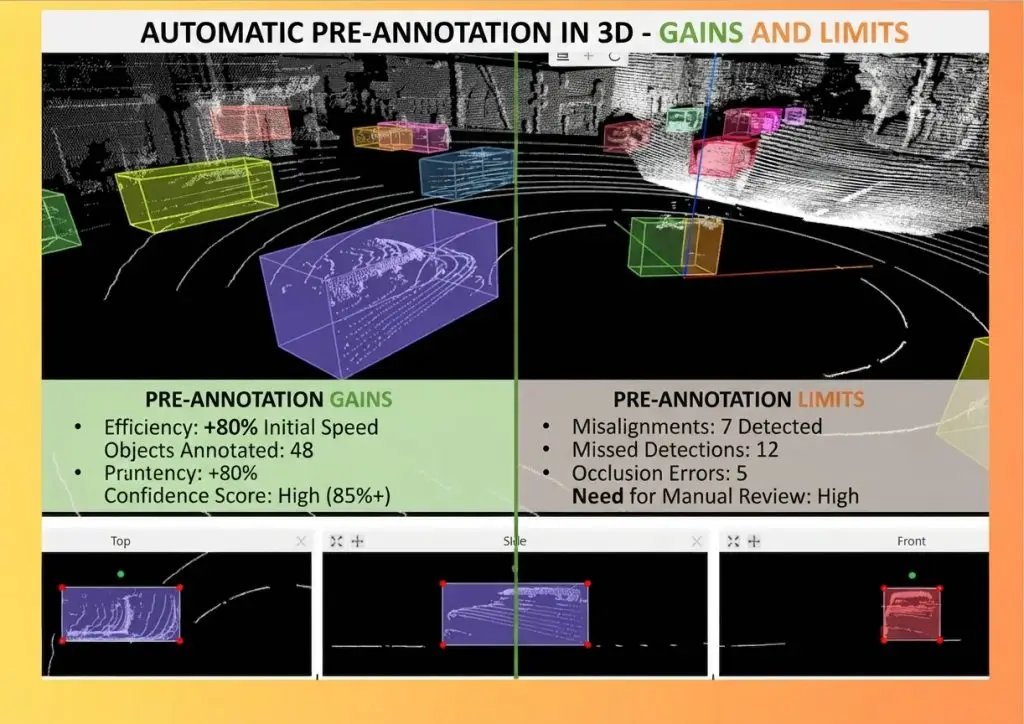
Three observations situate the contribution of assistance in 3D annotation.Classifying large surfaces works well, ground and built structures being abundant in training corpora.Boundaries stay human, a model producing a plausible limit rather than one conforming to the project’s convention.And instance separation on objects in contact remains the weak point.One observation follows. Those three findings lead to an effective division, the model handles the volume and the human handles the boundaries, a division matching exactly the cost structure set out above.What this task does not permit
Four limits bound what a 3D annotation segmentation can establish.An unsampled surface is not classifiable, occlusion removing the data rather than masking it.Two distinct materials of the same geometry are indistinguishable without complementary information.A progressive boundary becomes sharp only by convention.And an object too sparsely sampled receives a class by inference rather than by observation.That second limit deserves emphasis. It means a nomenclature distinguishing two surfaces by their nature rather than by their shape presupposes an image or an intensity measurement, a requirement to verify before accepting the nomenclature.The delivery formats
Four format decisions commit the exploitation of a segmentation.How the class is carried, an extra field per point or a label file indexed on the point order.The treatment of unclassified points, an explicit reserved value rather than an absent label.The representation of instances, an identifier separate from the class rather than combined with it.And the class table delivered with the corpus, without which the numeric values mean nothing to anyone who did not produce them.One practical consequence follows for a 3D annotation project. The second decision produces the commonest misunderstanding, an absent label meaning either that no class fits or that the zone was not handled, an ambiguity lifted by a reserved value and a declaration of the zones covered.The conventions to write first
Five rules cover most of the disagreement on this task.The attachment of contact points between an object and the ground, expressed by a height criterion rather than by a judgement.The threshold separating low vegetation from the ground.The treatment of composite objects, a post and a sign belonging to one class or two.The counting rule for continuous structures where instances are required.And the fate of aberrant points, with the class that receives them.One practical consequence follows for a 3D annotation project. Those five rules all concern boundaries, which confirms this chapter’s central finding, a useful case library documents the zones of contact and not the obvious situations.The first batch of a segmentation project
Four scenes compose a pilot batch that genuinely tests the conventions.A scene with large homogeneous surfaces, which supplies the reference throughput.A densely fragmented scene, furniture and vegetation intermingled, which reveals the real cost of boundaries.A scene containing objects of the same class in contact, which tests the counting rule where instances are required.And a scene with a problematic surface, glazing or water, which verifies the treatment of aberrant points.One observation follows. The throughput gap between the first two scenes is this batch’s most useful figure, it directly measures the effect of boundary length and it supplies the basis for a costing the point volume does not permit in 3D annotation.Combining the two formulations
A mixed arrangement occurs and it deserves flagging.One corpus can carry cuboids on the countable objects and a segmentation on the surfaces.Three advantages accompany that arrangement.The cost stays contained, the expensive segmentation bearing only on the categories that require it.Each use receives the representation that suits it with no global trade-off.And the checks of both formulations each apply to their own scope.One observation follows for a 3D annotation project. This arrangement requires deciding class by class rather than globally, an hour’s exercise that frequently produces a saving greater than any production optimisation.Approaching a segmentation project
Five questions scope a segmentation project in 3D annotation.Which formulation, semantic, instance or panoptic. That answer determines the cost by a substantial ratio.Are the classes distinguished by shape or by nature. The latter presupposes complementary information.Is a class provided for noise. Its absence pollutes the neighbouring classes.Are the ambiguous boundaries documented. Their absence produces irreducible disagreement.And is a projected image available. Its presence strongly reduces the time on ambiguous cases.Those five answers determine the load and the feasibility. Asking them before starting avoids a corpus whose boundaries vary from one annotator to another.The question that frames the project
One question determines the formulation and it concerns the expected deliverable.Does the user need to count objects or to qualify space.A counting-oriented answer places the project on the cuboid side, faster and sufficient for detecting, tracking and avoiding.A surface-qualification answer requires segmentation, no box describing a ground, a wall or a plant canopy.That question is asked in one sentence, it separates two very different cost regimes, and it avoids the most expensive case, a segmentation requested for a use a cuboid would have served.Three checks before delivering
Three verifications suffice to rule out most defects in a segmented batch.Compare the class distribution with that of previous batches, a divergence signalling an omission or a systematic spillover.Find the isolated islands, small groups of one class surrounded by another, the characteristic signature of a badly tuned propagation.And record the rate of points left unclassified, a value that must stay bounded and appear in the report rather than stay implicit.Those three checks run on a delivered export, they need no external reference, and they cover what distinguishes a usable segmentation from a visually acceptable one.What this chapter teaches
One cross-cutting observation deserves closing this examination.Point-wise segmentation moves the unit of work and therefore the cost structure.Three findings compose it.Boundary length predicts the load better than the number of points, which makes a costing by volume systematically wrong.The contact zones concentrate the disagreement, which justifies devoting the case library and the control to them.And propagation carries the productivity, which makes its per-class tuning a more important lever than individual competence.That finding matches the one the preceding chapter established about cuboids: the difficulty concentrates on one particular quantity, and the case library must address it first rather than cover the task uniformly.Why clients ask for more than they need
One pattern recurs when segmentation is requested and it is worth understanding rather than resisting.Clients ask for point-wise segmentation more often than their use requires, and rarely out of ignorance.Three reasons explain that in 3D annotation.Segmentation looks like the complete answer, a classification of everything appearing safer than a selection of objects.The published research they have read works on segmented benchmarks, which sets the expectation.And nobody has told them the cost ratio, since a provider quoting on what was asked has no incentive to.One practical response exists for a 3D annotation provider. Quote both formulations on the same pilot scene and show the two figures side by side, which converts an abstract preference into a priced decision and frequently produces the mixed arrangement described above.Common mistakes
These failures recur often enough that naming them is usually enough to avoid them.- Confusing semantic and instance segmentation at scoping.
- Costing by the number of points rather than by boundary length.
- Omitting the class intended for aberrant points.
- Using one propagation setting for every class.
- Not documenting the separation between an object and the ground.
- Fixing a nomenclature distinguishing materials with no complementary information.
- Neglecting the isolated island check, the signature of a spillover.
- Checking the whole scene rather than the boundary zones.
- Expecting a model to respect the project’s conventional boundaries.
- Not declaring the rate of points left unclassified.