
The European Commission states in one sentence what the continent’s space programme has produced: having deployed its own Earth observation and navigation systems, Europe holds capabilities that few actors possess.
Yet a sector conference report published in 2026 describes a debate that has shifted ground: single-source dependency is the strategic risk Europe is now organising around, dual use is no longer the operative category, and the replacement frame is technological sovereignty.
The same report adds an essential qualification in its own title: Europe has not agreed what that term means. This article sets out the positions, the facts and what remains open. It extends the article on AI and Earth observation.
What Europe controls in Earth observation
A factual preliminary avoids misunderstandings, since the debate sometimes concerns capabilities that already exist and work.
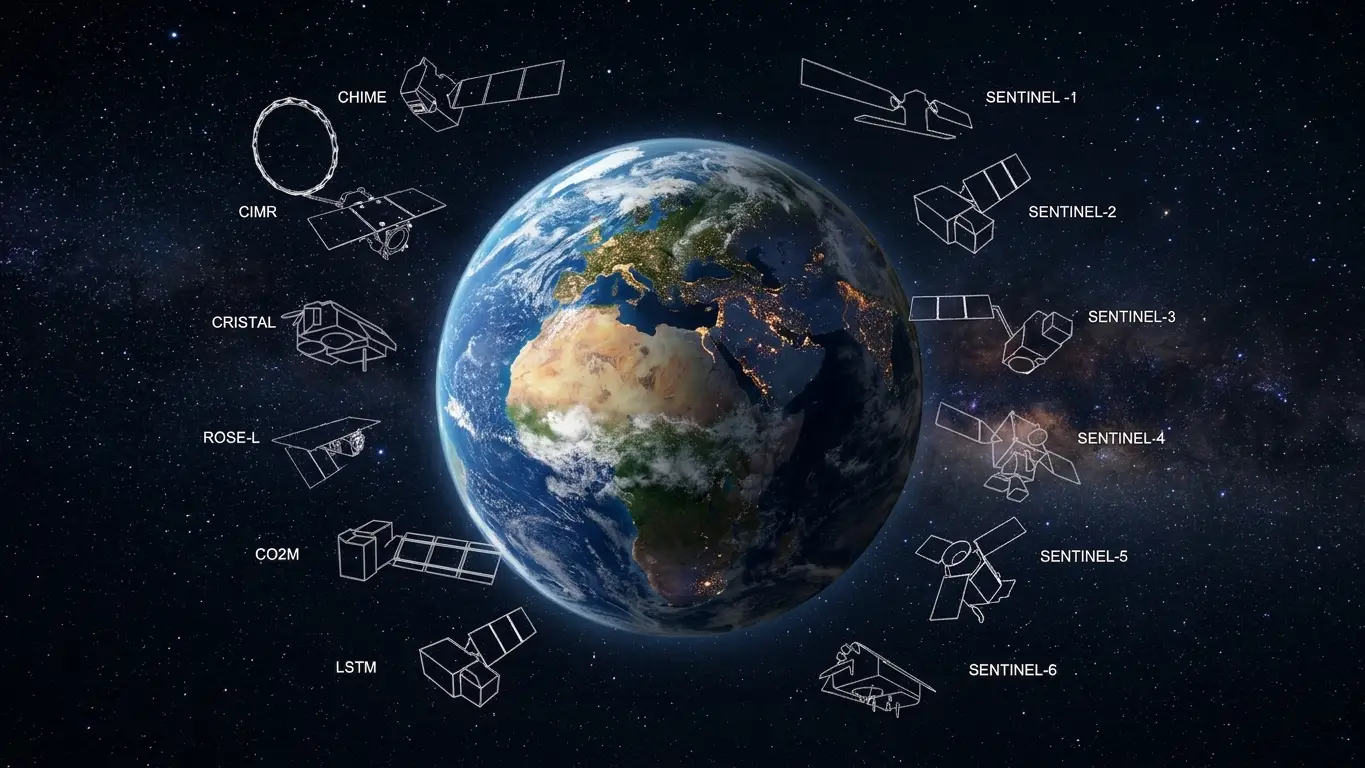
The continent operates its own Earth observation constellation, whose scale and open access regime the Copernicus article described and which has no equivalent elsewhere. It operates its own navigation system. And it is deploying a connectivity constellation whose acceleration the security article documented.
Those capabilities are substantial and they are frequently understated in a debate framed entirely around dependency.
Three further European strengths deserve stating. The continent holds a satellite manufacturing industry with established prime contractors. It holds a dense fabric of specialised companies, which the market article noted. And it holds a scientific community whose contribution to the climate records the corresponding article described.
What remains dependent in European Earth observation
One dependency concentrates the debate and it deserves setting out with the qualifications analysts themselves apply.
Launch capability is the principal point of dependency. A think tank analysis notes that strategic autonomy in space would mean having the ability to operate independent space capabilities, particularly for critical infrastructure like launch services, and that without launch sovereignty and access to space, Europe risks technological and security vulnerabilities that could leave it dependent on unpredictable geopolitical partners.
The same source notes that European launch capability has been delayed, its next-generation launcher having flown five years behind its original schedule, which explains part of the situation described.
Two further Earth observation dependencies deserve mentioning. Certain components and subsystems come from outside the continent, which the sovereignty debate covers under supply chain resilience. And the cloud infrastructure on which much processing runs frequently belongs to non-European operators, a point directly relevant to data work.
The shift in the Earth observation debate
A change of framing has occurred and it deserves noting precisely.
The conference report cited above states that dual use is no longer the operative category. That is a significant statement, since dual use had structured European discourse for a decade, presenting civil and security capabilities as two faces of one investment.
The security article showed why that framing has limits: a civil mandate can prevent a programme’s use in a defence context whatever its technical capability, which led to developing a distinct capability rather than extending the existing one.
The replacement frame, technological sovereignty, displaces the question. It no longer asks whether one capability can serve two purposes, but whether the capability is controlled at all.
That displacement of framing has a practical consequence for a data provider. The criterion is shifting from what a service does towards who controls the chain producing it, which is a different question and one on which a provider can position.
The four competing definitions of sovereignty
The absence of agreement on the term is not a detail, since the definitions lead to different policies.
A definition centred on capital ownership holds that a capability is sovereign if the entities owning it are European. It favours established industrial actors and it says nothing about where operations occur.
A definition centred on physical location holds that a capability is sovereign if the infrastructure sits on the territory. It favours operators with local facilities and it says nothing about who controls them.
A definition centred on jurisdiction holds that a capability is sovereign if the entity operating it answers to European law without competing extraterritorial obligations. It is the most demanding and it excludes some arrangements the previous two would accept.
And a definition centred on competence holds that a capability is sovereign if the know-how needed to operate it is available on the territory. It is the least discussed and it concerns data work directly.
Those four definitions are not equivalent at all. An arrangement can satisfy one and fail another, which is why the report cited notes the open question of which definition will end up encoded in procurement language by default.
The pragmatic position
A dissenting view deserves setting out, since the debate is real and a one-sided presentation would mislead.
The same think tank analysis argues for a measured approach: rather than chasing complete space sovereignty, Europe must embrace space pragmatism by leveraging autonomy where essential, and interdependence where advantageous, the path forward requiring a balance of ambition and realism.
That position does not contradict the preceding one. It draws a different conclusion: the question is not whether to be autonomous but on what.
Three arguments support that pragmatic position. The cost of complete autonomy would be considerable and it would fall on capabilities others supply efficiently. The catch-up time would be long, the delayed launcher illustrating it. And interdependence brings advantages, notably access to capabilities no single actor develops alone.
The same text nonetheless notes that in an international environment increasingly shaped by transactional norms, where cooperation becomes more contingent and subject to rapid policy shifts, such dependencies carry growing strategic risks.
What Earth observation data sovereignty covers
The debate concentrates on launchers and constellations, and it leaves in shadow a dimension more directly relevant to exploitation.
The security article distinguished four dimensions: acquisition, transmission, processing and competence. The first two attract public attention; the last two concern data work.
Processing sovereignty raises a simple question. Data acquired by a European satellite, transmitted through European infrastructure, but processed on a platform under a third-country jurisdiction, does not sit in the same regime as data processed within the Union.
Competence sovereignty raises the next. A technical capability whose exploitation depends on know-how unavailable on the territory is not fully sovereign, and that dimension is the least debated.
Those two have an immediate practical consequence. An Earth observation project subject to sovereignty requirements must examine where its data is processed and by whom, questions arising at scoping rather than afterwards.
The role of national actors
A structural feature of the European situation deserves stating, since it shapes how demand arrives.
Space competences are shared between the Union, an intergovernmental agency and national programmes, which produces three distinct channels of demand.
The Union funds the flagship programmes and increasingly formulates collective requirements, which the security article described regarding the governmental service in preparation.
The intergovernmental agency funds development and has recently extended its remit, having agreed for the first time to finance projects supporting defence-related space capabilities.
And national programmes remain substantial in several member states, with their own procurement procedures and their own sovereignty criteria.
That institutional fragmentation has a consequence for a provider. A reference established at one level does not transfer automatically to another, and the criteria differ, which means the sovereignty argument must be reformulated per interlocutor rather than stated once.
What this changes for a European Earth observation provider
Four practical consequences follow.
The first is that establishment in the Union becomes an explicit commercial criterion for a growing share of demand, notably institutional, which the market article flagged.
The second is that the location of processing must be documented rather than merely asserted, a serious client verifying where data actually transits.
The third is that the regulatory framework in preparation will create compliance requirements, and a provider anticipating them will be ahead of a competitor discovering them at the deadline.
And the fourth is that the competence sovereignty argument, rarely formulated, distinguishes a European actor from a non-European offering on ground other than price.
One caveat accompanies those four points. The sovereignty argument does not replace work quality; it opens a door that competence must then justify.
The limits of the sovereignty argument
An honest reading requires setting out what this argument cannot support.
It does not justify an unlimited price gap. An institutional buyer arbitrates between requirements and budget, and a sovereignty premium has a bound.
It does not apply uniformly. The security article showed requirements vary by use, and a purely scientific project does not meet them.
It does not remove the need to demonstrate capability. A European provider unable to handle a given sensor does not become competent through its location.
And it is evolving. The pragmatic counterpoint cited above indicates part of the debate concerns the perimeter of what must be sovereign, and that perimeter is not fixed.
Those four limits together lead to a simple recommendation. Use this argument as one differentiator among others rather than as the principal one, and formulate it precisely rather than generically.
What Europe could do with its Earth observation advantage
One observation deserves stating, since the debate dwells on weaknesses and says less about strengths.
The open data policy the Copernicus article described is a genuine strategic asset and it is rarely presented as one. It has produced an ecosystem of users, applications and competences that no closed policy would have generated.
Three consequences follow from that policy. European actors hold native familiarity with a resource others must learn. The applications built on it constitute an installed base. And the policy itself exerts influence, since a freely available resource shapes practices well beyond the territory that funds it.
That third point is by far the least discussed. An open resource of this scale sets de facto standards, in formats, in nomenclatures and in processing conventions, which is a form of influence distinct from capability and arguably more durable.
The Earth observation dependency that concerns models
One dimension deserves separating because it is recent and rarely raised in these terms.
The AI and Earth observation article showed that foundation models are trained on datasets whose geographic bias is documented. Those models and those datasets are largely produced outside the continent.
Three consequences follow from that. A European project building on such a model inherits its biases and its blind spots without necessarily knowing their extent. The evaluation of that model rests on benchmarks whose composition was chosen elsewhere. And the capability to train an equivalent depends on computing resources whose supply raises its own dependency questions.
That reading extends the sovereignty debate into a domain where it is little formulated. A continent holding its own satellites, its own launchers and its own ground infrastructure, but relying on models trained elsewhere on corpora chosen elsewhere, would hold an incomplete sovereignty of a kind the current debate does not name.
The practical implication is that building European annotated corpora, documented and representative, is a sovereignty contribution as much as a technical one, and it is considerably cheaper than a launcher and considerably faster to deliver.
How to formulate the argument without devaluing it
Four recommendations follow, since a generic sovereignty claim carries very little weight with an informed interlocutor.
State which dimension is meant. Saying that processing occurs within the Union under European jurisdiction says something; saying one is a European actor says almost nothing.
Document rather than assert. Where the data sits, which entities have access, under which law, and what happens at the end of an engagement, all of which the security article covered.
Acknowledge what is not sovereign. A provider using a non-European cloud layer and saying so is more credible than one implying complete control.
And connect the argument to a concrete benefit. Sovereignty is a means; the buyer’s end is continuity of service, protection of information or compliance, and framing it that way makes the argument operational.
A reading of Earth observation that goes beyond Europe
One generalisation deserves stating, since the question is not exclusively European.
Every region depending on capabilities it does not control faces a version of this debate, and most regions are in that position. The considerations set out here apply, with different actors, wherever a state or a group of states assesses its dependencies.
Two consequences follow for a provider of annotated data. The reasoning developed for a European context transposes to other regions facing the same question, which widens the relevance of the competences involved. And regions currently dependent constitute a demand that will develop, particularly for the ground truth the AI article showed to be concentrated in already documented areas.
That second consequence connects the strategic question directly to the commercial one. Building annotation capability in a region that lacks it serves the sovereignty of that region and it addresses the documented gap in global corpora, which are two arguments for the same work.
What a European provider should prepare now
Three preparations cost little and position an actor for what the calendar below will settle.
Document the current configuration precisely, storage, processing, access and jurisdiction, since that document will be requested and producing it under time pressure yields vaguer answers than producing it calmly.
Identify which of the four definitions the configuration satisfies and which it does not, which turns an uncertain position into a known one.
And build references in the domains where sovereignty requirements are lighter, civil security and environmental monitoring notably, since a demonstrated capability transfers upward far more easily than a claimed one.
The Earth observation calendar to watch
Four milestones structure the coming period in European Earth observation, and they are worth tracking rather than forecasting.
The regulatory framework in preparation, whose effective date and final shape will determine the compliance burden on operators.
The next budget framework, which will settle the funding of the governmental service the security article described.
The awards of the capability programmes under way, which will indicate which actors the criteria actually favour.
And the formulation of procurement criteria, which is where the definition of sovereignty will be settled in practice rather than in principle.
What a buyer actually verifies
Six questions recur when an institutional buyer assesses an Earth observation sovereignty claim, and preparing written answers to them matters more than any positioning statement.
Where is the data stored, physically and legally, a distinction the security article showed the two are not the same.
Which entities can access it, under what law, and whether any of them is subject to extraterritorial obligations that could compel disclosure.
Where is the processing performed, including any subcontracted or cloud layer, which is where most claims turn out to be looser than stated.
Who holds the competence, and whether the work could continue if a particular relationship ended.
What happens to the data at the end of the engagement, return or destruction, with proof.
And what the provider does not control, stated explicitly, since a claim of complete control invites verification and a candid limitation invites trust.
That final question is the one most providers avoid and the one most worth answering. A buyer assessing sovereignty is assessing risk, and an acknowledged limitation is a risk they can price, while an unacknowledged one is a risk they discover.
Common errors of reading
These misreadings recur often enough that naming them is usually enough to avoid them.
- Treating sovereignty as one notion rather than four distinct dimensions.
- Assuming the debate concerns launchers alone.
- Ignoring the jurisdiction under which data is processed.
- Asserting a processing location without being able to document it.
- Presenting sovereignty as a consensus when its definition is contested.
- Using the argument as the principal one rather than as a differentiator.
- Assuming a sovereignty premium is unlimited.
- Neglecting the regulatory framework in preparation and its deadlines.
- Confusing European establishment with demonstrated technical capability.
- Waiting for procurement criteria to be settled before preparing for them.
- Overlooking that models and training corpora are themselves a dependency.
- Presenting the open data policy as a cost rather than as a strategic asset.
Why this matters beyond procurement
A closing observation places the Earth observation sovereignty debate in the frame this series has used throughout.
Sovereignty discussions concentrate on hardware because hardware is visible and expensive. Satellites, launchers and ground stations have budgets, schedules and photographs. That visibility shapes what gets debated.
The articles in this cluster have converged on a different conclusion. The scarce input in Earth observation is not imagery, which is abundant and largely free, but the ability to interpret it, which rests on annotated corpora that are geographically concentrated and expensively built.
Applied to sovereignty, that reading suggests a reordering. A capability to acquire imagery one cannot interpret independently is incomplete in a way no additional satellite corrects. And the corpora that would complete it cost a fraction of the hardware, take years rather than decades, and are built by people rather than launched.
That is not an argument against investing in launchers, which the analyses cited make well. It is an observation that the cheapest remaining gap is the one attracting the least attention, which is an unusual position for any strategic question to be in and worth naming while it lasts.
What to take away
Single-source dependency is described as the strategic risk Europe is organising around, the replacement frame being technological sovereignty, without the content of that term being agreed.
Three readings emerge. Four competing definitions of sovereignty coexist, centred respectively on capital, physical location, jurisdiction and competence, and they are not equivalent, which is why the open question is which one will end up encoded in procurement language. The debate opposes two defensible positions, one holding that dependencies carry growing strategic risks in an environment shaped by transactional norms, the other arguing for pragmatism that leverages autonomy where essential and interdependence where advantageous. And a dependency the current debate rarely names concerns models and training corpora, a continent holding its own satellites but relying on models trained elsewhere on corpora chosen elsewhere holding an incomplete sovereignty, which makes building documented European corpora a contribution considerably cheaper than a launcher.
For the operational requirements accompanying these orientations, the article on Earth observation, security and sovereignty examines the applicable framework. For the resource underpinning the European position, the article on Copernicus describes the programme.
To explore delivery arrangements, supported formats and applicable control mechanisms, see our dedicated page on geospatial data processing. And if you need to document where your geospatial data is processed, let us discuss your project.