Launching an image annotation project on video streams captured by dashcams, drones, surveillance systems, or medical scanners immediately raises a regulatory question that data teams cannot afford to ignore: do the images being processed contain personal data? Unblurred faces, readable license plates, distinctive tattoos, visible identification badges, geolocation metadata: all of these elements can transform a technical dataset into a processing activity involving personal data under the General Data Protection Regulation (GDPR). Understanding this legal framework is not a secondary formality: it is a prerequisite for the long-term viability of any image annotation project carried out in compliance with the requirements of European supervisory authorities.
When Image Annotation Falls Under the Scope of the GDPR
Any image containing a recognizable face, a readable license plate, a visible postal address, or any other element allowing, directly or indirectly, the identification of a natural person constitutes personal data under Article 4 of the GDPR. An image annotation project covering street scenes, industrial video streams, surveillance footage, or medical imagery must therefore be preceded by a thorough analysis of the nature of the data involved, the purposes of the processing, and the applicable legal bases.
The GDPR introduces a particularly sensitive category for visual projects: biometric data enabling the unique identification of a natural person (Article 9). When an image annotation project aims to train a facial recognition system, faces are no longer ordinary data points but biometric data falling under the special category regime, subject to stricter requirements in terms of legal basis and documentation. Processing such data is, in principle, prohibited unless one of the exceptions listed in Article 9(2) can be validly invoked.
The mere presence of faces in a dataset does not automatically trigger Article 9: everything depends on the purpose of the processing. A model trained to detect people in crowd scenes without identifying them individually is technically distinct from a facial recognition system. In practice, however, the boundary is thin and difficult to defend before a supervisory authority. Pre-annotation anonymization therefore remains the safest approach for managing the legal risk of any image annotation project involving human faces, regardless of the stated purpose.
The
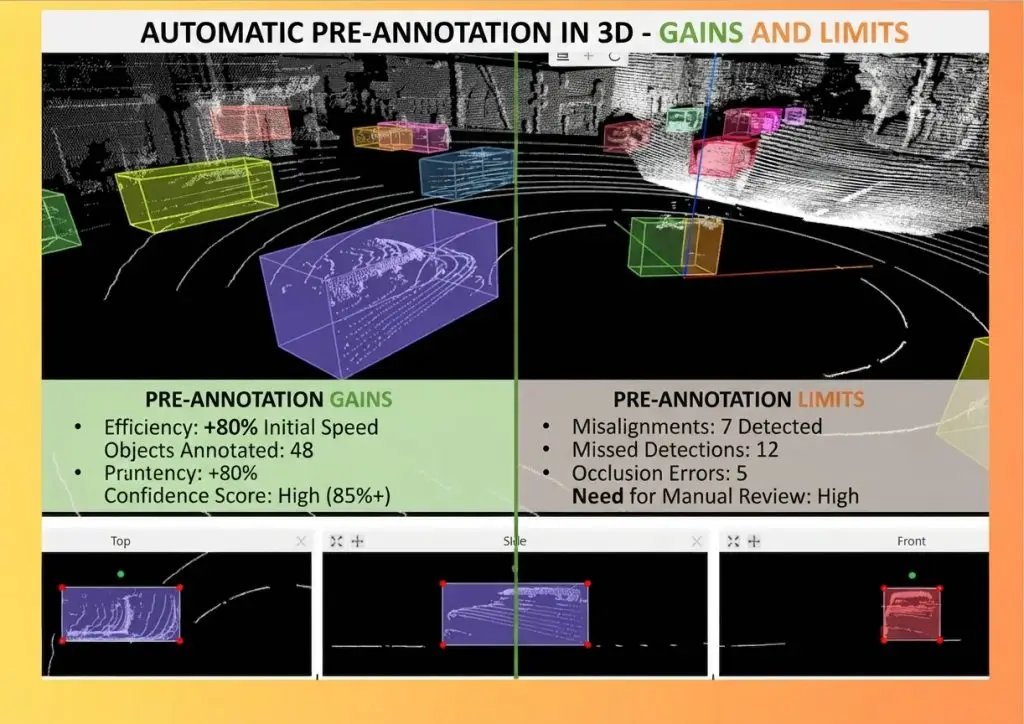
Infoscribe AI page dedicated to 2D and 3D annotation services presents the full scope of available capabilities for computer vision projects, including those operating in regulatory-sensitive environments.
The Most Common Personal Data Categories in Image Annotation Datasets
Several categories of personal data appear frequently in datasets submitted for image annotation. Each requires distinct legal treatment and adapted protection measures.
Faces are the most prevalent personal data type in computer vision projects. Present in outdoor scenes, commercial spaces, industrial camera feeds, and human-machine interfaces, they allow direct identification of the individuals captured. European supervisory authorities, and the French data protection authority (CNIL) in particular, pay heightened attention to processing activities involving faces, given the risks that the widespread deployment of facial recognition poses to individual freedoms. The CNIL published specific recommendations on data annotation for artificial intelligence projects in 2025, reiterating the obligations that apply to data controllers and their image annotation service providers.
License plates constitute indirectly identifying data. On their own, they do not allow the identification of a natural person. Combined with national vehicle registration databases, however, they do so readily. Under the GDPR, they are therefore considered personal data, and any image annotation project covering road traffic scenes, parking facilities, or street environments must account for this from the data collection phase onward.
Medical images present a particularly high-stakes case. A CT scan, a digitized pathology slide, or a chest X-ray may contain, beyond their visible anatomical content, DICOM metadata that includes the patient’s name, date of birth, hospital identifier, or national health number. Even when this metadata is not visible on screen during annotation, it is technically embedded in the files and constitutes personal data falling under the special categories regime (health data). Image annotation for medical purposes is therefore subject to a dual requirement: GDPR compliance on one hand, and sector-specific health regulations on the other.
Other elements may constitute personal data in specific contexts: postal addresses readable on parcels or documents in mail processing automation projects, tattoos enabling identification in forensic or sports analytics use cases, handwritten signatures in handwriting recognition datasets, or identification badges worn by employees in industrial or healthcare environments. Mapping the personal data present in a dataset is an indispensable preliminary step before launching any rigorous image annotation project.
Geolocation data embedded in image EXIF metadata also deserves attention. A photograph taken with a smartphone or a GPS-equipped drone contains precise geographic coordinates that, combined with other information, can reveal movement patterns or a person’s place of residence. Systematically stripping this metadata before any image annotation work begins is a best practice that must be integrated into data preparation pipelines.
Establishing the Legal Basis for an Image Annotation Project
The GDPR requires identifying a valid legal basis before initiating any processing of personal data (Article 6). For special category data (Article 9), an additional exception from those listed in paragraph 2 of that article must also be identified and documented. In the context of an image annotation project, several legal bases may be applicable depending on the nature of the data and the purpose of the processing.
Legitimate interests (Article 6(1)(f)) is often the first legal basis considered for commercial AI projects. It can be relied upon when the data controller can demonstrate, following a documented balancing test, that its interests prevail over the rights and freedoms of the data subjects. For an image annotation project covering road traffic footage intended for the development of a driver assistance system, this legal basis may be appropriate, provided that data minimization measures are applied and faces and license plates are anonymized as early as possible. The CNIL published detailed recommendations in 2024 on the invocation of legitimate interests in AI projects, requiring that the balancing test be conducted rigorously and documented in the record of processing activities.
Performance of a task carried out in the public interest (Article 6(1)(e)) applies to projects conducted in the context of public policy: urban traffic management, monitoring of critical infrastructure, public health, or academic research. It requires an explicit legal basis in national or EU law to be validly relied upon.
Consent (Article 6(1)(a)) is the most legally robust basis but the most difficult to obtain at scale. It is relevant in contexts where individuals have deliberately provided their images, for example as part of a voluntary collection for a gesture recognition dataset with explicit participant consent. For biometric or health data under Article 9, consent must be explicit, informed, and freely withdrawable. The withdrawability of consent raises practical questions about the ability to remove a person’s data from a dataset already used to train a model.
A Data Protection Impact Assessment (DPIA) is mandatory for any processing likely to result in a high risk to the rights and freedoms of natural persons (Article 35 GDPR). An image annotation project involving facial recognition or medical data systematically falls within this scope. The DPIA must identify the risks, assess their severity and likelihood, describe the measures taken to mitigate them, and conclude whether the residual risks are acceptable. If residual risks remain high after all feasible measures have been applied, prior consultation with the competent supervisory authority (Article 36 GDPR) is required before the processing begins.
To understand the full lifecycle of a computer vision project, from data collection through model training, the article
Image Annotation: The Complete Guide to Training a Computer Vision Model provides a structured overview of the key technical and organizational steps involved.
Anonymization and Pseudonymization: Protecting Data Before Image Annotation
Anonymization is the most effective risk-reduction technique in an image annotation project involving personal data. Truly anonymized data ceases to be personal data and falls outside the scope of the GDPR. To be legally recognized as such, however, anonymization must be irreversible: it must no longer be reasonably possible, even with significant resources, to identify the data subject from the processed image.
Face blurring is the most common technique in image annotation projects covering public or semi-public scenes. A Gaussian blur or an opaque mask is applied to face regions automatically detected by a face detection model. This operation can be performed in batch on thousands of images before any human annotation work begins. Several precautions are essential: face detection models are not infallible, particularly for small, partially occluded, or profile-facing faces, or in adverse lighting conditions. Human verification of a representative sample of anonymized images is recommended before transmission to image annotation teams. A face missed by the detection model and left unblurred in a dataset shared with an external service provider constitutes a GDPR breach that may be subject to enforcement action.
License plate masking follows the same technical logic. Detection models, trained on the specific formats used in the countries of origin of the images, automatically apply a mask over identified plates. Image annotation projects involving data from multiple European countries must anticipate the diversity of plate formats: a model calibrated on French white-background plates may fail on Belgian, Spanish, or Polish plates with different layouts and dimensions.
Metadata stripping is a frequently overlooked but genuinely important step. Image files may contain EXIF information invisible on screen but readable by any file management tool: GPS coordinates of the capture location, exact date and time, and camera model and device identifier. This metadata constitutes personal data and must be removed before images are transmitted to any external image annotation team. For medical images in DICOM format, file headers contain detailed patient information (name, date of birth, hospital identifier) that must be systematically processed before any data sharing with a service provider.
Pseudonymization differs fundamentally from anonymization. It replaces a direct identifier with an indirect identifier without permanently severing the link to the individual: a correspondence table maintained by the data controller allows re-identification if necessary. In the context of image annotation for medical applications, pseudonymization of DICOM metadata typically involves replacing the patient’s name with a project code, truncating the date of birth to the year, or substituting the hospital identifier with a research identifier. Pseudonymized data remains personal data under the GDPR, but the level of risk is substantially reduced. Pseudonymization is recognized as a security measure by the GDPR (Recitals 26 and 28, Article 25), but it does not exempt organizations from complying with other regulatory obligations, including those related to legal basis and data processing agreements.
Intellectual honesty about the limits of these techniques is essential. Research has shown that individuals can sometimes be re-identified from images considered anonymized, through cross-referencing with other databases or exploitation of contextual information such as body shape, clothing, or scene context. The European Data Protection Board states that anonymization must be assessed by taking into account means reasonably likely to be used to identify individuals, including techniques available at the time of processing and their foreseeable evolution. A residual risk analysis must accompany any anonymization decision, without presuming that the risk is zero after processing.
Outsourcing Image Annotation in Compliance with Article 28 of the GDPR
When an organization outsources its image annotation to a specialized service provider, it retains the status of data controller and remains fully responsible for GDPR compliance. The service provider takes on the role of processor and must demonstrate, before any project begins, that it offers sufficient guarantees regarding the implementation of appropriate technical and organizational measures for data protection (Article 28(1) GDPR). Choosing a service provider that cannot demonstrate these guarantees directly implicates the client’s liability.
A data processing agreement (DPA) compliant with Article 28 is mandatory and must precisely cover: the subject matter and duration of the processing, the nature and purpose of the image annotation operations performed, the types of personal data involved and the categories of data subjects, and the rights and obligations of the data controller. It must explicitly prohibit any processing of the data for purposes other than those contractually defined, any disclosure to unauthorized third parties, and any retention of data beyond the project duration. The conditions under which the processor may engage sub-processors must be governed by prior written authorization from the data controller, with the same data protection obligations imposed on any sub-processor.
The security measures expected from an image annotation service provider processing personal data are substantial. Encryption of data in transit (TLS for network exchanges) and at rest (disk or file-level encryption on storage servers) constitutes a baseline minimum. Access management following the principle of least privilege ensures that each annotator can only access the images necessary for their specific task, without the ability to download or export data outside the authorized system. Logging of access and operations allows the detection of any abnormal use and provides evidentiary support in the event of a supervisory authority audit. Securing annotator workstations through automatic lock policies, removable media restrictions, and network connection filtering is a common requirement for projects involving sensitive data.
An ISO 27001-certified service provider offers structural assurance regarding the maturity of its information security management system. This international certification covers the full range of organizational and technical processes related to information security and constitutes a recognized benchmark for supervisory authorities. It does not replace the GDPR data processing agreement but strengthens its credibility and facilitates the assessment of the guarantees offered by the image annotation service provider.
International data transfers are a particularly sensitive issue in image annotation projects outsourced to teams located outside the European Union. Any transfer of personal data to a third country must rely on a valid legal mechanism under Chapter V of the GDPR: an adequacy decision by the European Commission, standard contractual clauses (SCCs), binding corporate rules, or a recognized certification mechanism. The data controller must verify that these mechanisms are genuinely implemented, not merely mentioned in contracts, by conducting a Transfer Impact Assessment for the destination country. An image annotation service provider established and operating exclusively within the European Union significantly simplifies the management of this regulatory dimension.
Data subjects’ rights (access, rectification, erasure, and portability) remain enforceable even in the context of outsourced image annotation. The data controller must be able to respond to a rights request within the legal deadline of one month. This implies that the service provider maintains a data organization that allows locating and extracting, if necessary, the data relating to an identified natural person. This capability must be contractually verified before the project begins.
The modalities for data retention and deletion at the end of the project must be specified in the contract. Images must be retained only for the period strictly necessary for image annotation operations and associated quality controls, then returned to the client or securely deleted. Deletion procedures must ensure that data is not simply moved to a system recycle bin but is effectively overwritten or destroyed according to documented protocols, with a deletion certificate provided to the client upon request.
Training dataset design raises complementary questions about the required volume of images, the diversity of represented cases, and the management of representativeness biases. These questions are distinct from but related to compliance considerations, and are addressed in the article
Building a Training Dataset: Volume, Diversity, and Bias.
What the CNIL and European Authorities Expect from Image Annotation Projects
The CNIL finalized in 2025 a comprehensive set of recommendations on the development of artificial intelligence systems, including a specific section dedicated to data annotation. It reiterates that the data controller must document its legal basis before collecting any images, conduct a DPIA when the processing presents a high risk, and contractually govern any image annotation service provider processing personal data. The CNIL also emphasizes the data minimization principle: where pre-annotation anonymization of images is technically feasible without degrading the dataset’s relevance for the intended purpose, it must be implemented promptly, before data is transmitted to annotation teams.
The European Data Protection Board (EDPB) has adopted guidelines on facial recognition systems, emphasizing that processing faces for biometric identification constitutes a serious interference with privacy requiring a reinforced legal basis. These guidelines apply directly to image annotation projects aimed at training facial recognition systems, whether conducted in-house or outsourced to specialized service providers.
Recent enforcement actions illustrate the financial reality of penalties for non-compliant image processing. In 2022, the CNIL fined Clearview AI EUR 20 million for the unlawful large-scale collection and processing of faces scraped from the internet without a valid legal basis. Across Europe, other national supervisory authorities have imposed significant fines for video surveillance image processing conducted without proper data subject information or without defined retention periods. These decisions establish a body of case law that teams managing image annotation projects must integrate into their compliance approach.
The EU AI Act, which entered into force in 2024, adds a regulatory layer that operates alongside the GDPR rather than replacing it. Real-time remote biometric identification systems in public spaces are classified among prohibited AI practices. High-risk AI systems, including those in the domains of biometrics, critical infrastructure management, education, and employment, are subject to data governance requirements covering the quality, representativeness, and documentation of training datasets. The image annotation practices that feed these systems must be documented, traceable, and auditable by competent authorities.
The record of processing activities required under Article 30 GDPR is a documentation instrument whose importance is often underestimated. Any organization that conducts or outsources an image annotation project involving personal data must record the processing: purpose, categories of personal data and data subjects, recipients, retention periods, international transfers, and security measures implemented. This record is the first document examined during a CNIL audit and the basis for any dialogue with the data protection authority.
Several best practices allow structuring an image annotation project in compliance with all these requirements. Identify and document the legal basis before collecting any images. Anonymize as early as possible and verify the effectiveness of anonymization on representative samples. Select an image annotation service provider offering solid contractual and security guarantees, preferably ISO 27001 certified. Conduct a DPIA for any processing likely to present a high risk. Record the processing in the register and keep it current as the project evolves. Train internal teams, including data scientists and project managers, on the GDPR obligations that apply to their daily data management activities.
These commitments are not obstacles to AI project deployment. They are the conditions for sustainable delivery in a European regulatory environment that will continue to strengthen. Organizations that integrate privacy into the design of their image annotation projects (privacy by design) avoid costly rework and enforcement risk, while strengthening the confidence of their clients and partners in the quality of their data governance.
Teams seeking to structure an image annotation project in compliance with the GDPR, from defining anonymization measures to selecting a compliant service provider and drafting data processing agreements, are welcome to
contact Infoscribe AI for guidance tailored to their sector and regulatory context.