When a computer vision model needs to analyze a video stream rather than a still image, the demands placed on image annotation change fundamentally. A video is not simply a collection of independent photographs: it is a time-ordered sequence in which each frame maintains a logical relationship with those that precede and follow it. To train a model capable of tracking a moving object, predicting its trajectory, or recognizing an event over time, image annotation must incorporate an additional dimension — temporality — that profoundly transforms workflows, tooling, and quality criteria.
The rapid expansion of video-based applications across virtually every industry vertical — autonomous driving, sports analytics, intelligent surveillance, robotics — has made temporal sequences one of the most produced and most demanded data types in computer vision projects. Three technical specificities structure this domain and fundamentally distinguish video annotation projects from their still-image counterparts: tracking (maintaining persistent identities across frames), keyframe-based interpolation (techniques for accelerating production without sacrificing geometric precision), and temporal consistency (the central quality criterion that determines whether annotated data is actually usable for model training). Mastering all three dimensions is today a prerequisite for producing video datasets that meet production-grade standards.
Image Annotation in Video Context: What Changes Compared to Still Images
In still-image annotation, image annotation involves describing the state of a scene at a single moment T: placing a bounding box around a vehicle, tracing the outline of a region of interest, assigning a class to a detected object. Each annotation is autonomous and self-contained. Quality is measured exclusively by the geometric precision of the contour and the accuracy of the assigned class.
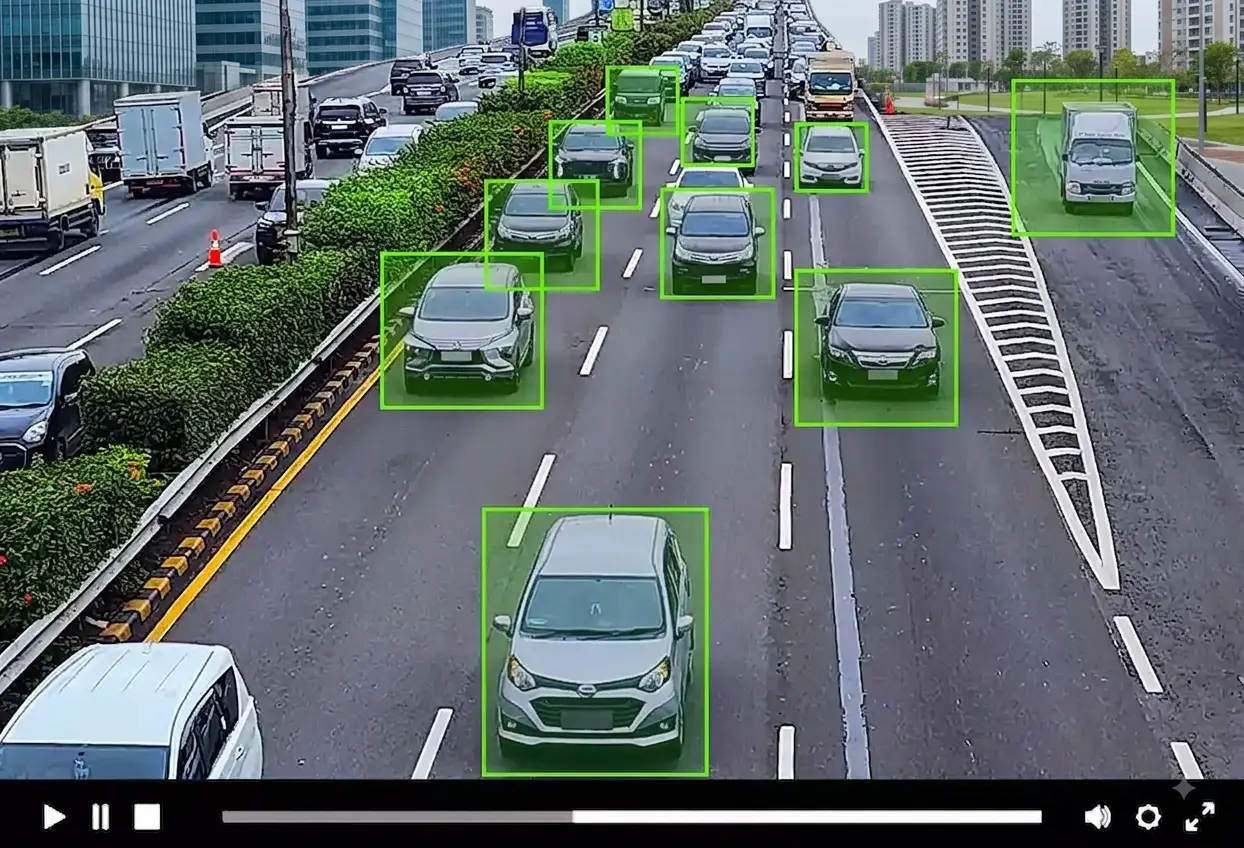
In a video sequence, that autonomy disappears. The same vehicle appearing across 500 consecutive frames must receive a unique identifier that remains constant throughout the entire sequence. If an annotator assigns a different ID between frame 247 and frame 248, a tracking model cannot learn that these two instances are the same object. This continuity break — invisible when verifying a single frame in isolation — produces tracking errors in the trained model that are often difficult to diagnose after the fact, because standard static metrics do not capture them.
Image annotation in video mode therefore requires three constraints absent from static annotation: managing persistent frame-to-frame identities (tracking), mastering annotation propagation techniques between frames without exhaustive manual annotation (interpolation), and verifying the consistency of entire sequences rather than individual images (temporal consistency).
These constraints directly impact workload volumes, annotator skill requirements, tool selection, and quality control methods. Understanding how they interact is the prerequisite to any sound project planning decision, from effort estimation to defining the target quality level.
For a comprehensive overview of the image annotation project lifecycle — from geometry type selection to vendor evaluation criteria — see
our complete guide to image annotation for training computer vision models.
Object Tracking: Maintaining Persistent Identities in Image Annotation
Tracking is the primary competency in image annotation on video data. It involves assigning a unique identifier to each object from its first appearance in the sequence, and maintaining that identifier rigorously and consistently until the object permanently exits the camera’s field of view.
In an autonomous driving context, a pedestrian crossing in front of a vehicle must retain the same ID across every frame in which it is visible — including when it passes partially behind a pole, when it is truncated by the edge of the visual field, or when it moves far enough away to occupy only a few pixels in the image. As soon as its silhouette becomes clearly identifiable again, the annotator must restore its original identifier rather than creating a new one. An additional identifier assigned to the same individual constitutes a tracking error in exactly the same way that a poorly fitted bounding box constitutes a geometric error.
This continuity requires active sequence reading before annotation begins. Annotators must memorize the objects present at the start of the sequence, anticipate occlusion zones, and apply precise rules defined in the guidelines for ambiguous situations. The key questions that guidelines must resolve include: at what visibility threshold should a partially occluded object still be annotated? If an object disappears for several frames and then reappears, should its original identifier be reused or a new one created? How should merging and splitting objects be handled — for example, two people who briefly overlap and become visually indistinguishable before separating?
Decision thresholds vary significantly across projects and use cases. An urban surveillance project may tolerate an ID break during a prolonged occlusion, whereas a sports analytics project may require continuity even during a brief three-frame occlusion. A ball-tracking project on football sequences must maintain the ball’s identifier throughout the entire sequence, including during its passage behind players or outside the primary camera’s field. This type of image annotation requires re-identification rules specifically designed for the video context, which cannot simply be derived from guidelines written for static images.
Re-identification presents a particular challenge in dense scenes. During a basketball game, multiple players may overlap across several frames, their silhouettes becoming temporarily indistinguishable before separating. Annotators must determine who is who based on contextual cues: jersey number when visible, position on the court, predicted trajectory from previous frames. This re-identification work demands sustained attention and an explicit arbitration protocol for cases that the general guidelines do not cover.
In multi-camera projects, tracking complexity increases further: the same individual may appear simultaneously across multiple video streams from different cameras, and identifiers must sometimes be harmonized across views depending on whether the trained model will process single-camera or multi-camera inputs. This additional constraint must be anticipated in guideline design and team organization before production begins.
Interpolation and Keyframes: Accelerating Image Annotation Without Sacrificing Accuracy
Manually annotating every frame of a video sequence would be economically prohibitive in most projects. A five-minute video recorded at 30 frames per second contains 9,000 frames. If each frame contains an average of 10 objects to annotate individually, the sequence alone generates 90,000 individual annotations before even accounting for tracking identifier management. A video corpus for autonomous driving can contain several million frames distributed across hundreds of sequences.
Interpolation is the technical answer to this volume problem. It involves manually annotating a subset of frames called keyframes, then letting the annotation tool automatically calculate intermediate positions according to a configurable progression rule. The annotator then validates the interpolated frames, corrects errors, and places new keyframes wherever the object’s real movement visibly diverges from the automated calculation.
The interpolation methods available in mainstream image annotation tools fall into several categories. Linear interpolation, the simplest to implement, calculates a uniform progression between two keyframes. It works well for objects moving at constant speed in a straight line, but produces imprecise results as soon as the motion is curved or variable. Cubic interpolation (or spline-based) adjusts the curve to account for accelerations and decelerations, producing more natural results for biological movements and maneuvering vehicles. Some tools integrate lightweight predictive tracking algorithms — Kalman filters, multi-object tracking algorithms — that use visual information from intermediate frames to automatically correct interpolated trajectories and reduce the number of manual corrections required.
The effectiveness of interpolation depends directly on the regularity of motion and the chosen keyframe cadence. For an object moving at constant speed in a straight line, linear interpolation with a keyframe every 15 to 20 frames typically produces excellent results with minimal corrective interventions. For an object exhibiting irregular motion — a braking vehicle, a player changing direction suddenly, an animal — the keyframe frequency must be increased, sometimes to one keyframe every 3 to 5 frames, which significantly reduces the expected productivity gain from interpolation.
The situations where interpolation consistently fails in image annotation production are well documented by experienced teams:
- Motion blur: a fast-moving object produces a blurred image on intermediate frames, making its actual position difficult to estimate precisely from the enclosing keyframes alone.
- Abrupt direction changes: linear or cubic interpolation cannot predict a sudden reversal not visible in preceding frames, and has no information about what occurs between the two keyframes.
- Occlusions: as soon as an object disappears behind another scene element, the interpolated trajectory is incorrect by definition, because the tool has no information about the hidden object’s position.
- Significant shape deformation: a human body in the middle of a sports movement changes silhouette in a non-linear way from frame to frame, which rectangular bounding box interpolation cannot model accurately.
In these situations, the annotator must place a keyframe on every problematic frame, effectively nullifying the benefit of interpolation for those passages. Reading the sequence before beginning annotation is decisive for identifying these passages in advance rather than discovering them during quality control, by which point interpolation errors may have propagated across dozens of frames.
Image annotation on video data is therefore typically organized into two successive and distinct phases: a strategic keyframing pass, where the most experienced annotator places keyframes at critical positions and configures the interpolation; and a validation and correction pass on the interpolated frames, which can be assigned to a less senior profile. Some projects explicitly separate these two roles in their production organization, enabling optimized allocation of expertise to the most demanding tasks.
Temporal Consistency: The Core Quality Criterion in Video Image Annotation
In still image annotation, quality control focuses on the geometric precision of each individual annotation and the accuracy of assigned classes. These criteria remain valid for video annotation, but they are insufficient and can lead to accepting data that is effectively unusable for training tracking models.
In the video context, an additional criterion is mandatory: temporal consistency. An annotation can be geometrically precise on every frame taken in isolation, yet still produce an unusable result if bounding boxes jump from one frame to the next in a way that is inconsistent with the physical motion of the object, or if identifier breaks occur mid-sequence without guideline justification.
Temporal consistency is measured primarily through two complementary indicators. The first is identifier stability: does the same object retain the same ID across the entire sequence, without unjustified breaks? Any identifier break constitutes a tracking error, even if the geometric annotation of each individual frame is otherwise correct. The second is geometric continuity: does the trajectory of an object’s bounding boxes follow a regular curve, consistent with the physics of the observed movement? An object that shifts by several dozen pixels between two consecutive frames without apparent physical reason indicates an inconsistent manual correction or a defective interpolation that was not caught during validation.
Quality control of video image annotation must therefore be performed in playback mode rather than by reviewing frames individually. Watching a sequence play at normal or slightly accelerated speed immediately reveals inconsistencies that frame-by-frame verification systematically misses. This practice of playback-mode quality control is today recognized as indispensable in the QC protocols of serious video projects, and must be planned as a distinct production step with its own time and budget allocation.
Some annotation tools can automatically calculate temporal consistency indicators: analysis of frame-to-frame object displacement distributions, automatic detection of identifier breaks, flagging of frames where an object’s area or shape varies abnormally relative to the preceding frame. These features automate the detection of video-specific error categories, but do not replace human validation, which remains necessary to arbitrate edge cases, correct flagged errors, and verify event annotation accuracy.
Required control levels vary by application. Safety-critical projects mandate exhaustive sequence review by an annotator-independent controller, with systematic playback review and traced non-conformance reporting for every delivered lot. Research or prototype projects may accommodate lighter protocols, provided that temporal consistency metrics remain within thresholds defined upfront with the client.
Volume and Planning in a Video Image Annotation Project
The most immediately visible video-specific characteristic for a project manager is data volume. A standard still image annotation project might process a few thousand images over several weeks. A video project rapidly generates tens or hundreds of thousands of frames, even from a relatively short video corpus.
The first planning decision concerns the frame sampling rate. Annotating every frame of a 30 fps video is rarely necessary, given the high redundancy of information between consecutive frames in low-motion sequences. Sampling at 5 fps — one frame every 200 milliseconds — is sufficient in many static surveillance scenarios. For high-speed autonomous driving or precise sports gesture analysis, however, a higher sampling rate is necessary to capture intermediate positions relevant to model training.
The sampling rate decision should be driven by the final model’s intended use, not budget considerations alone. Under-sampling a corpus of urban driving footage can cause the model to miss critical phases of braking or pedestrian insertion. Over-sampling a warehouse surveillance sequence produces redundant data without adding model performance value and generates image annotation costs without measurable benefit. The sampling decision should therefore be made in consultation with the client’s machine learning team, based on the characteristics of the target model.
Per-frame annotation density is the second volume variable. In dense scenes — urban intersections, team sports matches — each frame can contain 10 to 20 objects to annotate individually, each requiring a persistent tracking identifier. Multiplied across thousands of frames, this generates a substantial workload that interpolation reduces but does not eliminate. A football ball-tracking project spanning a full competition season and involving several hundred thousand frames illustrates the concrete scale of large video annotation projects.
Raw data management is also a structuring constraint. A high-definition video sequence can weigh several gigabytes per hour of footage. Annotation files — JSON, XML, frame-indexed CSV — themselves reach significant sizes for large corpora. Rigorous pipeline preparation — sequence segmentation into exploitable chunks, synchronization metadata verification, selection of a standard annotation export format — conditions production fluidity as much as the image annotation quality itself.
Reference formats for video annotation export include JSON files in the MOT (Multi-Object Tracking Challenge) format, COCO exports for detection and tracking, and proprietary formats specific to certain autonomous driving frameworks. The format choice must be aligned with the client’s training pipeline from the project’s outset to avoid costly conversion work at the end of production.
Sector Use Cases for Image Annotation on Video Sequences
Image annotation applied to video sequences covers a wide range of domains, each imposing its own technical constraints on annotation work and production organization.
Autonomous Driving and Connected Vehicles
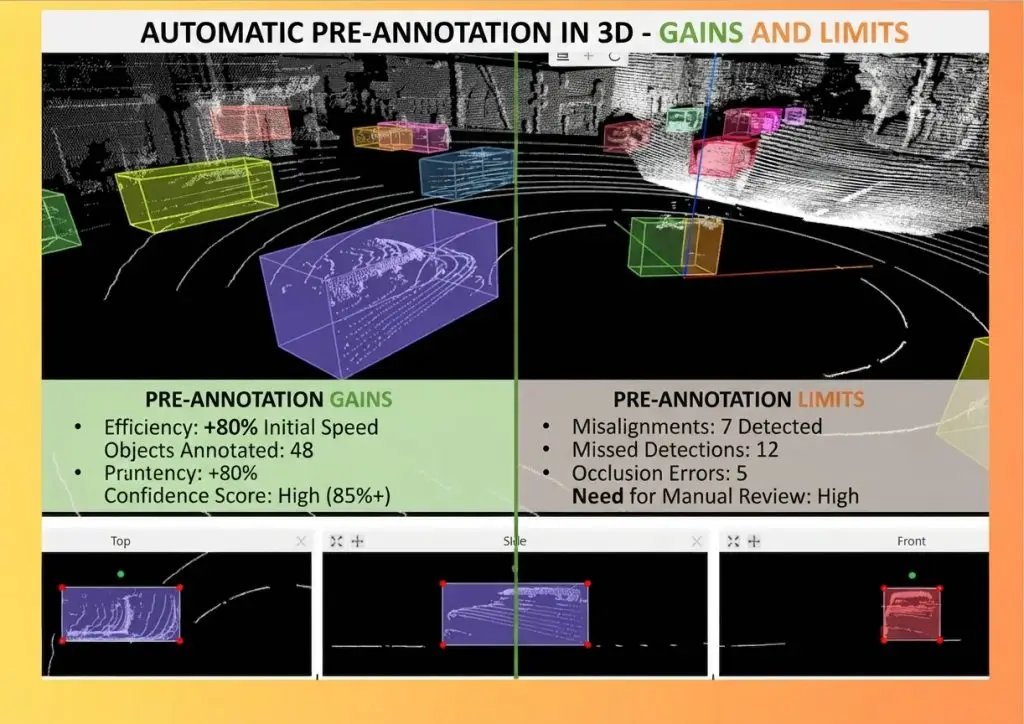
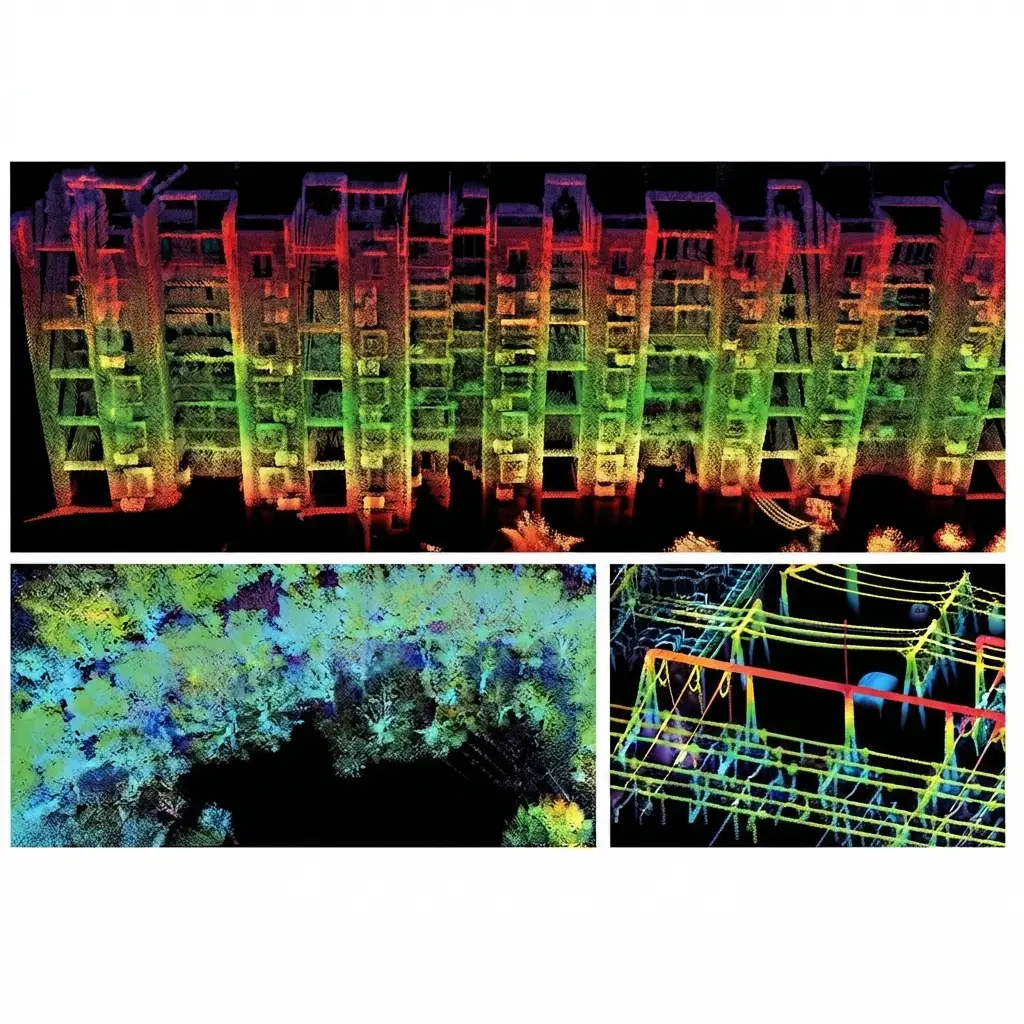
This is the domain that has most structured and formalized large-scale video annotation practice. Autonomous vehicle perception systems must detect, classify, and track pedestrians, cyclists, other vehicles, and road infrastructure elements in near real time. Annotated sequences are used to train and validate multi-object tracking models. Typical urban scene density reaches 15 to 20 objects per frame. Tracking guidelines in this sector are particularly precise about handling occlusions, field exits, pedestrian groupings, and class transitions. Projects in this sector often combine 2D image annotation with synchronized 3D LiDAR data, with multi-modal fusion constraints requiring consistency between both annotation types.
Sports Analytics
Sports represent a major application domain for object tracking on video sequences. Ball tracking, player tracking, action recognition, and event classification — goals, fouls, substitutions, ground contacts — require image annotation precise to the individual frame, sometimes to the tenth of a second. Volumes involved can be substantial: a competition season may require annotating several hundred thousand frames with persistent ball tracking. The temporal precision requirements for event annotation — identifying the exact moment of a contact or pass — distinguish these projects from surveillance applications, where accuracy to within a few frames is sufficient.
Body motion analysis projects add a layer of biomechanical keypoints to image annotation — joint positions across 21 to 22 anatomical landmarks — that must be consistent with human physiology from frame to frame, including for limbs not visible in certain shots. Respecting bodily symmetry and articular constraints constitutes an additional quality criterion specific to this project type.
Intelligent Surveillance and Smart City
Intelligent surveillance applications — pedestrian flow counting, behavioral anomaly detection, access management — rely on annotated video datasets incorporating person tracking, zone-of-interest segmentation, and event classification. These applications are subject to GDPR obligations regarding the processing of personal data visible in images. For a detailed treatment of these regulatory constraints, the article dedicated to
image annotation under GDPR (faces, license plates and personal data) covers the specific obligations applicable to this project type and the anonymization measures required upstream of production.
Industrial Robotics and Logistics
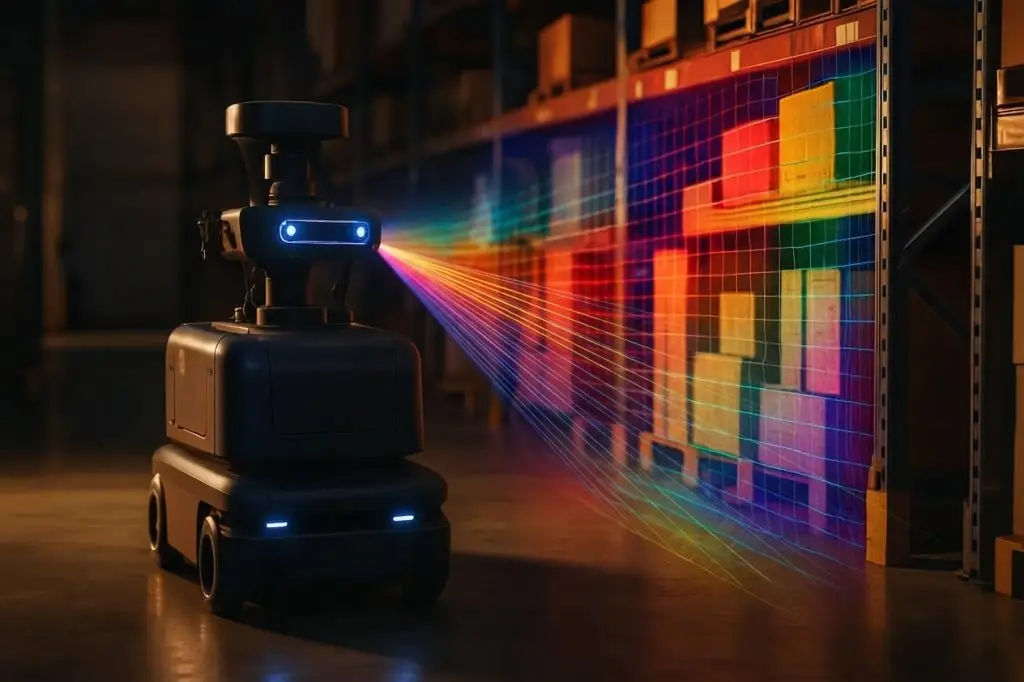
Manipulator robots in logistics warehouses and on production lines use vision models trained on videos of object handling and work gestures. Tracking enables following a package’s trajectory on a conveyor belt, identifying a non-compliant handling gesture, or detecting a behavioral anomaly in motion. Fine-grained segmentation of people within predefined zones of interest — for a machine safety system, for instance — requires pixel-level precision maintained consistently across the entire sequence and under varying industrial lighting conditions.
Best Practices for Successful Image Annotation on Video Data
The success of an image annotation project on video data is largely determined by decisions made before production begins. The most costly problems — widespread tracking inconsistencies, underestimated volumes, poorly structured data pipelines — almost always originate from insufficient preparation rather than errors made during production.
Write Guidelines Adapted to the Temporal Context
Standard still-image annotation guidelines must be supplemented with explicit rules covering tracking identifier management, expected annotator behavior during occlusions, minimum visibility thresholds for annotating an object, and re-identification criteria after prolonged disappearance. These rules cannot be left to individual annotator judgment without risk of significant divergence between workers on the same corpus. Illustrated cases — annotated screenshots showing the correct decision for each ambiguous situation — are consistently more effective than text descriptions alone, particularly for edge cases involving occlusions or object merging.
Select and Master a Tool Adapted to Video Mode
General-purpose image annotation environments are not all suited to video work. Native tracking module availability, sequence navigator quality, playback fluidity at different speeds, and available interpolation features must all be verified before committing to a tool. Specialized tools offer complete video mode with interpolated tracking, persistent ID management, and dedicated sequence review interfaces. Annotator mastery of the tool, achieved through structured pre-production training, is a non-negotiable prerequisite for both productivity and quality: an annotator unfamiliar with video tooling will produce statically correct but temporally inconsistent annotations.
Organize Quality Control in Video Playback Mode
Temporal consistency cannot be verified frame by frame. The quality control process must include systematic review in video playback mode, performed by a controller different from the annotator, to detect identifier breaks and trajectory inconsistencies that static verification misses. This playback review pass must be planned and budgeted from the project’s quotation phase, not added in urgency at the end of production upon discovering the first anomalies.
Prepare Data Rigorously Before Production Starts
A well-prepared image annotation video project distinguishes itself through rigorous sequence structuring from the moment data is received: segmentation into exploitable chunks, synchronization metadata verification, a consistent file naming plan, and upfront identification of high-motion sequences that will require higher keyframe cadences. These prerequisites, often neglected in the pressure to start quickly, condition the entire production’s fluidity and the reliability of the final exports.
Image annotation in video mode represents one of the most demanding frontiers of applied computer vision. Defining the right sampling rate, writing unambiguous tracking guidelines, organizing a rigorous temporal quality review: these structural decisions directly condition the value of the datasets produced and, ultimately, the performance of the models trained on those data. The
dedicated page on 2D and 3D annotation for computer vision presents the full range of services available to support these projects, from guideline design to final delivery.
To discuss your video annotation project — autonomous driving, sports analytics, intelligent surveillance, or industrial robotics — and evaluate the quality level appropriate to your requirements,
contact the Infoscribe AI team.