No computer vision model sees anything on its own. Behind every system that spots a defect on a production line, identifies a weed in a corn field, or segments an organ on a CT scan, there are tens of thousands of images that a human being has examined, understood, and labeled. That foundational step has a name: image annotation. It directly determines the performance, robustness, and reliability of every model built on top of it.For years, the subject was treated as a menial task at the edge of machine learning. That era is over. The global market for annotation tools passed 3 billion US dollars in 2026 according to Mordor Intelligence, with most research firms reporting annual growth rates above 25 percent, driven by AI adoption in automotive, healthcare, manufacturing, and agriculture. Image and video data account for the majority of annotation volumes worldwide. This guide covers the full subject: definitions, annotation types, the project lifecycle, quality management, cost drivers, and the build-versus-buy decision.
What is image annotation?
Image annotation is the process of adding structured labels to raw images so that a supervised learning algorithm can use them. In practice, an annotator identifies the objects or regions of interest in an image and assigns them a class, a geometric shape, or a set of attributes, following a protocol defined in advance.The output of this work is a training dataset: a collection of images paired with their ground truth. This is what the model learns from. During training, the algorithm compares its own predictions against the human labels and adjusts its parameters to reduce the gap. The quality of that reference therefore sets a hard ceiling on model performance: a neural network trained on wrong or inconsistent labels will learn those errors, no matter how large the dataset or how sophisticated the architecture.Image annotation should be distinguished from two neighboring activities. Data collection refers to acquiring the images themselves, upstream. Data curation refers to sorting, filtering, and structuring the corpus between collection and labeling. The three stages form a chain, and weakness in one is paid for in the next: annotating a poorly curated corpus means spending human effort on images that add nothing.
Why image annotation determines model performance
Machine learning research long concentrated its energy on model architectures. The data-centric AI movement, which gained prominence in the early 2020s, rebalanced the debate: with the architecture held constant, training data quality explains a major share of the performance gap between projects. Academic studies have shown that even the most widely used benchmark datasets contain measurable label error rates that distort model evaluation.The operational consequences are immediate. A defect detector trained on sloppy labels will generate false positives that stop the production line for nothing, or false negatives that let defective parts through. An agricultural model trained on weeds poorly distinguished from crops will trigger spraying in the wrong places. In healthcare the stakes rise further: annotations serve as the reference for diagnostic support systems, and a labeling error becomes a clinical risk.This is why mature organizations treat image annotation as an engineering discipline in its own right, with protocols, metrics, and continuous improvement loops, rather than a simple execution task. Teams that invest in rigorous guidelines and systematic quality control consistently report shorter iteration cycles: less relabeling, fewer retraining runs, fewer surprises in production.
The main types of image annotation
The choice of annotation type follows from the task the model must perform. Each geometry represents a trade-off between information richness and production effort.
Image classification
The simplest form: one global label per image, with no localization. It suits sorting tasks, for example separating compliant from non-compliant images, or categorizing products. Fast to produce, it says nothing about where objects are.
Bounding boxes
A rectangle enclosing each object of interest, paired with a class. This is the standard format for object detection, used at massive scale in automotive, surveillance, logistics, and retail. A bounding box localizes the object but inevitably includes background pixels, which limits its precision on irregular shapes.
Polygons
A multi-vertex outline that follows the actual shape of the object. Polygons localize far more faithfully than rectangles, at the cost of longer annotation time. They become necessary whenever shape matters: agricultural parcels seen from above, complex industrial parts, building footprints.
Semantic and instance segmentation
Segmentation assigns a class to every pixel in the image. Semantic segmentation treats all occurrences of a class as one region; instance segmentation distinguishes each individual object, which makes counting and tracking possible. This is the maximum level of precision, required in medical imaging, autonomous driving, and precision agriculture, and also the most expensive to produce.
Keypoints and lines
Keypoints mark precise positions: human body joints for pose estimation, anatomical landmarks, object corners. Polylines annotate linear structures such as lane markings, crop rows, or cables.Choosing between these formats deserves an analysis of its own, because the decision commits both the budget and the achievable performance. We cover it in a dedicated article:
bounding box, polygon or segmentation, how to choose the right type of image annotation.
Image annotation use cases, industry by industry
Demand for image annotation now runs through virtually every sector deploying computer vision, with very different requirements from one domain to the next.In manufacturing, annotation feeds defect detection and quality control systems: scratches on metal surfaces, weld defects, assembly anomalies, electronic component inspection. The difficulty lies in defect rarity, which forces teams to annotate large image volumes to capture enough examples of each class, and in the product knowledge needed to tell a genuine defect from an acceptable variation.In agriculture, weed detection, ear counting, and disease diagnosis models rely on images captured by drones, robots, and on-board cameras. Variability is extreme: growth stages, lighting conditions, soil types, seasons. Serious projects put annotators under agronomist supervision, because the visual boundary between a crop and a weed at seedling stage escapes an untrained eye.In healthcare, annotation covers X-rays, CT scans, MRIs, dermatology images, and pathology slides. Quality requirements climb to 99 percent, validation involves clinical experts, and the regulatory framework, from health data protection rules to medical device regulation, structures the entire process.Add to this mobility and autonomous driving, the largest consumer of annotated data worldwide, smart city applications such as counting and flow analysis, geospatial imagery from satellites and aircraft, sports analytics, retail, and logistics. Each vertical imposes its own classes, imaging conditions, and quality bar: there is no such thing as generic image annotation, only projects in context.
Preparing the corpus before annotation starts
An image annotation campaign is only as good as the corpus it processes. Three questions should be settled before the first image is labeled.The first is volume. The number of images needed depends on task complexity, class count, and scene variability; orders of magnitude range from a few thousand images for a targeted fine-tuning run to several hundred thousand for a general-purpose system. Rather than chasing a theoretical figure, the sound practice is to proceed in stages: train on a first batch, measure, identify the gaps, and extend accordingly.The second is representativeness. The dataset must cover the real distribution of situations the model will face in production: lighting conditions, viewpoints, seasons, product variants, rare cases. A corpus collected on a single production line, a single field, or a single acquisition site produces a model that does not generalize. A distribution audit, class by class and condition by condition, should precede any large campaign.The third is curation. Duplicates, blurred images, off-topic content, and near-duplicates inflate volumes without adding information. A curation pass upstream concentrates the annotation budget on the images that actually move the model forward.
The image annotation project lifecycle
A successful image annotation project follows a structured sequence. Skipping a step is always paid for later, in relabeling or in model underperformance.
1. Scoping and guidelines
Everything starts with a guidelines document: a precise definition of each class, drawing rules, treatment of edge cases (partially visible objects, occlusions, blur, overlaps), positive examples and counter-examples. This is the single most important document of the project. An ambiguous instruction produces inconsistent labels across annotators, and that inconsistency reaches the model as training noise.
2. The pilot
Before scaling up, a pilot batch of a few hundred images confronts the guidelines with the reality of the corpus. The pilot almost always surfaces unforeseen cases: a class more ambiguous than expected, a problematic capture condition, a drawing rule that needs sharpening. Guidelines are amended, annotators recalibrated, and the client validates a reference sample before volume production begins.
3. Production and quality control
Production runs in batches, with quality control embedded in the flow rather than deferred to the end. The standard mechanisms combine review by a second annotator or a senior reviewer, the insertion of golden samples with known ground truth to measure each annotator’s accuracy continuously, and regular exchanges with the client to settle newly discovered edge cases. Specialized providers such as
Infoscribe AI, which covers 2D and 3D annotation for computer vision, commit contractually to measurable accuracy rates, which anchors the entire control system to an enforceable metric.
4. Delivery and iteration
Annotations are delivered in a standard format (COCO JSON, Pascal VOC, YOLO, segmentation masks) compatible with the client’s training pipeline. The project does not end there: error analysis on the trained model typically reveals under-represented classes or poorly covered situations, which feed a new, targeted annotation campaign. The best projects run as a short loop between the data science team and the annotation team.
Tools and formats: the infrastructure of annotation work
The tooling market has settled into two families. Self-hosted open source platforms, with CVAT as the reference for image and video, give organizations full control of the infrastructure: images never leave a controlled environment, which answers the confidentiality requirements of industrial and medical corpora. Commercial SaaS platforms favor integration and collaboration features, at the price of hosting data with a third party, a trade-off that must be weighed against the sensitivity of the corpus.The choice of tool matters less than how it is operated: shortcuts and ergonomics that drive annotator productivity, batch and review queue management, version traceability, and export into the formats the training pipeline expects. On that last point, market standards cover most needs, but industrial projects often carry custom attribute schemas that should be validated on the pilot batch, not discovered at final delivery. A practical rule of thumb: before any volume production starts, run one fully annotated sample file through the actual training pipeline, end to end. Ten minutes of integration testing at that stage routinely saves weeks of format reconciliation later, especially when several teams, several tools, or several providers contribute annotations to the same dataset over time.
Measuring image annotation quality
Quality is not declared, it is measured. Three families of metrics structure the control system.Geometric precision is evaluated through IoU (Intersection over Union), which measures the overlap between a produced annotation and a reference: an IoU of 1 means a perfect match. Projects generally set a minimum IoU threshold per object type. Classification correctness is measured by comparing assigned classes against the reference, with particular attention to visually similar class pairs. Completeness verifies that no expected object was missed, which is often the most damaging error: an unlabeled object teaches the model that the object does not exist.Inter-annotator agreement completes the toolkit: having several people annotate the same images and measuring their convergence exposes residual ambiguities in the guidelines before they contaminate the dataset. A contractual quality rate, expressed as the percentage of correctly annotated objects on an audited sample, turns all of this into a verifiable commitment; market standards sit between 95 and 99 percent depending on how critical the domain is.
Manual, semi-automatic, or automatic image annotation
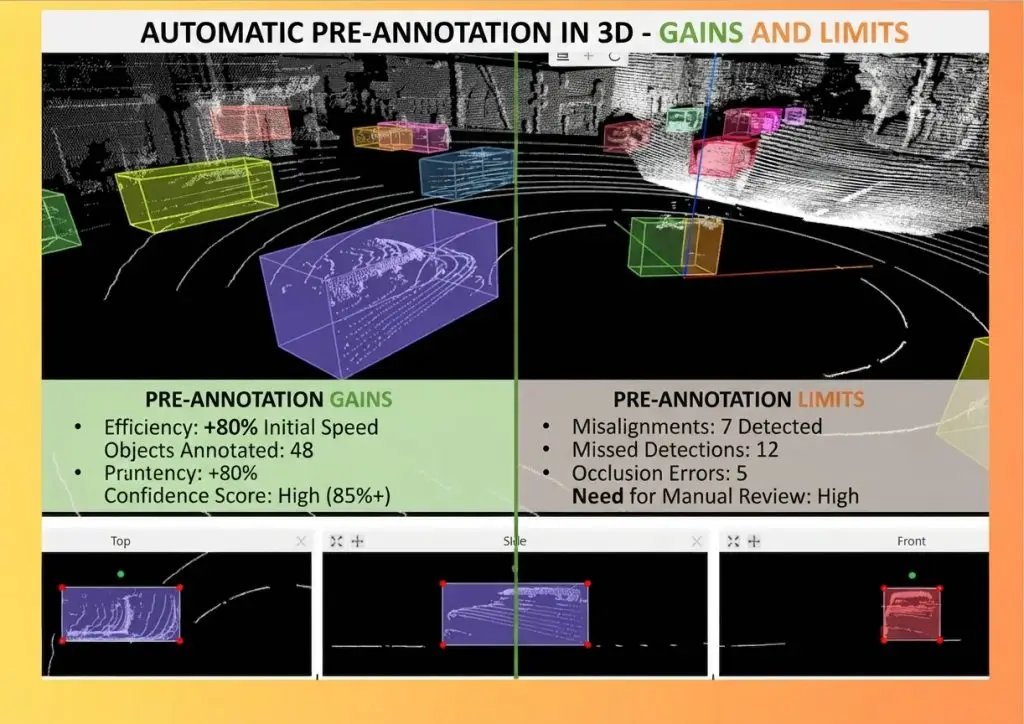
Foundation models have transformed the tooling landscape. Segment Anything (SAM) and its successors produce segmentation masks in one click; pre-trained detectors generate pre-annotations that humans correct instead of starting from a blank canvas. On generic classes and simple images, these assists cut production time substantially.Their limits appear exactly where the industrial stakes concentrate: domain-specific classes absent from the generic models’ training data (a particular weld defect, a weed at early growth stage, a fine anatomical structure), degraded imaging conditions, and pixel-level precision requirements. On these cases, automatic pre-annotation can even cost more than direct labeling, because correcting a wrong proposal sometimes demands more attention than drawing correctly the first time. Automatic errors are also systematic: they repeat across thousands of images and create consistent biases that the final model will faithfully learn.The mature approach is hybrid: automate what can be automated, focus human expertise on the hard cases, and above all keep systematic human control over the whole. In 2026, image annotation remains a discipline where human judgment is the final guarantee of ground truth.
How much does image annotation cost?
Project cost depends on five main factors: the annotation type (instance segmentation costs several times the price of a bounding box), object density per image, class complexity and the level of expertise required, the quality rate demanded, and total volume, which unlocks learning effects and volume pricing. The common billing models are per image, per annotated object, or per hour of work.Two misjudgments come up again and again. The first is comparing a provider’s rate against the bare hourly cost of an in-house annotator, forgetting supervision, training, tooling, quality control, and management, which represent a substantial share of the full cost. The second is optimizing unit price at the expense of quality, when the cost of relabeling and retraining far exceeds the initial saving. We break down pricing mechanisms, observed ranges, and optimization levers in our article on
how much an image annotation project costs.
In-house versus outsourced image annotation
Every AI team faces the question. Keeping annotation in-house offers maximum proximity to the data and suits exploratory phases, highly sensitive corpora, and small volumes. It hits its limits quickly at scale: recruiting, training, and managing annotators is not a data science team’s job, and putting engineers on labeling carries a considerable opportunity cost.Outsourcing brings production capacity, proven quality processes, and an elasticity that internal teams cannot match. Selection criteria go well beyond price: a contractual commitment to a measurable quality rate, information security demonstrated by a certification such as ISO 27001, GDPR compliance whenever images contain personal data, stable and trained teams as opposed to anonymous crowdsourcing platforms, and the ability to mobilize domain expertise (agronomists, staff trained in medical imaging) on technical corpora. The quality of the operational dialogue matters just as much: a dedicated production contact, fast feedback loops, and disciplined edge-case management make the difference over the life of a project.
Security, compliance, and documentation: the non-technical half of the job
As image annotation moved from research labs into regulated industries, a second layer of requirements grew around the technical work, and it now weighs heavily in project design.Security comes first. Training images frequently carry industrial secrets: a production line layout, an unreleased product, a proprietary sensor output. The annotation workflow must guarantee that images circulate only within a controlled environment, with access restricted to identified, contractually bound staff, encrypted transfer and storage, and full traceability of who accessed what. An ISO 27001 certified information security management system provides an auditable framework for these guarantees, and buyers in defense, healthcare, and heavy industry increasingly treat it as a prerequisite rather than a differentiator.Privacy follows. Whenever images contain identifiable people, license plates, or health information, data protection law applies to the annotation step exactly as it does to any other processing. That means a data processing agreement between the client and the provider, documented instructions, purpose limitation, retention rules, and appropriate safeguards for any cross-border transfer. Street-level imagery, in-store cameras, and medical files each trigger specific obligations that must be settled contractually before the first image is shared.Documentation closes the loop. The European AI Act, whose data governance obligations for high-risk systems apply from 2026, expects providers to document how their training datasets were designed, collected, and annotated, including labeling procedures and quality controls. Keeping guidelines versioned, quality reports archived, and annotation decisions traceable is no longer just good engineering hygiene: it is becoming regulatory evidence. Teams that build this documentation as they go spend days on compliance; teams that reconstruct it afterwards spend months.
The mistakes that sink an image annotation project
Experience across hundreds of projects keeps surfacing the same pitfalls. Guidelines written without confronting the real corpus, which collapse at the first edge case. A pilot skipped to save two weeks, which then costs eight in relabeling. Quality control postponed to the end of the project, when systematic errors have already spread through the entire dataset. Class imbalance ignored, producing a model excellent on frequent cases and blind on rare ones, often the most critical. Sporadic communication between the data science team and the annotators, leaving ambiguities to be resolved by diverging individual interpretations.What these mistakes share: they are invisible when committed and expensive when revealed, usually at model evaluation time. Process discipline is the cheapest insurance a project can buy.
Image annotation in the era of foundation models
Foundation models have not made image annotation obsolete; they have shifted where its value lies. Generic tasks have become commoditized; value now concentrates in the specialized data that generic models do not know: medical imaging, rare industrial defects, plant species, proprietary sensors. Fine-tuning a foundation model on a few thousand carefully annotated domain examples regularly outperforms approaches trained on far larger volumes of noisy data. Quality has overtaken quantity, and high-precision image annotation has become a strategic asset rather than a commodity.For organizations building computer vision systems, the conclusion is pragmatic: treat annotated data with the same seriousness as code, measure its quality continuously, and rely on partners able to commit to verifiable results. If you are preparing a project and want to test your requirements against an operational perspective, from choosing the annotation type to sizing a pilot, you can
get in touch with the team to discuss it concretely.