
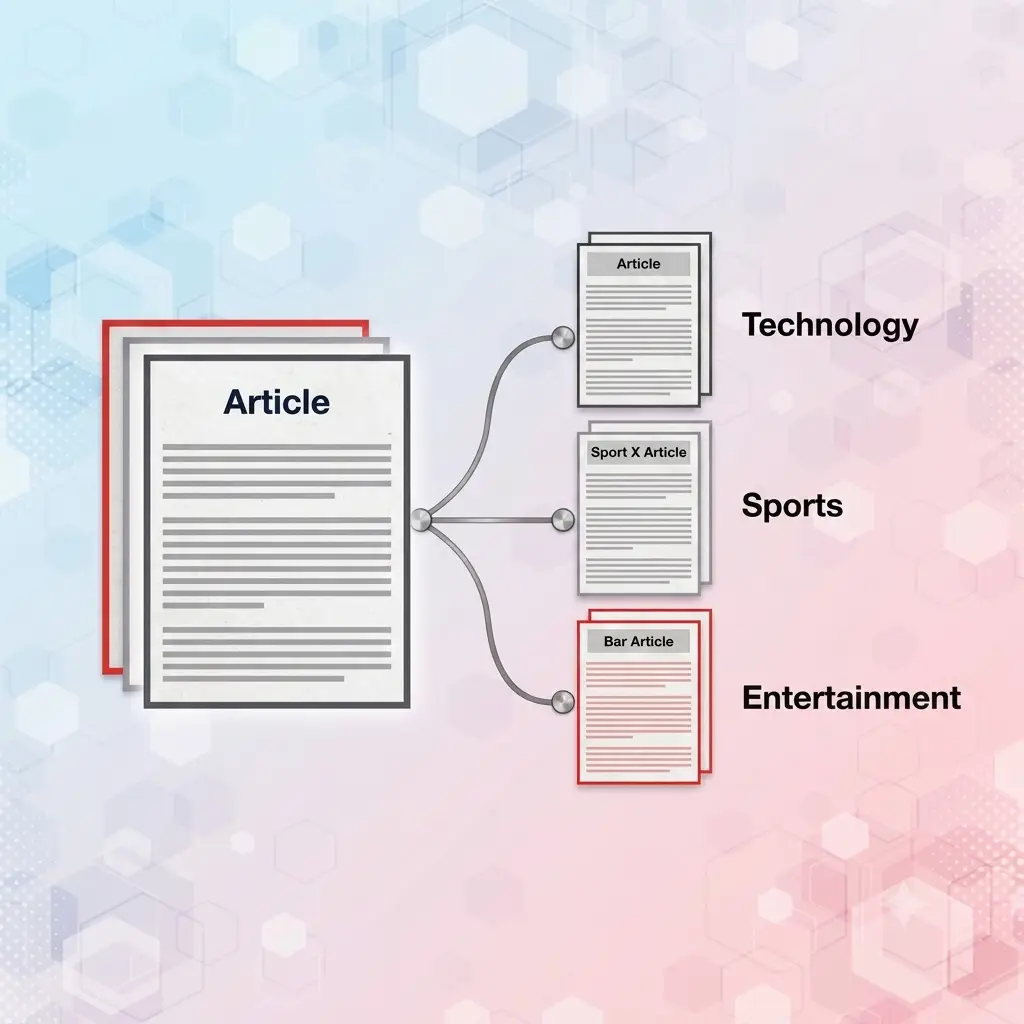
Document classification is one of the most widely deployed natural language processing tasks in applied artificial intelligence: routing incoming emails, categorizing support tickets, organizing enterprise document repositories, moderating content at scale. In every one of these use cases, the performance of the classifier depends directly on the quality of the corpus it was trained on. And that quality begins with text annotation. Defining a coherent taxonomy, handling documents that simultaneously belong to multiple categories, balancing class distribution to prevent the model from ignoring rare cases — every decision made during corpus construction will have direct consequences on the system’s behavior in production. This article presents the methods and principles that make it possible to prepare a robust, usable text annotation corpus for a document classification project.
Why Document Classification Depends on the Quality of Text Annotation
Document classification is a supervised task: the model learns to assign one or more categories to a piece of text by training on examples annotated by humans. The quality of text annotation therefore directly determines classifier performance, regardless of the architecture chosen.
A model trained on a poorly annotated corpus will produce incoherent classifications, even if it is built on a state-of-the-art architecture. What AI practitioners commonly describe as the “garbage in, garbage out” principle applies with particular force to document classification: a poorly defined category in the annotation schema creates an ambiguity the model will learn, reproduce, and amplify. The effects are difficult to diagnose once the system is deployed, because they resemble modeling problems when they are actually data problems.
The two main sources of error in a classification corpus are inter-annotator inconsistencies — identical or similar documents labeled differently depending on who annotated them — and poorly bounded categories in the original annotation schema. Fixing these defects in post-production is costly: affected documents must be identified, guidelines rewritten, re-annotation performed, and the model retrained. Investing in schema design and quality control from the outset is consistently more cost-effective than attempting to repair a flawed corpus after the fact.
Text annotation for classification is not a mechanical step. It requires a rigorous phase of classification schema design, thorough annotator training on domain-specific edge cases, and continuous monitoring of corpus consistency throughout production. The quality of an operational classification dataset is the product of this entire structured process, not just the labeling act itself.
For a broader introduction to NLP tasks and the landscape of text annotation, the pillar article of this cluster covers the conceptual foundations useful for any classification project.
Building a Solid Taxonomy: The First Step in Text Annotation for Classification
The taxonomy is the schema that defines the complete set of categories used to annotate the corpus. Its design is the most structurally important work in a document classification project: a poorly conceived taxonomy makes text annotation inconsistent, even when annotators are competent and rigorously trained.
Available Taxonomy Structures
Classification taxonomies come in several structures depending on the complexity of the business problem. A flat taxonomy lists independent categories at the same level: it works well for simple cases, such as a limited set of topics with no hierarchical relationship between them, or a binary document sorting task. A hierarchical taxonomy organizes categories into levels: a parent category “Invoice” might contain subcategories “Supplier Invoice”, “Customer Invoice” and “Credit Note”. This structure is the natural choice when the document scope is broad and heterogeneous, and when predictions at different levels of granularity are needed for different use cases.
A faceted taxonomy allows multiple independent dimensions to be assigned to a single document: a “Topic” dimension, an “Urgency” dimension, a “Confidentiality” dimension. This approach is frequently used in document management systems and customer relationship management platforms where several classification axes are simultaneously relevant, without any hierarchical relationship between them.
Criteria for an Effective Taxonomy
Whatever structure is chosen, an effective taxonomy for text annotation must follow a few fundamental principles. Categories should be mutually exclusive as far as possible: when two categories overlap frequently in practice, annotators are forced to make judgment calls without clear guidance, generating systematic inconsistency throughout the corpus. Categories must also be exhaustive: every document in the corpus must be assignable to a category, including through an explicit “Other” or “Out of Scope” class designed to absorb documents that fall outside the defined perimeter.
Taxonomy granularity must be calibrated to the volume of available data. Defining a large number of classes when the corpus only contains a few hundred examples per category is counterproductive. A classification model needs a sufficient number of representative examples for each class to learn its defining characteristics. For transformer-based pre-trained models, several hundred well-chosen examples per class are generally enough to achieve satisfactory performance; approaches without pre-training require considerably more data per class, with less tolerance for class imbalance.
In the text annotation guidelines, each category must be defined with a written description, positive examples — documents that belong to the class — and negative examples — similar documents that do not belong. These contrasts are essential for guiding annotators on ambiguous cases, which are always more numerous in practice than anticipated during the design phase.
Iterating on the Taxonomy
A taxonomy is never perfect in its first version. The recommended practice is to annotate a pilot batch of a few hundred documents, analyze inter-annotator disagreements, and revise the taxonomy accordingly before launching full-scale production. This iteration cycle is an investment: it avoids having to re-annotate thousands of documents after discovering that two categories are consistently confused in the text annotation production workflow. Taxonomy revisions mid-production require partial or full reprocessing of already completed batches, significantly increasing the overall project cost.
Multi-Label Text Annotation: When a Document Belongs to Multiple Categories
In many operational contexts, a document belongs not to one category but to several simultaneously. A customer email may be both a complaint and a refund request. A news article may cover multiple topics without any one clearly dominating. A contract may fall under both commercial law and employment law. This is known as multi-label classification, as opposed to single-label classification where each document receives exactly one tag. Text annotation in a multi-label context is considerably more demanding, and its specific challenges deserve careful attention during project design.
Specific Challenges of Multi-Label Annotation
The first challenge is defining the attribution threshold. An annotator must decide at what level of presence of a topic in a document they assign the corresponding label. If an email briefly mentions a delivery delay but is primarily about a product quality complaint, should it receive both labels? The answer depends on the intended production use of the model, and must be explicitly defined in the text annotation guidelines, with illustrative examples for every anticipated ambiguous situation.
The second challenge is cardinality — the average number of labels assigned per document. High cardinality increases task complexity and makes quality control more demanding: it is necessary to verify not only that the assigned labels are correct, but also that omitted labels were not missed through error or annotator fatigue.
The third challenge is combinatorics. With ten classes, the theoretical number of possible label combinations exceeds one thousand. In practice, only a subset of these combinations appears in the corpus, and some rare combinations may mislead the model if they are not sufficiently represented in the training data. The rarity of certain combinations is itself a form of class imbalance, compounding the imbalance that exists at the individual label level.
Adapting the Annotation Protocol for Multi-Label
For multi-label text annotation, guidelines must provide a clear protocol for each class: the annotator must answer the question “is this class significantly present in this document?” for each available class, rather than simply selecting among them. This distinction fundamentally changes how work is structured and controlled. Tools that allow multiple labels to be checked simultaneously make the operational task easier, but it is the quality of the guidelines and the rigor of initial training that determine the consistency of the resulting corpus.
Balancing Classes in a Text Annotation Corpus
One of the most frequent problems in document classification projects is class imbalance. It occurs when certain categories are far more represented than others in the corpus submitted for text annotation. A corpus of customer emails typically contains a large majority of routine information requests, with critical complaints representing only a small percentage. A corpus of contractual documents may contain ten times more standard agreements than atypical or disputed ones. This is the rule in real-world data, not the exception.
This imbalance creates a direct problem for model training. A classifier trained on an imbalanced corpus tends to systematically predict the majority classes, at the expense of minority classes. Yet in most operational applications, it is precisely the rare cases that are most important to detect correctly: a serious complaint, a disputed contract, a document with high regulatory risk. Overall model accuracy may appear high while being nearly useless on the classes that actually matter to the business. Class imbalance must therefore be addressed during corpus design, not after model training.
Identifying Imbalance at the Design Stage
Before launching text annotation, it is advisable to estimate the expected class distribution from a representative sample of the source corpus. This preliminary analysis makes it possible to calibrate the sampling plan: if certain classes are naturally rare in the available data, it may be necessary to deliberately over-represent the corresponding documents in the annotated set, or to seek additional data sources that provide better coverage of underrepresented classes.
Rebalancing Techniques During Text Annotation
Several approaches can address imbalance during corpus construction. Oversampling means annotating more documents belonging to minority classes. When such documents are rare in the source corpus, it may be necessary to apply pre-selection filters that prioritize rare cases in annotation batches, or to identify complementary data sources that better cover these classes.
Undersampling means limiting the number of documents annotated for majority classes, to achieve a more balanced distribution in the final corpus. This approach is often effective for transformer-based models, which learn quickly from a reduced number of well-representative examples, without requiring very large volumes per class to converge toward good performance.
Data augmentation generates variants of existing examples through paraphrasing, synonym substitution, or back-translation. This technique enriches minority classes without annotating new documents, but should be used with caution: augmented data must remain faithful to the real documents the model will encounter in production, to avoid creating a harmful gap between the training corpus and actual operating conditions.
Imbalance in Multi-Label Contexts
In multi-label text annotation, imbalance is doubly difficult to manage: each label may be imbalanced individually, and rare label combinations represent an additional layer of complexity. It is important to monitor not only the per-class distribution but also the distribution of the most frequent label combinations, to ensure that the real-world patterns of the domain are adequately represented in the annotated corpus.
Key Steps to Building a Reliable Text Annotation Corpus
Building a document classification corpus follows a structured process where each step conditions the next. Sloppy data collection will produce poor-quality data that text annotation cannot fix. A poorly designed schema will generate inconsistencies that quality control cannot fully eliminate. Sequence matters, and shortcuts taken early in the project always carry a higher price downstream.
Define Scope and Taxonomy
Before collecting a single document, several fundamental questions must be answered: what types of documents will the model handle in production? What is the natural class distribution in these documents? What edge cases are predictable? The initial taxonomy flows from these answers, not the other way around. Building the taxonomy from available data is a frequent mistake that leads to biased corpora misaligned with real operational needs and with the documents the model will actually encounter in production.
Collect, Filter, and Clean the Data
Collection must be guided by the taxonomy. Sources must be identified that cover all defined classes, including the rarest, and pre-selection filters must be applied to retain only relevant documents. Data cleaning is a consistently underestimated step: documents from production systems frequently contain formatting artifacts, partial duplicates, and parasitic metadata. These issues must be addressed before text annotation begins, not during it, since they distort annotator reading and lead to classification decisions based on spurious signals rather than actual document content.
Write the Annotation Guidelines
The guidelines are the reference document for annotators throughout the project. They must describe each class precisely, illustrate typical cases and edge cases, and explicitly specify exclusion criteria. Guidelines must be versioned: any modification made during the project must be documented and tracked, to preserve corpus consistency across the different text annotation batches produced at different times. Undated guidelines make it impossible to reconstruct the history of annotation decisions, which complicates model debugging when unexpected behavior is observed in production.
Annotate in Progressive, Iterative Batches
Text annotation production must proceed in successive batches. The first batch — often called a pilot or calibration batch — serves to validate the guidelines and measure inter-annotator agreement. Disagreements are analyzed collectively, guidelines are adjusted if necessary, and full production begins only once a satisfactory agreement level has been achieved on this reference batch. This iterative approach avoids producing thousands of incorrectly annotated examples that would need to be corrected or discarded at significant cost to the project.
Validate and Structure the Final Corpus
Once production is complete, the corpus must undergo a final validation: class distribution verification, identification and correction of persistent disagreements, and construction of training, validation, and test splits. The test split must consist of documents unseen during the main text annotation phase, to guarantee an honest, unbiased evaluation of the classifier. A test split built from documents present in the training corpus produces artificially optimistic evaluation metrics that do not reflect actual model performance in production.
For projects that ultimately involve fine-tuning language models or building conversational datasets, corpus requirements differ significantly from those of a simple classifier. The article Text Annotation for LLMs: Instruction Tuning, RLHF and Preferences covers these specificities and the associated methodologies in detail.
Quality Control and Consistency in Text Annotation for Classification
The quality of a classification corpus is not measured by raw error rate alone. It is measured primarily by internal corpus consistency: similar documents must receive similar labels, regardless of who annotated them. This consistency is the product of a rigorous quality control process applied throughout text annotation production, not just at the end of the pipeline.
Inter-Annotator Agreement
Inter-annotator agreement is the key measure of consistency in a text annotation corpus for classification. It involves having the same subset of documents annotated by at least two different annotators, then calculating the concordance between their responses. For single-label annotation, raw agreement provides a first indication, but it does not correct for chance: two annotators assigning labels randomly would agree on a non-trivial proportion of documents by chance alone. Cohen’s kappa is the reference measure for correcting this effect. A kappa above 0.8 is generally considered excellent for a text classification task; a kappa below 0.6 indicates that guidelines require revision before production continues.
For multi-label text annotation, agreement measures are more complex: sets of labels must be compared rather than single labels. Variants of kappa adapted to multi-label settings, or metrics such as the Jaccard index, are used in this context to capture partial agreements between annotators.
Gold Standards and Honeypots
Gold standards are documents whose correct classification is established with certainty, either through expert consensus or from a documented ground truth. They serve to calibrate annotators at the start of production, to measure the intrinsic difficulty of the task, and to detect individual drift over time. Honeypots are gold standard documents inserted without the annotators’ knowledge into regular production batches. They allow continuous monitoring of each annotator’s quality without interrupting the work flow. An annotator whose error rate on honeypots exceeds a defined threshold must be recalled for training before the drift contaminates a significant volume of the corpus.
Reviewing Disagreement Cases
Disagreements between annotators are not all errors. Some reveal genuine ambiguity in the guidelines, which must be resolved through reformulation or an additional example. Others reveal intrinsic document difficulty — a genuinely ambiguous case where the correct classification is debatable even for a domain expert. In such cases, several options are available: exclude the document from the corpus, assign a label by majority vote, or retain it with an explicit uncertainty marker. Each choice has direct implications for the trained model’s behavior, and must be decided based on the project’s operational requirements and tolerance for ambiguity.
When to Outsource Text Annotation for Document Classification
Building a document classification corpus is rarely achievable entirely in-house. Volumes to be processed are often substantial, deadlines are tight, and the required competencies span domain knowledge, industrial-scale text annotation process management, and the ability to implement rigorous quality control throughout production.
Outsourcing is appropriate as soon as a project requires several hundred hours of annotation, or when the taxonomy covers specialized domains demanding specific annotator training. It is also appropriate when regulatory compliance is at stake: documents being processed may contain personal or confidential information, and their handling must comply with GDPR and information security best practices. A provider’s ISO 27001 certification is a concrete signal of maturity on this dimension, alongside its ability to operate within an isolated, auditable production environment.
A provider specializing in text annotation brings a team of annotators trained in the relevant domain, a structured and auditable quality control process, and the capacity to absorb variable volumes with controlled delivery timelines. The relationship with the provider must be built around three pillars: a jointly developed annotation schema that accounts for operational production constraints, measurable contractual quality commitments, and a regular feedback mechanism to correct any classification drift during production before it becomes significant.
For projects involving technical, legal, or medical corpora, annotators with domain training are often indispensable. For a medical classification corpus, certain categorization decisions require expert clinical oversight; for a corpus of contracts or legal agreements, mastery of the relevant legal vocabulary and document structures is a prerequisite to reliable, consistent text annotation over the course of a project.
To analyze your corpus requirements together and define the annotation approach suited to your document classification project, contact our team.