
Assistance in 3D does not work as it does in image annotation. Some operations automate almost entirely, others resist completely, and the gap between them is predicted from the nature of the task rather than from the maturity of the models.This article sets out what it contributes. It extends the article on building a 3D dataset.
The four levels of assistance
Four mechanisms are distinguishable in 3D annotation and their confusion produces inaccurate expectations.Geometric preprocessing, ground removal and filtering, which uses no learned model.Automatic fitting, a box adapting to a designated cluster of points.Detection by model, which proposes objects and classes with no intervention.And registration of a known model, which aligns a reference geometry on the points effectively observed.One important practical consequence follows. The first mechanism is available immediately and the third presupposes a corpus, which makes them accessible at very different moments in a project.Ground removal
This operation stands apart from all the others in 3D annotation.Its ratio of cost to gain is unmatched.Separating the ground from the rest is obtained by geometric methods with no learning.Four benefits follow in 3D annotation.The majority of points in an outdoor scene are handled in one operation.Objects become visually separated, which eases their designation considerably.Height computation becomes possible for every object in the scene.And the visual load falls sharply, which speeds navigation through the scene.One important observation follows. This operation requires no prior corpus and it frees most of the volume, which makes it the only gain available from the very first scene of a 3D annotation project.What automatic fitting brings
This second mechanism works well in 3D annotation.It is often neglected.A box fits automatically to a cluster of points the annotator designates.Three contributions follow for a 3D annotation project.Delimitation becomes designation, a far quicker gesture than a manual adjustment.The result is reproducible, two annotators designating the same cluster obtaining the same box.And dimensions fit to the points actually measured rather than to a visual estimate.One practical consequence follows for a 3D annotation project. This mechanism uses no learned model and is therefore available immediately, which places it with ground removal in the category of unconditional gains.What automatic fitting does not do
Three limits bound this second mechanism.It fits to the observed points and not to the real object, which produces an undersized box on a masked face.It does not determine the orientation where the shape is symmetrical or partly observed.And it includes the stray points contained in the selection, without distinguishing them from the object.One important observation follows. The first limit is systematic rather than occasional, which requires following the fitting with an extrapolation conforming to the convention rather than accepting the raw result.What detection by model brings
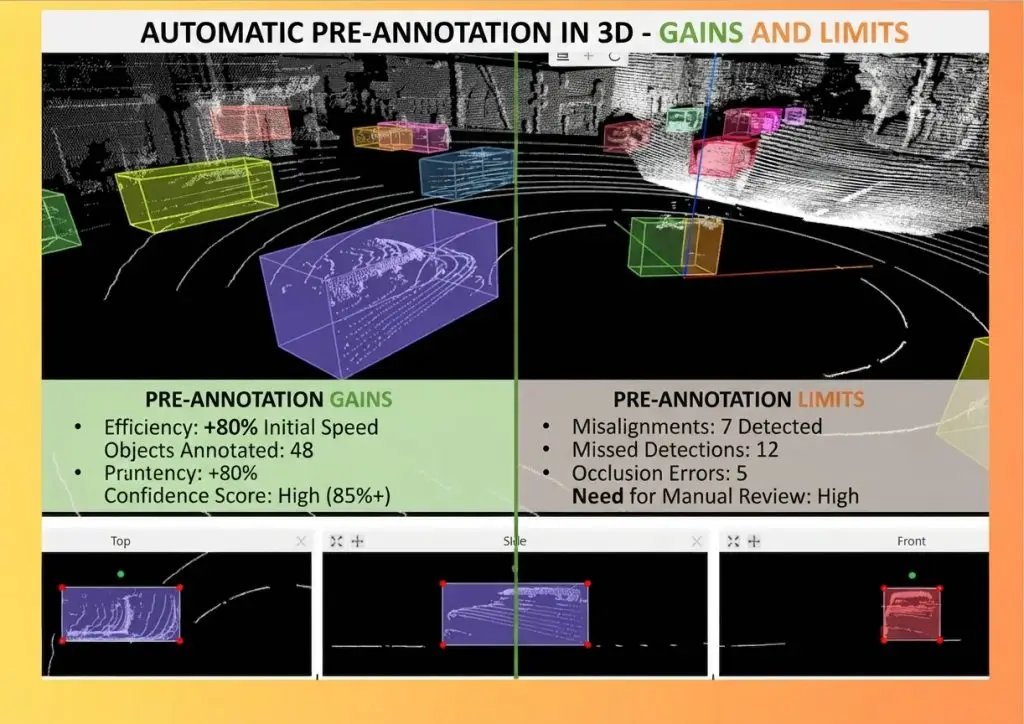
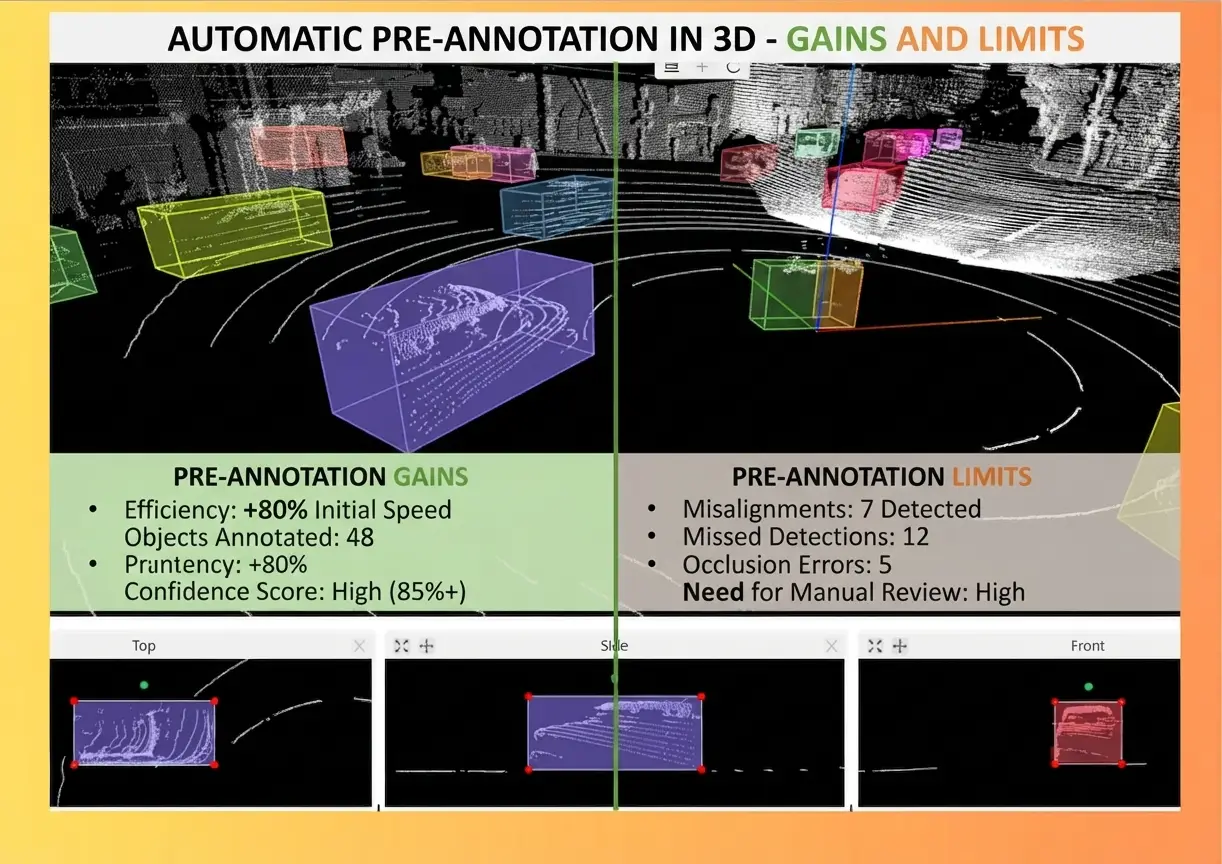
This third mechanism presupposes a corpus.Its return varies strongly.Four observations characterise this mechanism in 3D annotation.Detection of common classes works well at short range and on well-observed objects.It degrades sharply with sparsity, precisely where the human is slowest.The orientation proposed reproduces the ambiguities rather than resolving them.And the dimensions proposed reflect the training corpus’s convention, whatever it is.One important practical consequence follows. The second observation is the most disappointing, assistance being weak exactly on the objects that cost the most to handle manually.Registration of a known model
This fourth mechanism stands out for its reliability.It holds only in the contexts that permit it.A reference geometry aligns on the observed points of an identified object.Three conditions make that registration possible.A closed catalogue of objects, which restricts its use to controlled environments.Available digital models, which the client must supply before production starts.And sufficient observation of the object to lift the pose ambiguity.One observation follows for a 3D annotation project. This mechanism produces an exact shape including on unobserved faces, which makes it the only level of assistance removing extrapolation rather than displacing it.Assisted segmentation
One task calls for different mechanisms and it deserves separate treatment.Four forms of assistance apply to point-wise classification in 3D annotation.Height filtering, which isolates the ground and low objects with no learning at all.Propagation by surface continuity, which extends a selection on a purely geometric criterion.Segmentation into homogeneous regions, which pre-divides the scene without assigning it a class.And classification by a learned model, which proposes a class for each region or each point.One important practical consequence follows for a 3D annotation project. The third form is the most worthwhile and the least used, a geometric pre-division turning a point-wise classification into a region-wise one, which divides the number of decisions with no dependency on a corpus.Validation bias
This mechanism silently degrades quality.It operates differently in 3D annotation than elsewhere.Accepting a proposal takes less effort than producing an annotation.Three manifestations follow in 3D annotation.An undersized box is validated, the gap not being visible without an orthogonal view.A plausible orientation is accepted without the alternative being examined.And a proposed class is confirmed on an object far too sparse to determine it.One important observation follows. The first manifestation is specific to this field and it is fortunately detectable, the dimensional plausibility check automatically flagging what the eye lets through in 3D annotation.The improvement loop
This organisation turns assistance into a growing lever.Four stages compose that loop.Pre-annotation of the batch by the current model.Correction by the annotators, with disagreements recorded by distance band.Retraining the model on the enriched corpus.And analysis of the disagreements recorded, which directs the next batch’s content.One practical consequence follows for a 3D annotation project. Recording by distance band is specific to this field, it reveals that the gain concentrates on near objects and permits deciding whether an enrichment effort on distant objects is worthwhile.What the model learns from the corpus
One property of the loop deserves flagging since it produces a cumulative effect.A model retrained on a corrected corpus reproduces that corpus’s conventions.Three consequences follow in 3D annotation.The extrapolation convention propagates into the proposals, which makes assistance progressively conform to the project.An uncorrected undersizing reinforces, the model learning to produce boxes that are too short with consistency.And the sparsity threshold used determines what the model learns to ignore definitively.One important practical consequence follows. The second consequence justifies wiring the dimensional check in before retraining rather than after, a corpus validated with a systematic bias producing a model that amplifies it at each iteration.Measuring what assistance brings
Four indicators quantify the 3D annotation gain.They are read with no particular effort.Time per object with and without assistance, measured by distance band.The rate of proposals accepted without modification.The rate of proposals corrected, the only indicator distinguishing real help from hindrance.And the rate of dimensional alerts on pre-annotated objects, a direct indicator of systematic undersizing.One important observation follows. The fourth indicator has no equivalent in image annotation, it directly measures the characteristic defect of assistance in 3D and it is read automatically.When assistance becomes worthwhile
A calendar constraint structures this arrangement in 3D annotation.Three phases succeed one another and they do not offer the same 3D annotation gains.The start, where only the geometric mechanisms are available, removal, fitting and pre-division.The ramp, where a first model proposes imperfect detections on the common classes and at short range.And the established regime, where the model handles the majority of near objects while the human concentrates on sparse objects and on edge cases.One important observation follows. This progression differs from that of the other domains by its first phase, the geometric mechanisms supplying a substantial gain before any corpus, which makes assistance worthwhile even on a short project where in video it was not.The bootstrap corpus
A practical question arises at the start and it admits three answers.A detection model needs a first annotated corpus before it can be useful.Three sources permit obtaining that bootstrap corpus in 3D annotation.Manual annotation of a first batch, assisted by the geometric mechanisms available immediately.A public corpus from the same domain, which gives a starting point and requires the dimensional convention to be checked.And a pre-trained generalist model, whose common classes cover part of the need and entirely ignore the domain categories.One important observation follows. The second source produces a side effect specific to this field, a public corpus using another extrapolation convention transmitting systematically offset dimensions to the model, which requires checking that convention before using it.What stays human
Five 3D annotation decisions cannot be delegated.Extrapolating unobserved faces, which automatic fitting does not do.Determining orientation on partly observed objects.Judging an object too sparse to be classed with certainty.Separating objects in contact that geometry does not distinguish.And flagging a case the convention does not yet cover.One practical consequence follows. Those five decisions correspond exactly to the configurations the chapter on difficulties identified, which confirms that assistance handles the easy and leaves the hard intact.What assistance changes in the control
Four adaptations of the control arrangement are required.The search for systematic undersizing, a defect specific to automatic fitting.Keeping a share of unassisted batches to measure drift.Checking orientations on pre-annotated objects, a known weak point of these models.And tracking the correction rate by distance band, which reveals where assistance stops helping.One observation follows for a 3D annotation project. The first adaptation is the most effective, a systematic offset in dimensions being detectable on a distribution while staying invisible object by object.What assistance changes in the costing
Four effects modify a cost estimate in 3D annotation.The cost per object falls sharply on near and well-observed objects.It barely falls on sparse objects, which stay handled manually.Control becomes more expensive, the search for systematic undersizing adding to the ordinary arrangement.And setting up the geometric mechanisms constitutes a modest one-off cost at the start.One practical consequence follows for a 3D annotation project. The second effect requires costing by distance band rather than globally, a gain announced across the whole being systematically higher than the gain realised as soon as the corpus contains a substantial share of distant objects.Training annotators for assisted work
Five reflexes distinguish a 3D annotator trained for this way of working.Systematically checking a fitted box in an orthogonal view, the only view where undersizing shows.Completing the extrapolation after an automatic fit rather than accepting the raw result.Examining the proposed orientation rather than validating it by default.Discarding a whole proposal on an object too sparse rather than correcting it piecemeal.And flagging a recurring model error rather than silently correcting it.One practical consequence follows for a 3D annotation project. The first reflex is the most decisive and the least natural, a fitted box appearing correct in perspective view while being systematically too short on the unobserved side.When to abandon learned assistance
Four situations make detection by model counterproductive in 3D annotation.A corpus mostly composed of sparse objects, where the model fails precisely where the need lies.A domain nomenclature with no public equivalent, which precludes any external bootstrapping.A nomenclature still stabilising, a pre-annotation fixing conventions under revision.And a corpus heterogeneous in sensors, where the model meets densities and artefacts it was never trained to handle.One observation follows. Those four situations rule out only detection by model, the geometric mechanisms staying applicable and worthwhile, which distinguishes a partial withdrawal from abandoning assistance.The minimal arrangement
Five measures frame an assisted 3D annotation chain and their cost stays modest.The dimensional plausibility check wired into the proposals before validation.A share of unassisted batches, fixed at the outset and maintained throughout the project.Tracking the correction rate by distance band.Systematic verification of orientations on pre-annotated objects.And the explicit instruction to flag recurring errors rather than silently correct them.One observation follows. The first measure is what distinguishes this field, it automatically intercepts the characteristic defect of assistance and it requires only a dimensional range table already needed for other reasons.What to tell the client
Four framings make this conversation honest and they avoid an untenable promise.Announce a gain by distance band rather than a global gain, the distinction being verifiable.Distinguish the geometric mechanisms, available immediately, from learned detection, which presupposes a corpus.Set out that control changes nature rather than disappearing, the search for undersizing being a new expense.And recall that sparse objects stay entirely with the human, which bounds the saving on long-range corpora.One observation follows for a 3D annotation provider. The second framing is the most distinctive, a client generally hearing that assistance presupposes a corpus and discovering with interest that part of the gain is available from the first scene.Approaching an assisted project
Five questions scope an assisted 3D annotation arrangement.Is ground removal in place. Its absence deprives the project of the most immediate gain.Does a catalogue of digital models exist. Its presence opens registration.Does a detection model exist or must one be bootstrapped. That answer determines when the gain arrives.Is an unassisted share planned. Its absence makes drift undetectable.And is the dimensional check wired into the proposals before validation. Its absence lets through this arrangement’s characteristic defect.Those five answers determine the real gain. Asking them before starting avoids a promise of saving the arrangement will not keep.The question that decides on assistance
One question settles the worth of learned detection and it concerns the corpus distribution.What share of the objects sits at short range and well observed.A high answer makes learned detection decisive, the model handling the majority of the volume and the human concentrating on the rest.A low answer makes it marginal, the gain bearing on a fraction of the work while setup and control apply to the whole.That question is answered by counting objects per distance band on a pilot batch, and it concerns only learned detection, the geometric mechanisms staying worthwhile in every case.Three precautions before launching
Three precautions distinguish a sound assisted 3D annotation chain from one that drifts.Wiring the dimensional plausibility check into the proposals before the first validation, and not after the first batch.Fixing the share of unassisted batches before starting, a value that is not renegotiated under schedule pressure.And verifying that the dimensional convention of the model used matches the project’s, a divergence producing a systematic offset invisible object by object.Those three precautions cost little, they are taken at scoping, and their absence produces a fast chain whose dimensions drift slowly with nobody noticing before delivery.What this chapter teaches
One cross-cutting observation deserves closing this examination.Assistance in 3D divides into two very unequal categories.Three findings compose it.The geometric mechanisms, removal and fitting, are available immediately and produce an immediate gain with no prior corpus.The learned mechanisms degrade with sparsity, hence exactly where manual work costs the most.And the characteristic defect of assistance, undersizing, is automatically detectable by a physical constraint.That finding distinguishes this field from the video cluster, where assistance introduced a defect only a human check revealed, whereas here physics supplies the safeguard.What the two categories mean for a provider
One consequence of this split is worth stating plainly, since it shapes how a provider should position assisted work.The geometric mechanisms are available to everyone and confer no advantage.Three things follow from that in 3D annotation.A provider who has not implemented ground removal and box fitting is simply slower than the market, since neither requires a corpus or any proprietary capability.The differentiation sits in what surrounds the learned mechanisms, the dimensional check wired in before validation, the unassisted share maintained under pressure, the convention verified against the model used.And those three are process rather than technology, which means they can be described to a client and verified by them, unlike a claim about model quality.One practical consequence follows for a 3D annotation provider. Competing on model performance invites a comparison nobody can settle, while competing on the safeguards around it invites a comparison the client can run themselves.Common mistakes
These failures recur often enough that naming them is usually enough to avoid them.- Confusing geometric preprocessing with detection by model.
- Not putting ground removal in place from the first batch.
- Accepting an automatically fitted box with no extrapolation.
- Expecting a model to resolve the orientation ambiguity.
- Hoping for an assistance gain on distant objects.
- Using a model whose dimensional convention differs from the project’s.
- Not wiring the dimensional check into the proposals.
- Omitting the share of unassisted batches.
- Measuring the gain globally rather than by distance band.
- Neglecting known-model registration where the catalogue permits it.